

Editor’s note: The next president is in for a rough welcome to the Oval Office given the list of immediate crises and slow-burning policy challenges, both foreign and domestic. What should Washington do? Why should the average American care? We’ve set out to clearly define US strategic interests and provide actionable policy solutions to help the new administration build a 2017 agenda that strengthens American leadership abroad while bolstering prosperity at home.
What to Do: Policy Recommendations for 2017 is an ongoing project from AEI. Click here for access to the complete series with content from AEI’s Foreign & Defense Policy, Economic Policy, and Education Policy teams.
 Geopolitical realities leave us stuck with a One China policy ambiguous enough to let Washington define its relationship with its longtime friend, Taiwan. But the framework is fraying for two reasons.
First, a more powerful China has been successful in demanding that countries accept its view that Taiwan is part of China and that any improvement in relations with the island is a “provocation.” The United States has never accepted China’s position; instead it has maintained that Taiwan and China have a sovereignty dispute that they must settle diplomatically. But diplomacy has not been China’s preference on these issues. Rather, its approach has been unrelenting in its coercion, intimidation and isolation of Taiwan. China’s policy yet may force the United States to question whether Beijing is really upholding its end of the bargain.

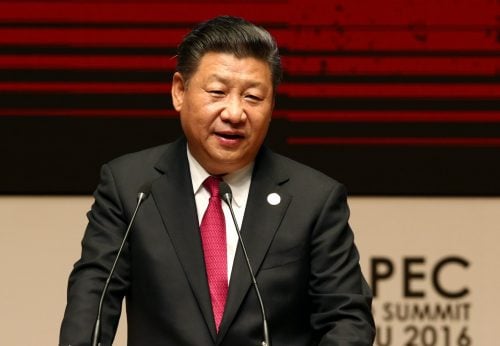
China’s President Xi Jinping addresses the audience during a meeting of the APEC (Asia-Pacific Economic Cooperation) Ceo Summit in Lima, Peru, November 19, 2016. REUTERS/Mariana Bazo – RTSSDPP
Second, Taiwan has become a genuine liberal democracy ruled by the Taiwanese people who never acquiesced in the fiction pushed by its former autocrat that Taipei ruled “One China.” It may have once been true, at least for autocratic leaders in Beijing and Taipei, that “all Chinese on either side of the Taiwan Strait maintain there is but one China,” but today the Taiwanese harbor no pretensions to rule One China.
For the sake of stability and good relations with the People’s Republic of China we won’t soon adjust this uncomfortable fiction. But there is much the United States can do to rebalance its relations between Taiwan and China under the One China framework. The objectives should be to meet our obligations to Taiwan that allow it to continue its democratic development, while continuing to build our relationship with China. The zero-sum thinking on display by experts since Mr. Trump had a phone-call with President Tsai must be rejected.
Contrary to conventional wisdom, selling Taiwan the weapons systems it needs like submarines and fighter aircraft and sending senior military officers to Taiwan is not a violation of the One China policy. Neither is consummating a free-trade agreement. Furthermore, the United States government can change its internal policy and allow Taiwan officials to meet at the Department of State itself.
Finally, the United States can make a much harder push for Taiwan’s membership in international and regional organizations.
Taiwan is a liberal democracy that deserves our support on moral grounds. But prudent strategy also dictates closer engagement with a people we are obligated by law to help defend. Continuing to accept Beijing’s definition of what the One China Policy means will only undermine our interests in cross Strait stability and our commitments to Taiwan.