
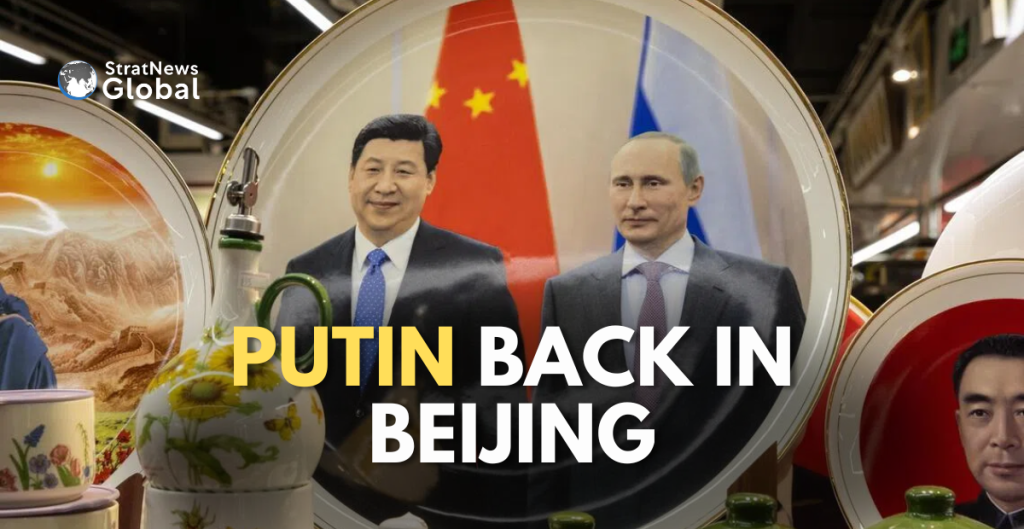

Chinese President Xi Jinping is set to host Russian President Vladimir Putin in Beijing on Wednesday, just days after U.S. President Donald Trump’s high-profile visit to China, placing Beijing once again at the centre of global diplomacy.
The summit between Xi and Putin will focus on both bilateral ties and major international issues, but much of the attention is also on the symbolism and optics surrounding the meeting between the two leaders often described by Chinese and Russian officials as “old friends”.
The Kremlin said the visit will conclude with a private tea meeting between Xi and Putin, where the two leaders are expected to discuss international affairs in an informal setting.
Xi is known for using such tea meetings as a diplomatic signal of personal trust and political closeness.
Last year, Xi hosted Putin outdoors in Beijing’s Zhongnanhai compound, where the two leaders spoke casually without ties in what was seen as a display of personal chemistry.
In contrast, analysts noted that Trump’s recent garden walk and Temple of Heaven tour with Xi appeared far more choreographed and ceremonial.
“Beijing is loving the optics of this,” said Graeme Smith of the Australian National University. “They’re loving being the centre of world attention.”
Beijing Pushes ‘Multipolar World Order’
The visit comes at a time when China and Russia are presenting themselves as partners in shaping what they describe as a “multipolar world order”.
According to the Kremlin, around 40 agreements are expected to be signed during the visit, alongside a lengthy joint statement outlining deeper strategic cooperation.
The two leaders are also expected to issue a declaration supporting a “new type of international relations”, language often used by Beijing and Moscow to criticise U.S.-led global influence.
Trade, Energy And Strategic Ties
Putin arrives in Beijing with a large delegation including senior ministers, bank chiefs and state company executives.
Russia has increasingly relied on China economically since Western sanctions over the Ukraine war deepened Moscow’s isolation.
Although bilateral trade dipped slightly last year, trade between the two countries has rebounded strongly in early 2026.
Energy cooperation is also expected to feature heavily in talks, particularly discussions surrounding the proposed Power of Siberia 2 gas pipeline linking Russia to China.
Analysts say instability in the Middle East and energy supply concerns linked to tensions around Iran may strengthen Moscow’s case for expanding long-term gas exports to China.
(with inputs from Reuters)