
May 20, 2026
JAKARTA – Indonesia has largely kept fuel prices at pump stations affordable despite a roughly 50 per cent surge in global oil prices since the Iran war, swelling the country’s already hefty energy subsidy bill.
Every day, South-east Asia’s largest economy spends more than 500 billion rupiah (S$36 million) subsidising fuel – equivalent to the cost of building 250km of district roads.
Economists are now urging Jakarta to slash the subsidies and let fuel prices rise. Failing that, they warn, the national budget risks becoming unsustainable.
Among them is Mr Achmad Nur Hidayat of the Universitas Pembangunan Nasional in Jakarta, who told The Straits Times: “The government’s current policy of maintaining subsidised fuel prices risks triggering a budgetary catastrophe.”
The policy comes as Indonesia faces mounting fiscal pressure.
The rupiah, hit by fallout from the Middle East conflict, has fallen more than 5 per cent against the US dollar this year and slid to record lows in mid-May – making it one of Asia’s worst-performing currencies in 2026 – while the stock market has pulled back after an early-year rally.
In the face of such fiscal strains, experts say Indonesia should use well-tested policy instruments: raise fuel prices at pump stations when global crude oil prices surge, and hike interest rates when the rupiah is under pressure.
Neither of these steps has been taken so far.
Experts warn that Jakarta’s continued maintenance of fuel subsidies carries high systemic risks. Instead of passing on costs to consumers to curb demand and protect fiscal health, Indonesia is bleeding cash to subsidise fuel consumption.
Mr Achmad said the state coffers’ emergency funds – or Sisa Anggaran Lebih (SAL) — will be depleted by July if the government does nothing about fuel subsidies and global supply disruptions persist.
The SAL refers to accumulated excess funds resulting from past years of underspending, usually withdrawn only in times of crisis or emergency.
“To avert a fiscal crisis, pump prices must be adjusted,” said the economist.
Global crude oil prices have spiked following the onset of the Iran war, which has severely disrupted traffic through the Strait of Hormuz.
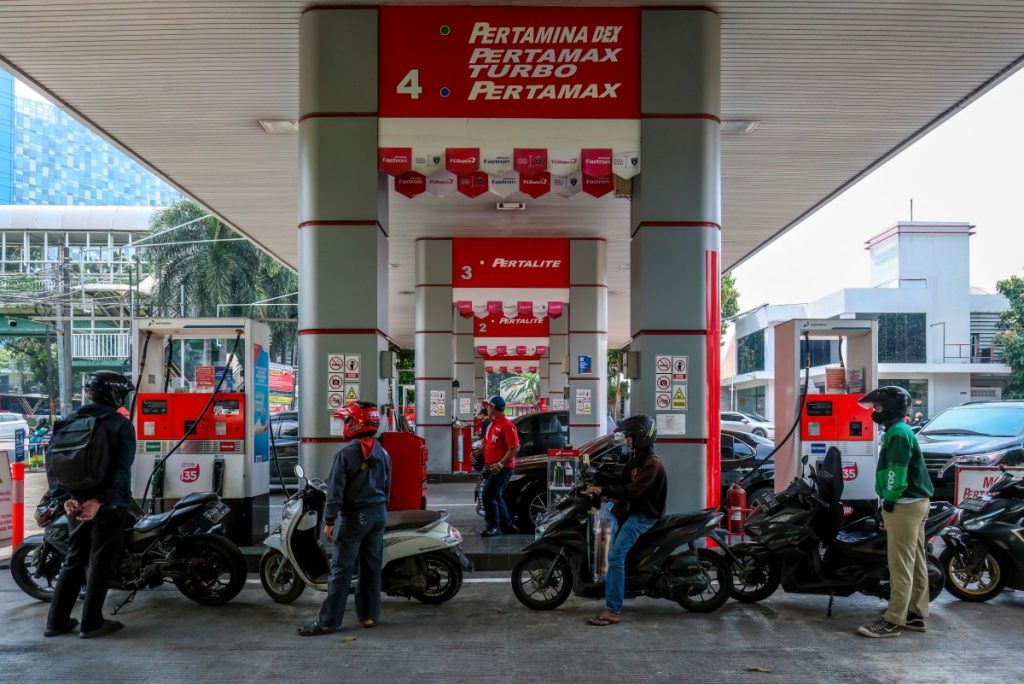
While Indonesia has raised the prices of industrial diesel and non-subsidised premium fuels, such as Pertamax Turbo, it has not raised the price of Pertalite, the subsidised fuel which accounts for 80 per cent of fuel consumption in the country.
Indonesia’s subsidised fuel remains among the cheapest in the region, retailing at around $0.72 a litre, compared with around $3.40 in Singapore, $1.76 in Thailand and $1.21 in the Philippines.
A senior government official told ST on condition of anonymity that the Indonesian government would likely take “certain steps” if Middle East tensions continue beyond June, though he declined to specify what measures were under consideration.
The official noted that the country’s 2026 state budget had assumed an annual average Indonesian crude price of US$70 a barrel but following the Iran war, global crude oil benchmarks surged, dragging Indonesia’s domestic crude benchmark up to US$90 a barrel.
Every US$1 rise in crude prices adds between 6.8 trillion and 10 trillion rupiah to Indonesia’s annual fuel subsidy bill, government estimates show.
The baseline assumption for crude oil pricing has vastly decoupled from market reality due to the Iran war, creating a critical fiscal deficit risk. For 2026, the government initially allocated nearly 400 trillion rupiah to fund energy subsidies and manage compensation payment to state owned oil and gas corporation Pertamina.
Economists who spoke to ST said that fuel subsidies disproportionately benefit wealthier Indonesians who own cars, while straining state finances.
Any subsidy cuts should be paired with direct cash assistance to poorer households to soften the impact of higher transport and food prices, they added.
Ms Esther Sri Astuti, an economist at Jakarta-based think-tank Institute for Development of Economics and Finance, said she has seen luxury vehicles pumping subsidised fuel, underscoring weak targeting of the programme.
Dr Jahen Fachrul Rezki, a researcher at the Institute for Economic and Social Research at the University of Indonesia’s Faculty of Economics and Business, said a firm decision must be taken to save the state coffers.
“The government needs to adjust fuel prices, but it also needs to prepare a safety net for the groups of people who will be affected,” he stressed.
Economists say that delaying fuel-price adjustments could deepen fiscal and currency pressures, pointing to Indonesia’s 2005 fuel-price crisis under then President Susilo Bambang Yudhoyono as a cautionary tale.
Faced with soaring oil prices and pressure on the rupiah, the government eventually reduced fuel subsidies and raised pump prices by more than 100 per cent, alongside aggressive interest-rate hikes by the central bank to stabilise the currency.
Besides cutting fuel subsidies, economists have also urged Indonesia’s central bank, Bank Indonesia, to raise interest rates amid the rupiah’s depreciation.
“It seems Bank Indonesia is holding off on raising interest rates to help stimulate economic activity, but this isn’t happening,” said Mr Achmad. “It would be better off taking steps to defend the rupiah by hiking rates.”