
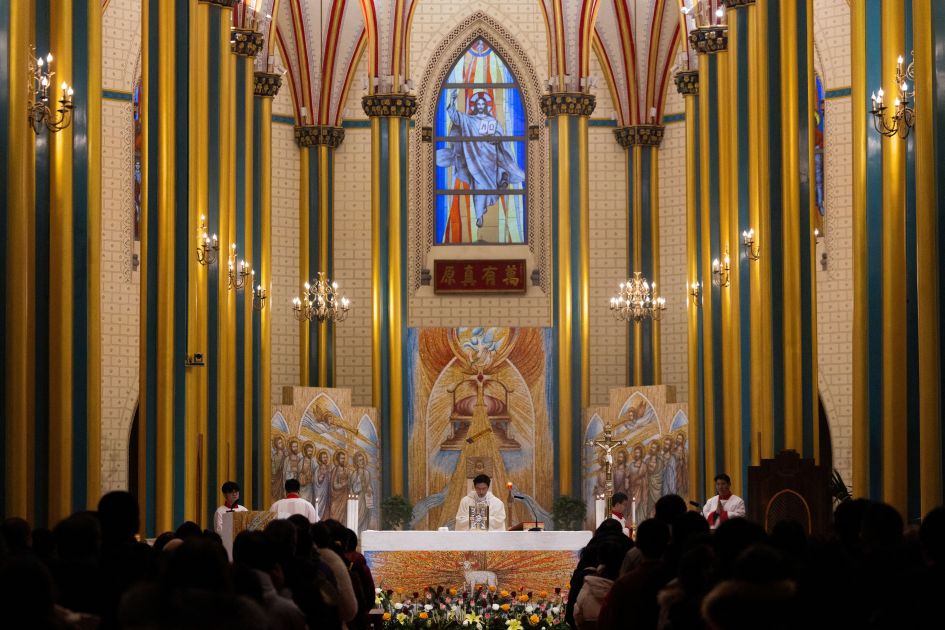
Authorities in China have increased pressure on underground Catholic communities to join the state-controlled official Church.
A Human Rights Watch report released on Wednesday has warned that the Chinese government has tightened ideological control, surveillance, and travel restrictions on the estimated 12 million Catholics who live there.
The watchdog has claimed that independent researchers are not permitted in China and that the government punishes people for speaking to foreign media or rights groups. Therefore, its research has been based on the accounts of nine people outside the country who had firsthand knowledge of Catholic life in China, as well as experts on religious freedom and Catholicism in China.
The charity also reviewed government documents and articles in the Chinese government press.
Yalkun Uluyol, a China researcher at Human Rights Watch, said: “A decade into Xi Jinping’s Sinicization campaign and nearly eight years since the 2018 Holy See-China agreement, Catholics in China face escalating repression that violates their religious freedoms.”
“Pope Leo XIV should urgently review the agreement and press Beijing to end the persecution and intimidation of underground churches, clergy, and worshippers,” he added.
The report highlighted that while religious persecution in China is longstanding, the environment has become increasingly repressive since President Xi Jinping took power in November 2012.
China’s Catholics have been divided between an official, state-controlled church that did not recognise papal authority, and an underground church that remained loyal to Rome through decades of persecution.
Since 2018, Chinese authorities have pressured Catholic communities “by arbitrarily detaining, forcibly disappearing, and subjecting underground Catholic bishops and priests to house arrest.”
The report also highlighted that authorities have demolished hundreds of church buildings and the crosses atop them, prevented adherents from gathering in unofficial churches, restricted access to the Bible, and confiscated religious materials not authorised by the government.
The Sinicisation campaign has also meant severe repression of Tibetan Buddhism and Islam, Human Rights Watch said.
People interviewed said that the 2018 Holy See-China agreement provided an overarching structure for the authorities to pressure underground Catholics, which left them with “no other choice but to join the official church.”
Some underground Catholics said in the report that they felt betrayed by the Vatican.
While “members of those communities are used to persecution from the [Chinese] government,” said one expert who has interviewed dozens of Catholics in China, “since 2018, they feel like the Vatican is also coming after them.”
Earlier this month, Human Rights Watch sent a summary of its findings seeking comment from the Chinese government and the Holy See. Neither has responded.