
Lee says Korea to join India-led Indo-Pacific oceans initiative for free, open and rules-based maritime order
NEW DELHI — President Lee Jae Myung said Monday that South Korea would work closely with India to help ensure safe and free navigation through the Strait of Hormuz and diversify energy supply chains to reduce dependence on the Middle East.
Lee made the remarks in a written interview with local media outlets, published hours before his summit with Prime Minister Narendra Modi in New Delhi, amid heightened global volatility and mounting supply chain disruptions compounded by the US-Israel war on Iran.
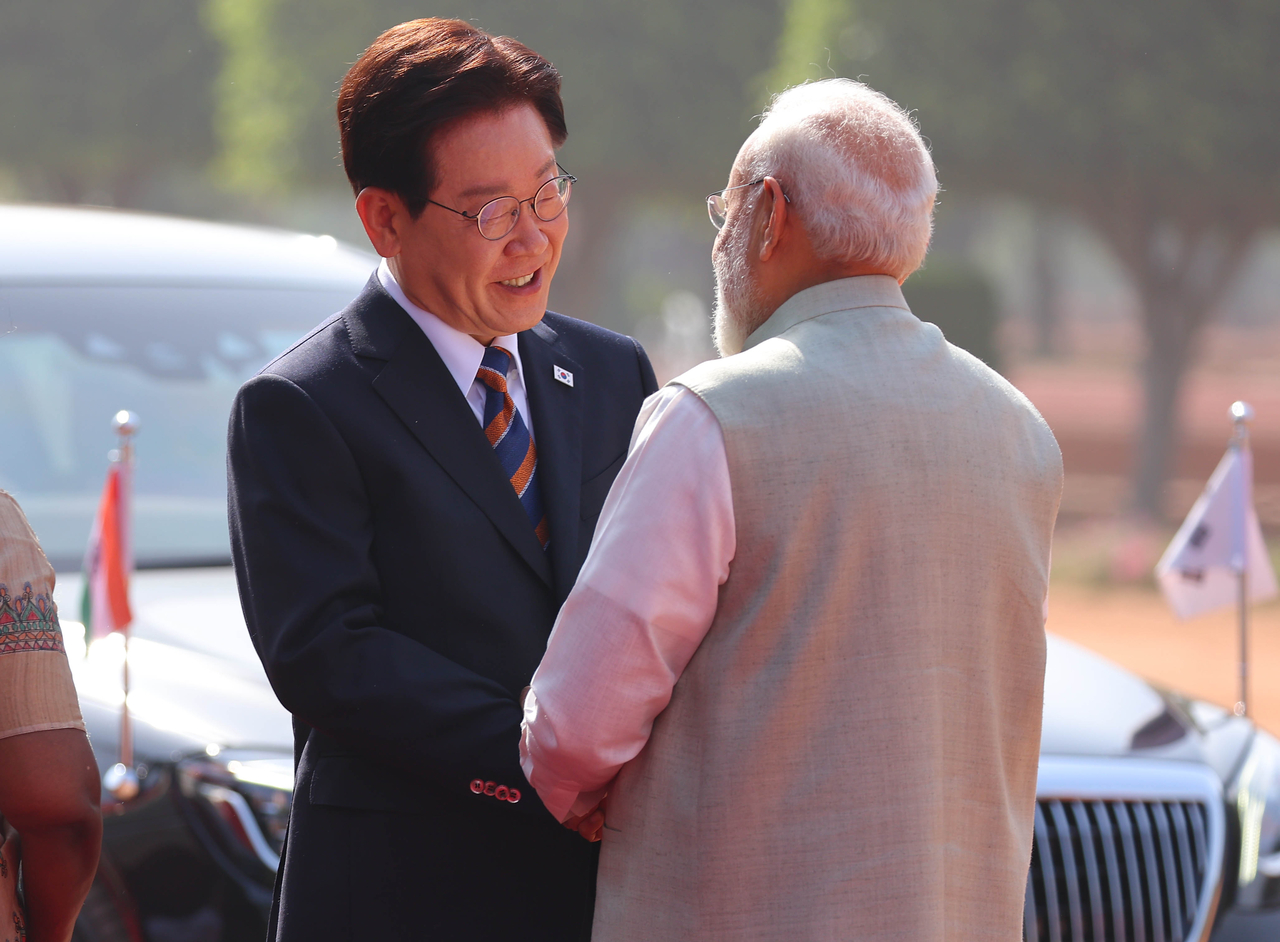
Lee and Modi kicked off their first stand-alone summit on Monday with an official welcome ceremony, followed by a visit to the Gandhi memorial, a small-group meeting, an expanded summit, a signing ceremony of memoranda of understanding, a joint press conference and a state luncheon hosted by the prime minister.
Since he arrived in New Delhi on Sunday afternoon, Lee has repeatedly underscored both the need to expand economic and business ties with India in line with its economic scale and the growing importance of cooperation between Seoul and New Delhi.
The war in the Middle East has disrupted energy supplies for both countries by effectively closing the vital Strait of Hormuz.
“Amid continued supply chain instability and a global economic crisis triggered by the fallout from the Middle East war, the Republic of Korea and India are becoming ever more important strategic partners to each other,” Lee said in an X post on Monday just before his meeting with Modi. The Republic of Korea is South Korea’s official name.
“I expect this summit will serve as an opportunity to further deepen and broaden our relationship.”
In his interview with The Times of India published in English on Monday, Lee also pledged, “Korea will maintain close communication with India to ensure that all vessels can navigate the Strait of Hormuz safely and freely.”
“We will also continue to work together in relevant international forums to uphold this shared commitment.”
Lee pointed out that the two countries “depend on the Middle East for a significant share of their energy supplies, including crude oil and natural gas.”
“Accordingly, ensuring the security of critical maritime routes is essential to the safety of our peoples and the very survival of our nations.”
Lee further highlighted the need for both countries to work together in diversifying supply chains.
“Amid growing uncertainties in the global economy, I am confident that forward-looking and strategic cooperation between Korea and India can substantially further our shared national interests.”
Lee underlined that “reducing excessive dependence on any single country has become a matter of survival, directly linked to the economic security of both nations” as global supply chains undergo reconfiguration.
In that process, Lee said Korea and India can harness each other’s comparative advantages, as India possesses critical minerals while Korea can turn them into rechargeable batteries, electric vehicles and other advanced products.
“This makes our two countries ideal partners for generating synergy.”
Lee said South Korea intends to join the India-led Indo-Pacific Oceans Initiative at a juncture when “strategic coordination and unity across the Indo-Pacific have become ever more vital.”
The IPOI, launched by Modi in November 2019 at the ASEAN-led East Asia Summit in Bangkok, is a voluntary, non-treaty-based international framework aimed at promoting a free, open and rules-based Indo-Pacific region through collaborative efforts.
“The war in the Middle East has underscored the strategic reality that the Indian and Pacific Oceans form a single, interconnected maritime space — one whose stability no country can secure alone,” Lee said.
Lee emphasized that countries in the Indo-Pacific region, including Korea, “have the capacity to lead in strengthening multilateralism and advancing a rules-based order.”
“At this critical juncture, Korea will work closely with regional partners, playing a bridging role to foster deeper cooperation and help anchor a more resilient regional order,” he said.
South Korea also participated this year in the International Fleet Review and the multilateral exercise MILAN hosted by India. South Korea first joined MILAN in 2022 and participated again in 2024 and 2026.
On the economic front, Lee said a “key priority” is accelerating negotiations to upgrade the Comprehensive Economic Partnership Agreement, a free trade agreement that initially took effect in 2010.
“Beyond traditional sectors such as electronics and automobiles, we will broaden cooperation into shipbuilding, finance, and the defense industry, bringing to life the vision of ‘Make in India, Together with Korea,” Lee said.
Following the summit with Modi, Lee was set to attend a large-scale South Korea-India business forum on Monday afternoon, bringing together 600 participants, including key business leaders from both countries, according to Cheong Wa Dae.
On the South Korean side, major companies from the shipbuilding, steel, electrical and electronics, automotive and consumer goods sectors took part. The Indian side was represented by companies from a range of industries, including chemicals, steel, biotechnology and materials.
dagyumji@heraldcorp.com