
Gliding when others are rocking – with the catamaran Solitude Adventurer, a trip diving the Banda Sea becomes a walk in the park, even with wind and waves. Live band included…
“It happens at 25 degrees… Search at 25 degrees,” I can still hear my journo buddy repeating over and over like Gollum raving about his ‘precious’ in The Lord of the Rings movies. What a thought to recall when one is fluttering on the reef hook in the middle of the thermocline at 40m! The computer shows the correct temperature and the five-minute window thanks to the gentleman, who established nitrox, gives hope.
Indeed, seconds later, the vanguard emerges. With synchronised rowing head movements, the first hammerhead sharks set off on a frontal course, right into the middle of a dreamlike picture frame of soft corals. Behind the ‘guardians’, the real school is getting ready. The finger is on the trigger.
All hell breaks loose
Three seconds more, two, one.. and suddenly there’s a jangling, rattling and shining behind us, as if the circus comes to town. They’re gone, the sharks – and there they are, the hammerhead shark briefing-free disturbers of the peace from that other safari boat.
Back on board, Solitude Adventurer’s Pieter Van den Abeele switches profession from manager to shrink, promising more chances to catch the shy fellows and recounting a comforting historical incident. Because it takes ‘what the heck’ to a new level: In the 17th century, the inconspicuous Banda Island of Run, barely three kilometres in size, off which we are anchored, became an international bone of contention without a hammerhead shark scandal.
Numerous rare nutmeg trees, whose fruits were advertised in Europe at the time as a medicine against the plague and sold with an incredible profit margin of 60,000 per cent, caused murder and manslaughter until a barter deal brought peace in 1667. Pulau Run went to the Dutch -their nutmeg monopoly collapsed decades later – and the British received an island in the New World in return. Its name? Manhattan.
Pristine Reefs and Hidden Gems: Diving Banda Sea’s Spice Islands
Rest easy – otherwise there is no time for belated history lessons on the Solitude Adventurer’s Banda Sea route. Even the check dive off the island of Ambon takes place at a macro hotspot for the rare and grotesque Rhinopia scorpionfish so that no camera housing remains dry. As soon as the 35-metre catamaran reaches the open water, almost every dive site has the potential for memories for a lifetime.
As the central part of the Spice Islands, aka the Moluccas, the Banda Islands are home to less than a handful proper volcanic and coral islands in seemingly endless seas.
Explorers may feel a pleasant tingling sensation. “Of course, the classics are not to be missed, but there are also dive spots that are quite new,” confirms Pieter, who is constantly refining the route after two years of experience on site. The coral plateau Karang Hatta, for example – named after the first Indonesian deputy prime minister Mohammad Hatta – is off the beaten track and is ignored by fishermen thanks to discreet donations and presents itself as a true gem.
Young silky sharks and solitary hammerheads, Napoleons and clusters of small tuna and barracuda are mercilessly trumped by sheer endless processions of schooling fish. The almost-opaque curtains of red-toothed triggerfish on this reef easily keep up with the richest regions of the Maldives.
Add the odd cloud of surgeonfish or fusiliers to the menu and the Banda Sea is pretty much at the biomass level of the East Pacific dream triangle of Cocos, Galapagos and Malpelo. “Yes, this season is quite nice”, chuckles Pieter after this display of fish-lunacy in October 2023. It’s surprising the wetsuits don’t smell.

Did you know?
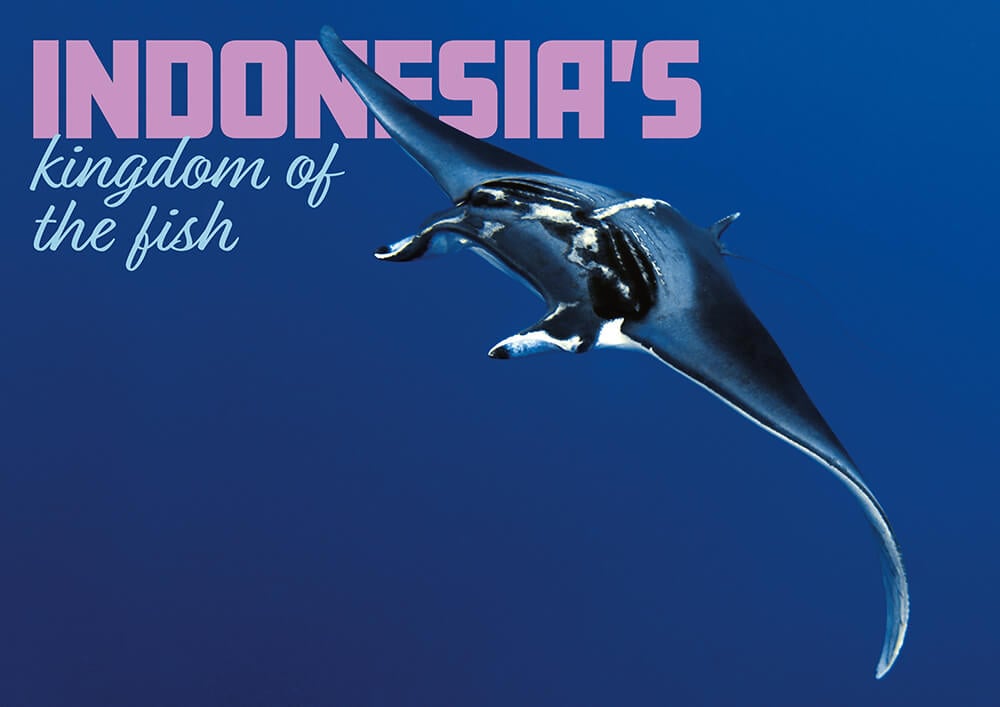
The reef manta ray is commonly found in the waters around Indonesia, growing up to an impressive five metres across. They are known for their distinctive black body with white markings on their bellies and fins.
Despite the euphoria, change is the only constant in the exposed sea area. Visibility, currents, waves – all this can change within a day. And because diving after sunrise on the open sea is simply frowned upon, the nights are used to make the distance. However, the berths on the Adventurer don’t usually roll in the waves, they usually just rock to sleep.
18 crew members, 18 guests
Whoever designed the catamaran launched in the Millennium for a Singaporean businessman must have had a pretty efficient crystal ball for looking into the future. The Solitude Adventurer (www.solitude.world), which was completely renovated in 2017, is not an opulent wellness safari ship with a doorbell and 12 light switches in the cabin.
With the exception of the sophisticated master suite, the double cabins and quadruple cabins are actually relatively small. The generous dimensions of the other areas and pragmatic comfort make up for this: between camera workstations, a modern espresso machine, a selection of drinks ranging from high-quality juices to Australian wines, a steak and barbecue evening, a large smart TV and a massage chair that makes it really difficult to follow the ringing of the ship’s bell, everything is taken care of. What’s sizzling in the pan, wok and oven is no secret – the kitchen is located in the centre of the saloon behind glass walls.

Campfire spirit on the high seas
Incidentally, the two acoustic guitars on the saloon wall are not dust catchers. In the Barracuda Band, dive guides and kitchen crew pick up the six-strings, cajon and percussion and interpret classics from Bob Marley to 4 Non Blondes quite convincingly with up to four-part vocals. And as is the case with barracuda, (musical) conspecifics are welcome to join the shoal!

On the large dive deck with a central camera table and plenty of storage space for chargers and odds and ends, the Asian service concept reigns supreme: every piece of equipment is numbered and assigned, and helping hands are always on hand – whether it’s to help you get dressed or to hand you ginger tea and a hand towel after the usually hour-long dives. Not only is the departure order of the dinghies subject to the rotation principle, the guides also change between the groups for the sake of fairness.

The daily jamboree bag
Probably the biggest asset of the Banda Sea is that the underwater world changes almost from day to day given the long distances travelled. After the critter-filled seaweed bottom of Ambon, a deep-sea flavour creeps in at the offshore island of Nusa Laut with expansive leather and soft corals, tuna and grouper. The island of Suanggi and its Jackpot – a chain of coral hills that rises from the depths and attracts mantas, whale sharks and hammerheads – are pretty much the gate to the actual Banda Sea. And with it to the so-called Ring of Fire.

At the moment, however, things seem to be rather quiet under the Earth’s crust, as the rather puny columns of smoke above and sparse curtains of gas bubbles off the snake island of Manuk indicate. Banded sea kraits and olive sea snakes writhe individually, but in record numbers, through bare lava canyons and coral fields interrupted by pitch-black sand patches. Whether you love the highly poisonous yet peaceful ‘danger noodles’ or prefer to see them in pictures – the rainbow-coloured mobula ray playground Manuk Ridge is not to be missed.

The same goes for Coconut Corner, where schools of hammerhead sharks pass by between September and November and – surprise surprise – sea snakes can occasionally be seen hunting together with blue-spotted trevally in the last rays of the sun. The unequal tandem works something like this – jack shoos damselfish into crevice, snake strikes; or snake shoos damselfish out of crevice, jack strikes…
Indonesia’s largest red light district
After so much excitement, blood pressure finally comes down at the main island of Banda Neira. The sight of the fjord-like bay at the foot of the Gunung Api just demands the ‘Titanic pose’ in the bow, and below the surface the landscape also takes centre stage.
Not only gorgonians and soft corals proliferate on walls and tunnels, but also the region’s landmarks: giant barrel sponges, which were often already there long before the first Europeans set foot on the islands. The living stone gardens below the cooled lava flow, on the other hand, are formed by what National Geographic calls the fastest growing corals in the world’s oceans – an impressive testimony to natural healing processes after the devastating volcanic eruption in May 1988.

Before camera-wielding voyeurs from all over the world take the official population of colourful mandarinfish in the crossfire at sunset, you can bravely grab your shoes. After a short walk past market stalls, piles of chickens and colonial buildings in clove cigarette-scented tropical air, you reach Fort Belgica. In the 17th century, the Dutch took aim at British privateers from the battlements – today the place is ideal for a relaxed look at the trip in the rearview mirror and the stunning diversity experienced on this nine-day trip. Maybe it’s really not all about that one picture of the schooling hammerheads in the soft coral frame…

News from the alien kingdom
Planning a follow-on to an epic liveaboard trip can be daunting, but a visit to Solitude’s Lembeh Resort is the perfect way to decompress from life afloat – and add to your critter count, not to mention yet more colourful corals, blue water and even sharks and turtles.
Welcome to Lembeh
Introducing the Lembeh Strait to underwater photographers and fans of all things bizarre and tiny is like taking an aquarium full of clownfish to the Red Sea. Octopods teased by cheeky reef dwellers that mime sea snakes for defence, shrimps ‘surfing’ on nudibranchs and fingernail-sized frogfish – these can be found elsewhere in Southeast Asia, but both variety and density of critters in the strait in north-eastern Sulawesi are hard to beat. Among critter connaisseurs, ‘almost as good as Lembeh’ has become a common phrase. Almost as good…

The region owes its exceptional position to several factors: the nutrient-rich lava sand from the slopes of the Dua Saudara volcano, upwelling currents, river sediment, its protected location in the absolute centre of the Coral Triangle and – this is where it gets less romantic – organic and inorganic waste from the port metropolis of Bitung. In the world capital of ‘muck diving’, there are various biotopes ranging from rubble, algae and black and white sand beds to steep walls covered in sponges that attract a wide variety of weird residents. Only the diver’s favourite habitat falls a little behind when rummaging through algae, sea urchins and beer bottles: the coral reef. That could now change because of Covid-19, of all things…

“Even with the help of the dedicated dive guides, portraits of agile squid or transparent flounder larvae are easily as far away from the focal point as the Moon is from the Earth”
Necessity, the mother of invention
It could have been so easy. Knowing that even wildest subjects such as hatching flamboyant cuttlefish and mouth-breeding Banggai cardinalfish are easy prey for the bucket list, multiple award-winning photographer Patrick Neumann rubbed his hands in anticipation of his dream job in 2019.
A small hotel in a prime location was to be transformed into a fine boutique resort for macro and photo-savvy divers for the Singaporean diving tourism brand Solitude. Within months, the place became an almost barrier-free facility with two sea view villas, eight garden villas and seven deluxe rooms in a lush tropical garden with infinity pool, open restaurant, camera room, and house reef.

Along with excursions to Tankoko National Park and Tomahon market, spa treatments, repeater programmes, and the plan to pay good wages to attract the best guides and chefs possible. After all, Patrick was not only brought in as resident manager to run photo workshops, but for the kind of fine-tuning expertise that comes with having worked for dive centres around the globe. Then came March 2020 and Covid – no flights, no customers, no revenue. What now?

“I always wondered what’s on the other side of Lembeh Island,” recalls Neumann, who then studied nautical charts with his partner Anna Manzel and discovered plenty of walls and canyons dropping deep into the open ocean. As the mayor of Bitung arranged for the donation of the petrol, nothing stood in the way of an 11-day expedition.
On the Sulawesi shelf
The results are now very popular with guests who fear for failing eyesight after days of rummaging for tiny skeletal shrimps: Fireball, a spray-covered shoal that just breaks the surface a good hundred metres off Lembeh Island’s exposed east side, is overgrown with small orange soft corals in its richly flowing canyons. In the blue – the visibility is disconcerting after a few days of critter diving – first a whitetip reef shark and then a hawksbill turtle pass by. Well outside photo range unfortunately, still blue-striped snapper and seafans make up for them, and, above all, the pink-coloured crust anemones that are somewhat reminiscent of Komodo’s prime spot Batu Bolong.
Rather surprisingly, the next two dive sites on the day’s tour are completely different. The steep edges and slopes at the islet of Pulau Dua and Cape Fell Mishmish are home to huge elephant ear, tube and barrel sponges, some of which are probably several hundred years old.

Of course, the abundance of fish cannot be compared with the Banda Sea, but healthy fields of lettuce coral and hard coral gardens in the very shallows water makes divers want to come back for more.
After all, hardly any of the approximately 50 other dive centres in the area ever go there – the weekly trips are the privilege of Solitude Lembeh Resort as the operation, by its own admission, owns the two fastest boats in Lembeh powered with 400hp and 300hp engines. While the outside of the island can be reached in just over an hour, almost 60 diving spots within the Strait are often less than ten minutes away, which is why the boats return after each of the three day dives for the next meal.

Funnily enough, it’s up to the guests to pace themselves and not fall short on the food side of things – there are no dive time limitation. It’s even ‘worse’: there a ratio rule of one guide for two guests and most of the guides are photographers themselves and ready to help with (back) lighting, snooting and all kinds of creative ideas.
Creatures of the night
And because the almost 300m deep Lembeh Basin meets an extensive shallow area in the immediate vicinity of the hotel, numerous larvae and deep-sea dwellers can be discovered there in the night-time light.
As a seasoned underwater photography pro, who still dives as a hunter-gatherer to display subjects in the most of creative ways, Patrick reveals tips before blackwater dives and whenever asked for that are only available in workshops elsewhere. After all, focus and lighting are a challenge in pitch-black open water. Even with the help of the dedicated dive guides, portraits of agile squid or transparent flounder larvae are easily as far away from the focal point as the Moon is from the Earth.
Those who have succumbed to the fascination of macro stalking in black water – non-photographers should reach for a magnifying glass – may shed a tear into the mask glass as there actually is a time limit for these dives. Then again: what kind of captain likes fishing divers out of a shipping lane at night…


FAQs
What is the best time of year to dive the Banda Sea for hammerhead sharks?
The peak season for schooling hammerhead sharks in the Banda Sea is between September and November. During this window, thermoclines bring these majestic predators into shallower depths, making them more accessible to divers.
What makes the Lembeh Strait famous among scuba divers?
Lembeh Strait is globally recognized as the “muck diving capital of the world.” It is famous for its incredible density of rare, bizarre “critters,” including flamboyant cuttlefish, hairy frogfish, and numerous species of octopuses.
What kind of marine life can I see at Pulau Manuk?
Pulau Manuk, also known as the “Snake Island,” is famous for its high concentration of banded sea kraits and olive sea snakes. Divers can also spot mobula rays and vibrant reef fish against a backdrop of volcanic black sand.
Do I need to be an experienced diver for an Indonesian liveaboard?
Many Indonesian dive sites, especially in the Banda Sea, involve strong currents and deep wall dives. While many resorts cater to all levels, a Liveaboard trip is best enjoyed by those with an Advanced Open Water certification and experience in drift diving.
This article was originally published in Scuba Diver Magazine
Subscribe today with promo code DIVE1 — enjoy 12 months for just £1!