
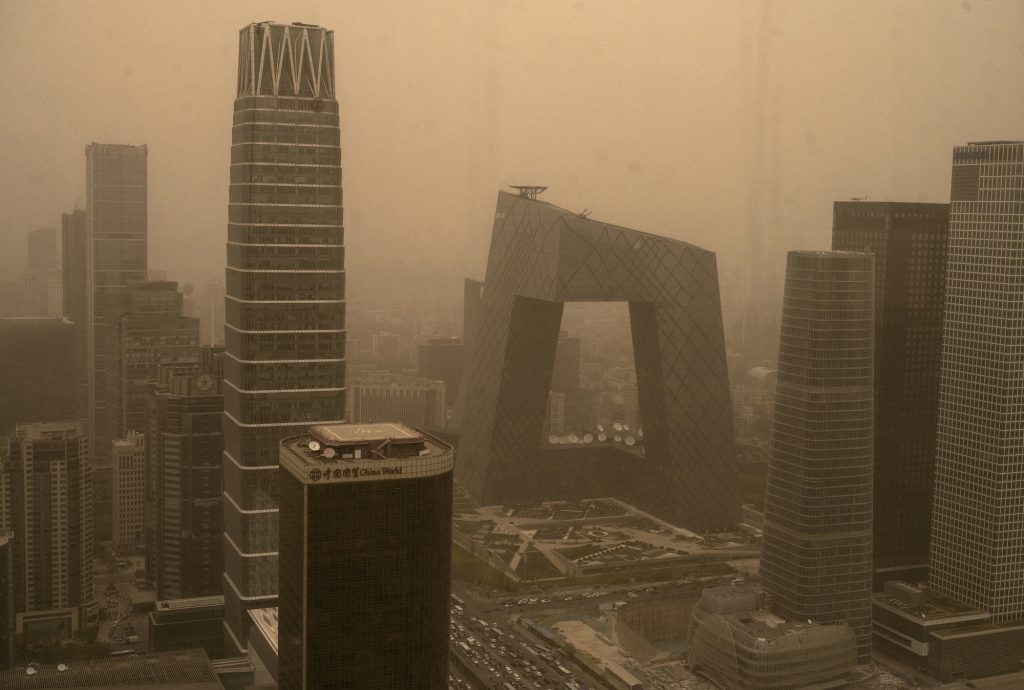
On April 19, a surge of extreme weather swept across China, with northern regions hit by intense sandstorms and strong winds, while southern areas, including Chongqing, experienced heavy rain, powerful gusts, and thousands of lightning strikes within the span of a few hours.
Beijing saw a combination of high winds, sandstorms, and rainfall, with airborne dust significantly reducing visibility. Videos shared online showed streets shrouded in haze as strong winds carried dust through the city, leaving buildings obscured and covered in dust.
RELATED: Beijing Hit by Force-14 Winds as Sandstorm Triggers Severe Pollution in 130 Cities
Beijing battered
According to the Beijing Municipal Ecological and Environmental Monitoring Center, the sandstorm originated in northwestern China on the night of April 18. Driven by northwesterly air currents, the dust system moved southeast, leading to a sharp rise in particulate matter levels.
Monitoring data showed that cities upwind of Beijing, including Ulanqab in Inner Mongolia and Zhangjiakou in Hebei Province, experienced extreme spikes in PM10 concentrations. Ulanqab recorded levels exceeding 4,000 micrograms per cubic meter early on April 19, while Zhangjiakou reached 1,664 micrograms per cubic meter later that morning.
Success
You are now signed up for our newsletter
Success
Check your email to complete sign up
By early afternoon, Beijing’s PM10 levels rose to 162 micrograms per cubic meter, indicating light pollution. However, forecasts warned that concentrations could spike further as strong winds continued to transport dust into the region, with short-term levels potentially reaching heavy pollution thresholds.

Authorities also reported that a cold air system affecting northern China from April 19 to 20 contributed to widespread strong winds and sandstorm activity across the region. Alongside the sandstorm, Beijing experienced scattered rainfall throughout the day. Between 11 a.m. and 8 p.m., average precipitation reached 0.8 millimeters, with localized areas such as Mentougou recording up to 6.1 millimeters.
The extreme conditions sparked widespread reaction online. Some residents described the scene as surreal, with one commenter saying it felt like “a scene out of an apocalyptic movie.” Others expressed frustration over recurring air quality issues, noting that heavy pollution remains a concern even on clear days.
Chongqing hit by violent storms
In southwestern China, Chongqing faced a different set of extreme conditions. Beginning in the evening of April 19, strong winds, torrential rain, and intense lightning activity swept through the city.
RELATED: Beijing Sandstorm Brings Level 14 Winds and Rare Blue Sun, Air Quality Index Hits 500
According to local meteorological data, the city recorded 8,068 lightning strikes between 6 p.m. and 4 a.m., a concentration largely centered in western districts but also affecting central and southeastern areas. Rainfall totals were also significant, with some areas receiving up to 107.9 millimeters of precipitation. Reports described urban flooding in low-lying areas, with water levels rising high enough in some locations to submerge vehicle wheels.
Residents shared images of streets inundated with water, while one account described a stairway near a local school transformed into a temporary “waterfall” under the force of the downpour.
Extreme weather patterns
The events in Beijing and Chongqing are part of a wider pattern of unusual weather across China in recent weeks. Data from weather authorities indicate that southern regions have experienced sustained rainfall over the past month, with provinces such as Guizhou, Hunan, and Jiangxi recording precipitation levels significantly above seasonal averages. In some areas, rainfall totals have exceeded historical norms by as much as 50 to 100 percent.
Several cities have reported record-breaking rainfall for this time of year, including Shangrao in Jiangxi Province and Tongren in Guizhou. Forecasts indicate that another round of heavy rain will impact southern China from April 20 to 23, with some regions expected to experience severe storms accompanied by strong winds, hail, and lightning.
China’s National Meteorological Center issued multiple alerts on April 19, including a yellow warning for strong winds and a blue warning for severe convective weather. Authorities also activated a Level IV emergency response for major meteorological disasters.
Experts have cautioned that continued heavy rainfall, particularly in areas already saturated, may increase the risk of secondary disasters such as flash floods and landslides. As extreme weather events become more frequent across different regions, the contrasting conditions, sandstorms in the north and severe storms in the south, underscore the growing variability and intensity of weather patterns affecting the country.