

The city of Beijing has issued the outline of a plan to accelerate the city’s satellite internet industry development, proposing to build the capital city into China’s first satellite internet demonstration city by 2030, according to the Beijing Municipal Bureau of Economy and Information Technology.
According to the outline of the plan issued on Monday, Beijing will prioritize infrastructure construction, core technology breakthroughs, application scenario cultivation, industrial ecosystem building, regional collaboration, and international development to promote large-scale application of the satellite Internet of Things services.
“We will build a supply-and-demand matching platform based on Beijing’s actual operational needs, so that the commercial aerospace industry can truly serve the people’s livelihoods and urban development. These real-world application scenarios can also help close the supply-and-demand gap, stimulating innovation and cultivating new quality productive forces,” said Yang Jing, deputy director of the aerospace industry division under the Beijing Municipal Bureau of Economy and Information Technology.
The city is also actively expanding into the international commercial space market, deepening cooperation with global partners.
“I think China has been in a way through a tremendous development, whether it’s in the space or in other technology. So we look forward to working together with them and bringing the technology into Malaysia, especially in the rescue and emergency services,” said Yau Chyong Lim, Chief Operating Officer of MEASAT, a leading space technology company in Malaysia.

Beijing accelerates development of satellite internet industry
The Caixin Robotics Industry Index (RII) was released at the Inaugural AI High-Quality Development Conference held in Hangzhou City, east China’s Zhejiang Province, on Saturday.
The index, a comprehensive benchmark dedicated to the robotics sector, reached 125.1 last month, up nearly 25 percent from two years ago.
According to Caixin, Beijing topped the city robotics industry index, which measures the share of robotics-related industrial inputs in a city’s overall economic inputs.
Nanjing, Xi’an, Hangzhou, and Suzhou also ranked among the top five.
In 2025, China produced more than 770,000 industrial robots and over 18 million service robots, with output expected to continue rising in the years ahead.
The climb of the index comes as robotics has been elevated in China’s national planning, underscoring the sector’s growing role in industrial transformation and future economic strategy, according to Wang Zhe, senior economist with the Caixin Insight, the compiler of the index.
“The robotics industry was mentioned in both the 14th Five-Year Plan (2021-2025), and the 15th Five-Year Plan (2026-2030) . Over the past five years, this industry has fully developed. From these two plans, we can see that the position of this sector has been upgraded. Five years ago, robots were just part of manufacturing upgrades, but now and looking ahead to the next five years, robotics, alongside many other emerging industries, is poised to grow into a pillar industry for China,” said Wang.
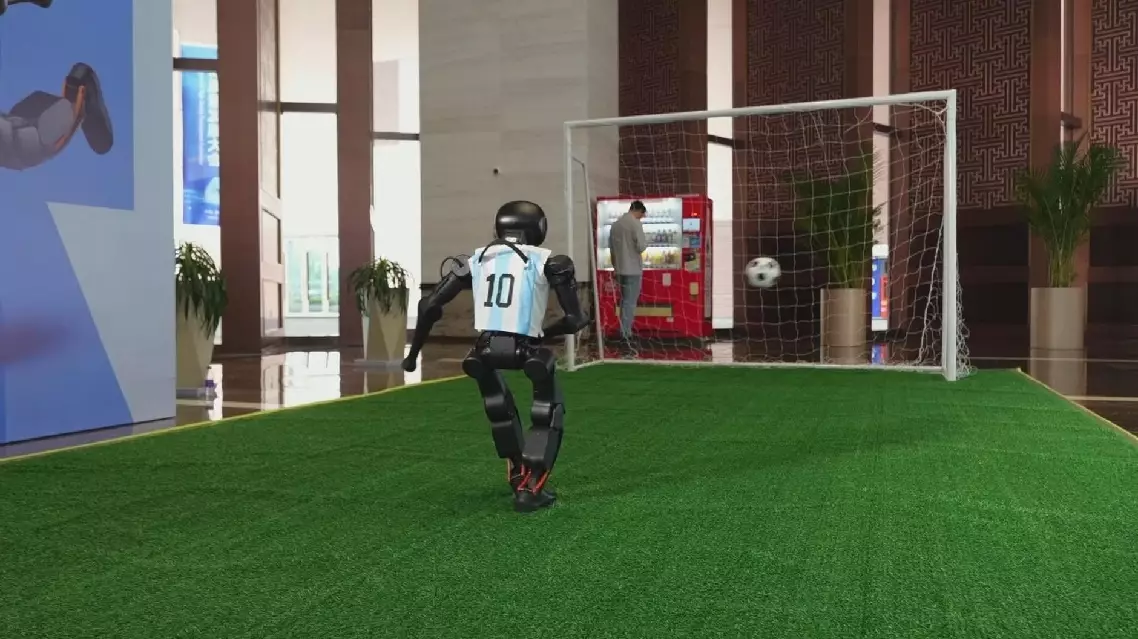
Climb of robot industry index point to industrial growth