
Close Menu
Simply Invest Asia
  • Home
  • About us
  • Explore industries/sectors
    • Automobile
    • Aviation
    • Banking
    • Biotechnology
    • Chemical & Fertilizer
    • Entertainment and Media
    • Food Processing
    • Healthcare
    • Iron and Steel
    • Leather
    • Mining
    • Oil and Gas
    • Pharmaceutical
  • Explore by countries
    • China
    • Dubai / UAE
    • Hong Kong
    • India
    • Indonesia
    • Japan
    • Malaysia
  • Explore cities
    • Bangkok
    • Beijing
    • Chongqing
    • Delhi
    • Dubai
    • Guangzhou
    • Jakarta
    • Kuala Lumpur
  • Why Asia
Facebook X (Twitter) Instagram Threads
Trending:
  • Amundi, State Bank of India Announce Listing Of SBI Funds Management
  • Chengdu Rongcheng vs Beijing Guoan Prediction, Betting Tips, Lineups & Odds
  • No discussions yet regarding general election – Zahid | Malaysia
  • How Japan is putting AI in its cybernetic place
  • Subscription car business Carbar seeks $10m for merger with UAE’s Carasti
  • UOB Private Bank Sets Out Hong Kong AuM, Headcount Growth Goals
  • Price of parenting: the household maths giving China’s consumers pause
  • Delhi Police likely to withdraw FIRs as CJP protest ends
  • Journey through aviation history – The Island
  • Jesuit university in Indonesia opens doctoral program in theology
  • Italian students who sparked outcry over bad behaviour on Bangkok train apologise following fines
  • Madinati explained: How to report road, traffic and infrastructure issues in Dubai
  • Lloyds Bank seeking permission to open in the Cotswolds
  • Invesco Biotechnology & Genome ETF : PBE – 24/7 Wall St.
  • Residents cash in on Dubai real estate cooldown amid Mideast war
  • Vedanta Iron & Steel Q1 Results: Earnings call on July 30 – scanx.trade
  • Hong Kong Developers Adjust Greater Bay Area Strategy as Mainland Property Crisis Reshapes Market – News and Statistics
  • From marches to memes: why India’s youth turned against Modi
Sunday, July 26
Facebook X (Twitter) Instagram
Simply Invest Asia
  • Home
  • About us
  • Explore industries/sectors
    • Automobile
    • Aviation
    • Banking
    • Biotechnology
    • Chemical & Fertilizer
    • Entertainment and Media
    • Food Processing
    • Healthcare
    • Iron and Steel
    • Leather
    • Mining
    • Oil and Gas
    • Pharmaceutical
  • Explore by countries
    • China
    • Dubai / UAE
    • Hong Kong
    • India
    • Indonesia
    • Japan
    • Malaysia
  • Explore cities
    • Bangkok
    • Beijing
    • Chongqing
    • Delhi
    • Dubai
    • Guangzhou
    • Jakarta
    • Kuala Lumpur
  • Why Asia
Simply Invest Asia
Home»Explore industries/sectors»Aviation»Fry to fly: Japan steps up efforts on cooking oil in race for sustainable aviation fuel​​
Aviation

Fry to fly: Japan steps up efforts on cooking oil in race for sustainable aviation fuel​​

By IslaJune 6, 20265 Mins Read
Share
Facebook Twitter Pinterest Threads Bluesky Copy Link


Japanese homemaker Maki Watanabe carefully pours into a plastic bottle the oil she used to cook her deep-fried aubergines, doing her part in her Tokyo kitchen for a national effort to ramp up production of eco-friendly jet fuel.

“It would take a tremendous amount to make an aircraft fly, so I hope we can collect more,” said Watanabe, whose penchant for cooking allows her to donate about 40 liers a year.

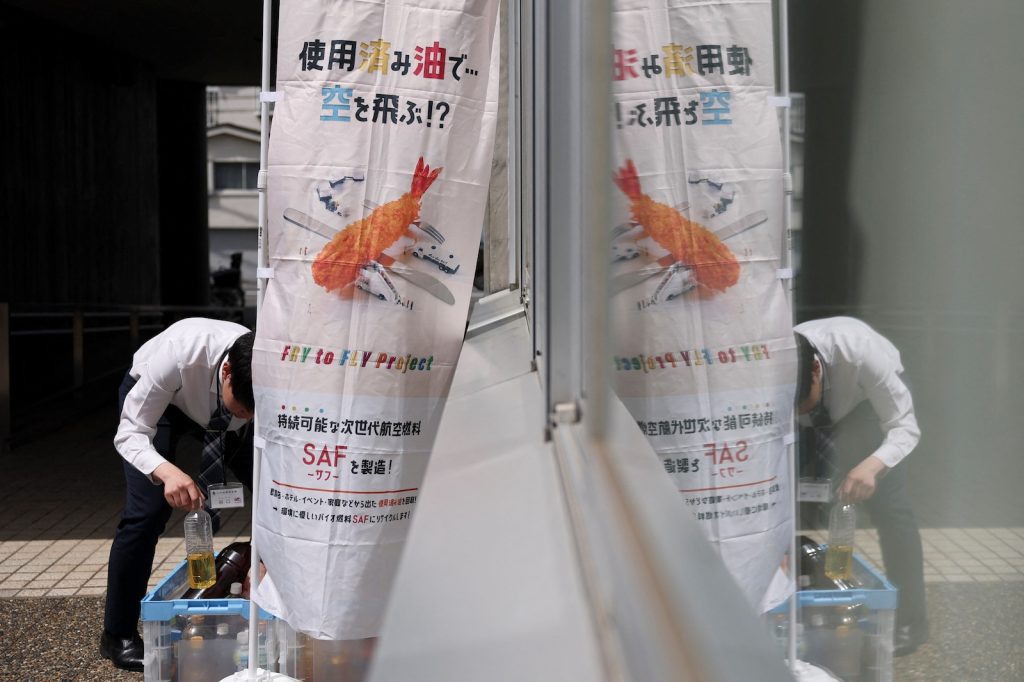
Her contribution is pooled at a nearby supermarket that is among roughly 300 participants in a public-private project dubbed “Fry to Fly”, as the Iran war squeezes energy supply and raises costs for the resource-poor country.

2026-06-05t010417z_2_lynxmpem54021_rtroptp_4_japan-energy-saf.jpeg

A local government employee helps to collect bottles containing used or expired cooking oil at a waste oil collection point for the “Fry to Fly” project, which collects used cooking oil from households to refine it into Sustainable Aviation Fuel (SAF), at a community center in Adachi Ward, Tokyo. Image: REUTERS/Issei Kato

Japan is looking to consumers like Watanabe with more urgency than ever as it scrambles to reach a goal of procuring a tenth of airline fuel from sustainable sources by 2030.

The world’s fourth-biggest economy estimates it needs about 1.7 million kiloliters in 2030, and hopes to gain as much as it can domestically through used cooking oil, a relatively cheap feedstock for sustainable aviation fuel.

But scarce feedstock and lack of infrastructure have limited domestic output of SAF to just 30,000 kiloliters now, or 0.3% of total jet fuel use.

“We’re facing a reality far harsher than expected,” the country’s top two carriers, ANA and Japan Airlines, told a May joint presentation on SAF efforts.

The flurry to collect cooking oil highlights the challenge for the aviation industry, one of the biggest emitters of greenhouse gas, in trying to reduce its carbon footprint.

A Reuters investigation last year showed that only about a fifth of SAF projects unveiled by airlines globally have materialised.

Adoption of SAF has long been held back by its high cost, but falling short of the volume targeted for 2030 will lead to higher costs for refiners and airlines.

That is because refiners may need to seek more expensive imports of SAF or feedstock, in addition to facing possible penalties, creating a knock-on effect for airlines.

By comparison, among countries that have already adopted a national mandate, the tiny Southeast Asian aviation hub of Singapore relies heavily on imported feedstock for its 1% target.

PIVOTAL YEAR

This year will prove critical for refiners’ SAF efforts.

They will have to make final investment decisions by March to allow for mass production in 2030, the government has said.

Industry leader Eneos said the volume of cooking oil that can be collected is a key in deciding whether it will pursue a venture with Mitsubishi Corp to produce 400,000 kiloliters of SAF after the 2028 fiscal year.

A complex and costly production process, from feedstock collection, treatment and hydrogenation to distillation, means that committing to SAF production carries significant risk.

2026-06-05t010417z_1_lynxmpem54023_rtroptp_4_japan-energy-saf.jpeg

Yuki Nishimura, deputy general manager of JCG Holdings’ Energy Innovation Unit, holds bottles of used cooking oil and sustainable aviation fuel (SAF) samples in Yokohama. Image: REUTERS/Irene Wang

A clearer outlook for demand was needed to justify expanding production, said engineering firm JGC, which started Japan’s first commercial-scale SAF plant last year.

Its joint venture with Cosmo Energy and biodiesel producer REVO International has annual capacity of about 30,000 kilolitres.

Public-private supply chain initiatives are stepping up efforts as the target year approaches.

The Tokyo government wants to commission more businesses to raise awareness and coordinate collection to tap the capital’s 7.8 million households for oil.

Last fiscal year, it distributed 13,000 plastic funnels carrying QR-coded collection instructions after putting together a paltry 160 kilolitres in 2024.

That figure would have been just enough to keep a Boeing 787 Dreamliner in the air for 17 hours, based on Reuters’ calculation using a formula from the JGC-Cosmo joint venture, Saffaire Sky Energy.

“If we don’t start now, we simply won’t make it by 2030,” said Tokyo official Yasushi Sato.

2026-06-05t010417z_1_lynxmpem54025_rtroptp_4_japan-energy-saf.jpeg

A worker from a firm collecting used cooking oil to produce sustainable aviation fuel (SAF) carries collected cooking oil in cans from a Tempura Ten-ichi restaurant, in Tokyo. Image: REUTERS/Kim Kyung-Hoon

Fujifilm was among the business enterprises that began collecting oil this year from employee cafeterias, while retail giants Aeon, Ito-Yokado and 7-Eleven are setting up more drop boxes.

Even if every drop of used cooking oil were collected, though, that would amount to 550,000 kilolitres, says UCO Japan, a group of companies engaged in recycling such oil. That would yield about a quarter of the SAF required in 2030.

Since Japan already collects almost all available waste oil from businesses, SAF imports are virtually inevitable before technology such as producing bioethanol-based jet fuel can be rolled out for commercial use, analysts say.

“Against that backdrop, the target is incredibly ambitious,” said Motoomi Suzuki, senior economist at Norinchukin Research Institute, adding that Japan’s need for domestic feedstock makes used cooking oil the only viable option in the near future. ​

© Thomson Reuters 2026.


Source link

Related Posts

Journey through aviation history – The Island

July 26, 2026

14 Year Old Boy Linked to Hoax Phone Call Causing QRA Intercept of Qatari Airliner

July 25, 2026

Government backs eight aviation innovators with £7.3 million in new funding

July 25, 2026
Add A Comment
Leave A Reply Cancel Reply

Top Posts

China Scraps 12,000 Degrees in Biggest Academic Overhaul in Years

June 14, 2026

Chinese Wall may stem India tech flows for electronics and automobile

June 1, 2026

Abandoned malls, whispers of nuclear war and young foreigners detained. This is what’s REALLY going on in Dubai… and the chilling warning one taxi driver gave to the Mail’s IAN BIRRELL

April 11, 2026
Don't Miss

Amundi, State Bank of India Announce Listing Of SBI Funds Management

By IslaJuly 26, 2026

This week, Amundi and the State Bank of India announced the successful listing of SBI…

Chengdu Rongcheng vs Beijing Guoan Prediction, Betting Tips, Lineups & Odds

July 26, 2026

No discussions yet regarding general election – Zahid | Malaysia

July 26, 2026

How Japan is putting AI in its cybernetic place

July 26, 2026
SUBSCRIBE TO OUR NEWSLETTER

Get our latest downloads and information first. Complete the form below to subscribe to our weekly newsletter.


I consent to being contacted via telephone and/or email and I consent to my data being stored in accordance with European GDPR regulations and agree to the terms of use and privacy policy.

Stay In Touch
  • Facebook
  • YouTube
  • TikTok
  • WhatsApp
  • Twitter
  • Instagram
Top Trending

Lloyds Bank seeking permission to open in the Cotswolds

By IslaJuly 26, 2026

Invesco Biotechnology & Genome ETF : PBE – 24/7 Wall St.

By IslaJuly 26, 2026

Residents cash in on Dubai real estate cooldown amid Mideast war

By IslaJuly 26, 2026
Most Popular

Chongqing landslide kills 11, leaves 50 missing

July 23, 2026

India, Japan deepen business ties

July 3, 2026

Upcoming Succession Planning Requirement for Malaysia’s MDEC and ESD-Registered Companies

June 19, 2026
Our Picks

Nigeria Inks $1bn Steel Investment Deal with India’s Rashmi Metaliks

April 15, 2026

Aussies add Delhi-born spinner to squad for Bangladesh T20Is

June 12, 2026

Why getting governance and corporate structure right is critical in the Hong Kong regulatory environment

May 6, 2026
SUBSCRIBE TO OUR NEWSLETTER

Get our latest downloads and information first. Complete the form below to subscribe to our weekly newsletter.


I consent to being contacted via telephone and/or email and I consent to my data being stored in accordance with European GDPR regulations and agree to the terms of use and privacy policy.

© 2026 Simply Invest Asia.
  • Get In Touch
  • Cookie Policy
  • Privacy policy
  • Terms & Conditions

Type above and press Enter to search. Press Esc to cancel.

SUBSCRIBE TO OUR NEWSLETTER

Get our latest downloads and information first.

Complete the form below to subscribe to our weekly newsletter.


I consent to being contacted via telephone and/or email and I consent to my data being stored in accordance with European GDPR regulations and agree to the terms of use and privacy policy.