
The German Marshall Fund of the United States has just published a thoughtful and pointed commentary titled “Beijing Wrote the Script,” arguing that China “slipped a loaded phrase” into the White House statement on the Trump-Xi summit.
The phrase in question is one of the summit’s most eye-catching diplomatic outcomes: that the United States and China should build what the White House called “a constructive relationship of strategic stability on the basis of fairness and reciprocity.”
The GMF piece is right to take diplomatic language seriously, but perhaps went too far in implying that the Trump White House may not have understood what it was accepting:
“It is unclear how exactly the phrase ended up in the White House readout, but it must be assumed that China pushed the United States to include it. What did the Trump White House think it was agreeing to? Most likely, it saw the request to use the phrase as just diplomatic boilerplate to accompany a trade package and maintain a cooperative tone.”
The limitation of this framing is that it risks turning what appears to have been a negotiated diplomatic formula into a story of American inattentiveness and Chinese manipulation. It gives the reader the impression that Beijing carefully loaded a phrase with political meaning, while U.S. officials sleepwalked into repeating it.
But the public record suggests something more complicated.
First, the GMF article makes a factual mistake near the beginning. It says:
“Not coincidentally, the same wording appeared in the White House’s statement.”
But the same wording did not appear.
The Chinese formulation is “a constructive bilateral relationship of strategic stability.” (中美建设性战略稳定关系)
The White House formulation is longer and different: “a constructive relationship of strategic stability on the basis of fairness and reciprocity.”
The final phrase — “on the basis of fairness and reciprocity” — does not appear in the Chinese version, at least in the Chinese public readouts so far. That is not a minor decoration. It is the American qualifier.
“Fairness” and especially “reciprocity” are familiar American terms in U.S. debates . They reflect Washington’s longstanding complaints about asymmetry, market access, industrial policy, technology restrictions, and rules of engagement. If Beijing wanted a broad relationship formula, Washington insisted on placing that formula on American terms.
Nor did “strategic stability” suddenly appear as a Chinese phrase smuggled into the summit statement. Part of the record is publicly observable. Secretary of State Marco Rubio used “strategic stability” to describe the state of U.S.-China relations months before the summit.
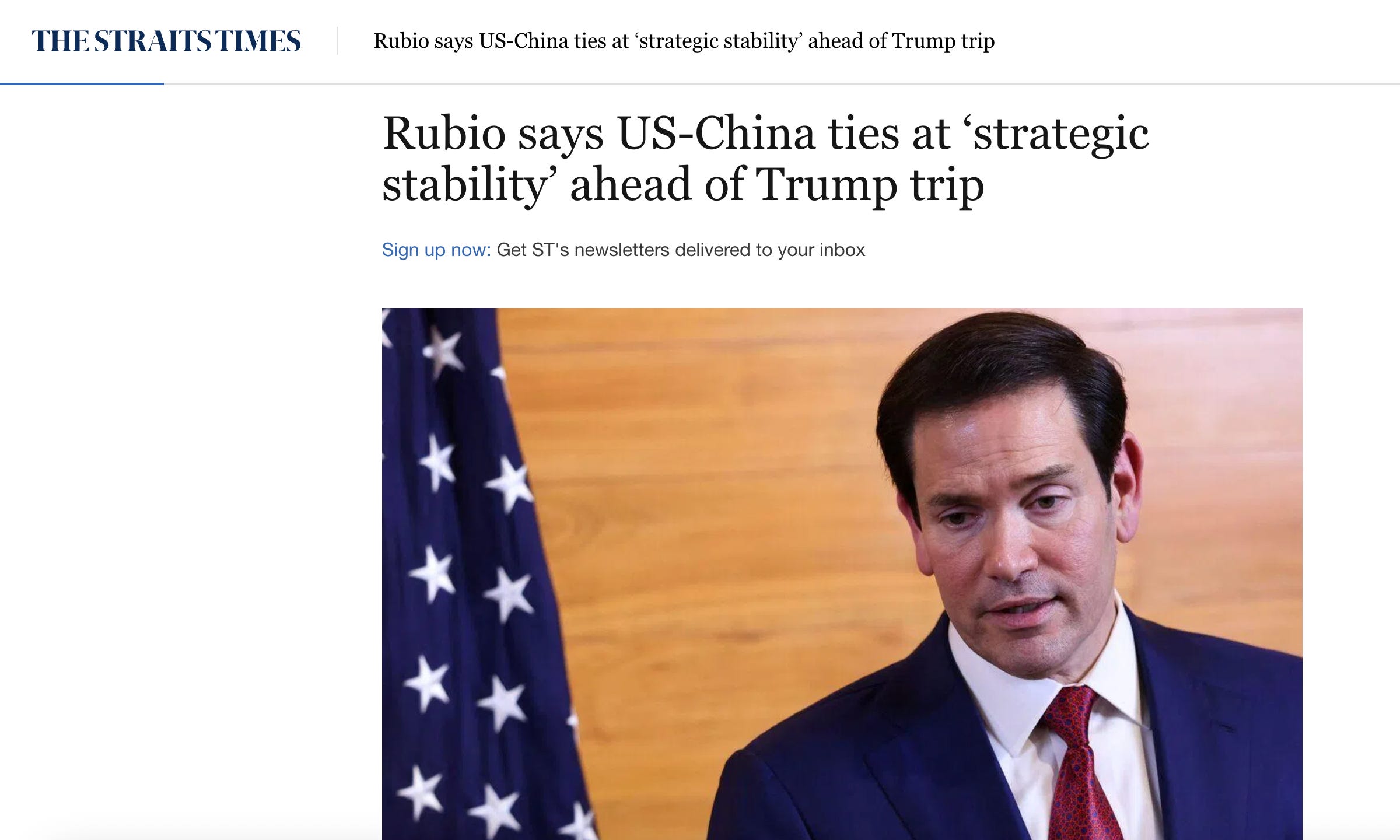
A bare reference to “strategic stability,” however, was never going to be Beijing’s preferred formulation. In Chinese ears, the phrase can easily evoke the U.S.-Soviet Cold War, especially nuclear balance and strategic rivalry. That is precisely the kind of framework China has long tried to avoid.
Beijing does not want the world, or the U.S.-China relationship, described as a new Cold War. Its preferred language emphasizes cooperation: Xi Jinping’s three principles for China-U.S. relations — mutual respect, peaceful coexistence, and win-win cooperation — include cooperation at the end. (相互尊重、和平共处、合作共赢)
That helps explain the word “constructive.”
The addition of “relationship” is also not difficult to understand. Beijing wanted not merely a description of the current atmosphere, but a formula defining the bilateral relationship itself — and, more importantly, a formula that could help guide and discipline that relationship. This fits a long-standing Chinese diplomatic habit. Earlier, Beijing tried to persuade Washington to accept “a new model of major-country relations” (新型大国关系) to describe China-U.S. ties. The word “relation(ship)” (关系)was there too. China’s descriptions of many bilateral ties also include the word “relationship.” (关系)
So yes, a phrase like ““a constructive bilateral relationship of strategic stability.” is very much within China’s diplomatic tradition.
Xi Jinping has said that building such a relationship is “not a slogan” and should mean concrete actions by both sides moving in the same direction.
“中美建设性战略稳定关系”不是一句口号,而应该是相向而行的行动。
Here is yet another complication. As I understand it, the insistence that the phrase is “not a slogan” in fact comes from the U.S. side. The exact reasoning behind that is not yet clear to me, but one plausible explanation is that U.S. officials were well aware of Beijing’s preference for broad political concepts and did not want to accept another empty slogan without practical meaning.
Then came the final American addition: “on the basis of fairness and reciprocity.”
So far, that phrase has not appeared in China’s own formulation. After all, in the Trump era, “reciprocity” is no longer understood as it appears in a dictionary. Trump’s global tariff campaign was itself justified under the language of “reciprocal” tariffs. After “Liberation Day,” the word does not sound so benign to many countries.
But the fact remains: the White House did not endorse the Chinese phrase alone. It added fairness and reciprocity. That addition reflects a very American political logic. It makes the formula conditional. It says, in effect: stability is desirable, but not at the expense of one-sided restraint, unequal obligations, or asymmetrical concessions.
This is why the “Beijing wrote the script” framing is, at minimum, incomplete.
There is a fair criticism to be made. But that is different from suggesting that the United States was unaware, careless, or manipulated into parroting a Chinese phrase.
A more plausible reading is that there was back-and-forth. Rubio began with “strategic stability.” Beijing wanted a broader, relationship-defining formula. Washington accepted a version of it, but added its own limiting language: fairness and reciprocity. Both sides then presented the result in ways that served their own political and diplomatic needs.
That is diplomacy. It may prove wise or unwise. But it is not the same as being duped.
The distinction matters. If the United States knowingly made a trade-off, then the debate should be about whether that trade-off was worthwhile — not whether China somehow slipped a phrase past the White House.
Both sides know words matter. Both sides got words they wanted. And both sides will now try to use those words to shape what comes next.