
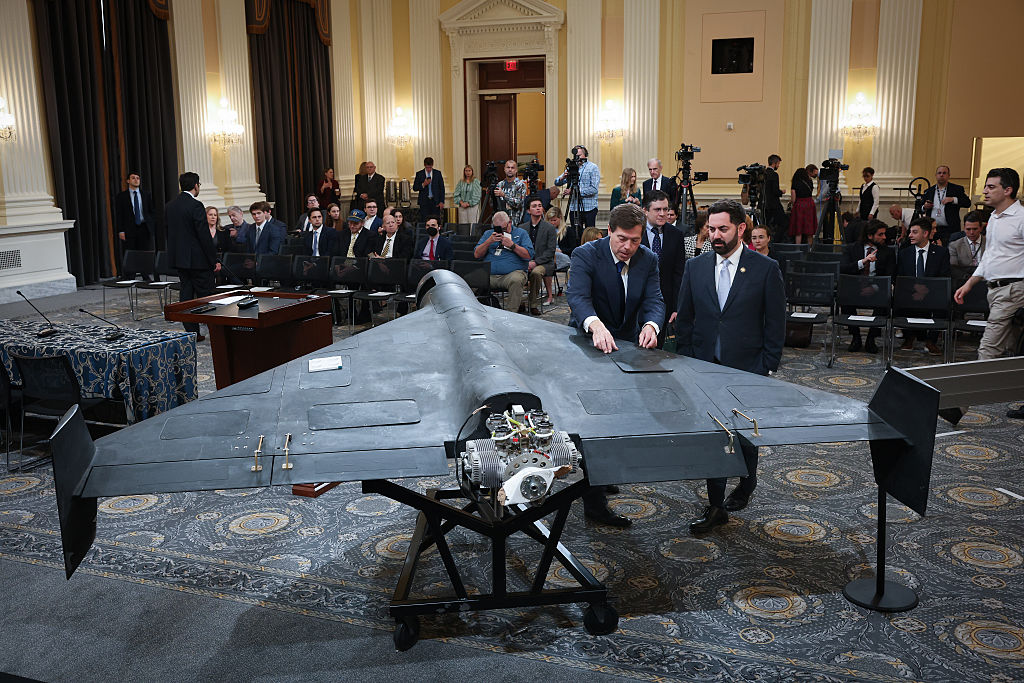
The United States sanctioned nine mainland Chinese and Hong Kong companies and individuals on Friday, accusing them of helping Iran’s military procure weapons and the raw materials needed to build its Shahed drones and ballistic missiles — in a move that risks complicating President Donald Trump’s planned visit to China next week for a long-awaited summit with President Xi Jinping.
The simultaneous announcements from the Treasury and State departments targeted what U.S. officials described as a procurement network sustaining Iran’s military-industrial base amid stalled efforts to end the war with Tehran and continued tensions around the Strait of Hormuz.
Treasury said it remained ready to take economic action against Iran’s military industrial base to prevent Tehran from reconstituting its production capacity. The department also warned it could pursue action against any foreign business backing illicit Iranian trade — including airlines — and signaled potential secondary sanctions on overseas financial institutions.
The Treasury Targets: Drones, Missiles and Front Companies
The Treasury Department’s designations named five firms and one individual. China-based Yushita Shanghai International Trade Company is accused of facilitating Iran’s purchase of weapons from China. Hitex Insulation Ningbo Company is accused of supplying millions of dollars’ worth of materials used in ballistic missile research and flight test launches. Its legal representative, Li Genping, was also sanctioned.
Hong Kong-based HK Hesin Industry Company is accused of working as an intermediary in procurements, while Mustad Limited, also based in the city, is accused of helping Iran’s Islamic Revolutionary Guard Corps to buy arms.
Among the other entities, Dubai-based Elite Energy FZCO was sanctioned for allegedly transferring millions of dollars to a Hong Kong firm to support procurement, and Belarus-based Armory Alliance LLC was designated for acting as an intermediary. Iran-based Pishgam Electronic Safeh Co was targeted for procuring drone motors.
The UK-funded Centre for Information Resilience estimates Iran has the capacity to manufacture around 10,000 drones a month, underscoring why Washington views cutting the supply chain as strategically urgent.
The State Department Targets: Satellite Imagery That Guided Iranian Missiles at U.S. Troops
The more explosive revelation came from the State Department, which sanctioned four additional entities — three of them Chinese satellite companies accused of providing imagery that directly enabled Iranian strikes against American forces in the Middle East.
Secretary of State Marco Rubio said that China’s Meentropy Technology (Hangzhou) Co., also known as MizarVision, The Earth Eye, and Chang Guang Satellite Technology Co. provided satellite imagery and data collection services detailing U.S. military activity during “Operation Epic Fury.”
The State Department was unambiguous about the stakes: “The supply of satellite imagery of U.S. facilities in the Middle East to Iran threatens American and partner personnel. The targeting of U.S. service members and partners will not go unanswered.”
Meentropy Technology published open-source images detailing U.S. military activity during Operation Epic Fury, while The Earth Eye provided satellite imagery directly to Iran. Chang Guang collected data on U.S. and allied military facilities at Tehran’s request. Chang Guang had previously been sanctioned by Washington — first in December 2023 for sales to Russia’s Wagner Group, and later for providing imagery to the Houthis to target U.S. assets in the Red Sea.
The State Department also sanctioned Iran’s Ministry of Defence Export Center, known as MINDEX — described by U.S. officials as the export arm of Iran’s sanctioned Ministry of Defense and Armed Forces Logistics.
IMAGE CAPTION (Secondary): U.S. Secretary of State Marco Rubio speaks at the State Department in Washington, D.C. On Friday, Rubio announced sanctions against three Chinese satellite companies — Meentropy Technology, The Earth Eye, and Chang Guang Satellite Technology — accusing them of providing imagery that enabled Iranian strikes on American forces. (Andrew Caballero-Reynolds/AFP via Getty Images)

Stefano RELLANDINI / POOL/AFP via Getty Images
The Timing: A Message to Beijing Before Trump Lands in China
The sanctions land at a diplomatically sensitive moment. The Treasury move comes days before U.S. President Donald Trump plans to travel to China for a meeting with President Xi Jinping, as efforts to end the war with Iran have stalled.
Washington has walked a careful line with Beijing throughout the Iran conflict — publicly pressing China to stop enabling Iran’s military while simultaneously pursuing the trade truce that has defined the early economics of Trump’s second term. The satellite imagery sanctions in particular mark a significant escalation in the language Washington is willing to use against Chinese firms, explicitly accusing them of facilitating attacks on American service members.
Brett Erickson, managing principal at Obsidian Risk Advisors, said the step targets Iran’s ability to threaten commercial shipping and regional allies. Iranian authorities closed the Strait of Hormuz on February 28 after U.S. and Israeli strikes inside Iran, sharply curbing global oil traffic and driving energy prices higher.
None of the three Chinese satellite companies provided an immediate response outside of office hours, and there was no immediate comment from Beijing officials.
The Broader Pattern: China’s Shadow Role in the Iran War
Friday’s designations are the latest in a series of U.S. actions targeting what Washington calls China’s tacit support for Iran’s war effort. China purchases roughly 95 percent of Iran’s oil exports, much of which Iran must sell at a discount due to sanctions risk — saving Beijing nearly $4 billion annually. As half of Iran’s total oil revenue is allocated toward funding its armed forces, China’s purchases are critical to funding the regime’s capacity to resist.
The commercial satellite imagery industry has emerged as a particular flashpoint. The U.S. has sought to restrict commercial satellite imagery in the Middle East during the war, as it can quickly inform military planning. Last month, the Trump administration asked providers of the technology to voluntarily withhold images of designated areas of interest, prompting Planet Labs PBC to restrict access to data from the region.
The State Department’s statement made the U.S. position explicit: “The United States will continue to take action to hold China-based entities accountable for their support to Iran and ensure Iran cannot reconstitute its proliferation-sensitive programs following Operation Epic Fury.”
Whether Trump raises the sanctions directly with Xi next week — or whether Beijing uses them as a negotiating chip — may say more about the true state of U.S.-China relations than any summit communiqué.