
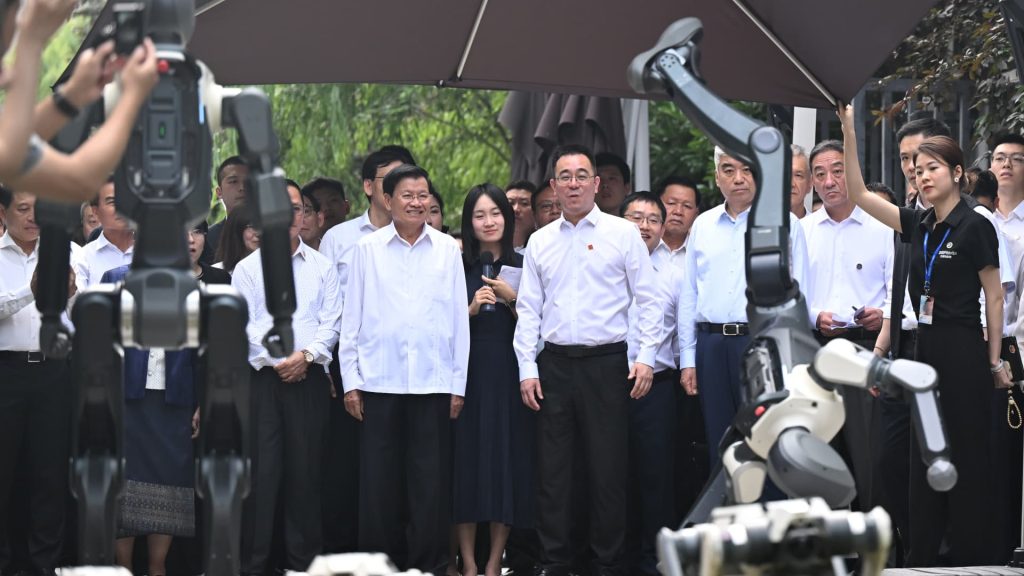
HANGZHOU, CHINA – JUNE 02: General Secretary of the Lao People’s Revolutionary Party Central Committee and Lao President Thongloun Sisoulith watches DR02 humanoid robot performance at Deep Robotics on June 2, 2026 in Hangzhou, Zhejiang Province of China.
Wang Gang | China News Service | Getty Images
The rush of capital into China’s tech start-up world hit a speed bump this month.
Within hours of each other last Friday, a Chinese city government ordered companies to disclose their financial ties to robot vacuum maker Dreame Technology, and China’s State Council issued sweeping rules to tighten oversight of the country’s 23 trillion yuan ($3.4 trillion) private fund industry.
The events, in quick succession, underscored Beijing’s tough balancing act in trying to rival U.S. tech dominance. While the state pours in money to support China’s tech ambitions, there are not always the guardrails and market forces to prevent widespread misallocation.
Beijing is reining in a co-investment model that local authorities have embraced in recent years to lure businesses into their regions, said Dan Wang, China director at Eurasia Group.
Local governments often “race to outspend one another” on strategic sectors, generating substantial fiscal waste and raising credit risks for the central government, Wang said.
Chinese local governments have sought to pivot from land financing — which has essentially collapsed since the housing crisis in the early 2020s — to equity finance, using state capital and government guidance funds to acquire stakes in startups and use capital gains as a new source of fiscal income.
Wall Street-linked U.S. funds that once invested in China have also largely pulled out in recent years due to geopolitical risk, leaving a gap for local Chinese yuan-denominated funds to fill.
Local officials cannot necessarily evaluate projects the way professional investors do, and tend to go all-in on one or a handful of hopefuls — leaving public finances exposed when bets sour, Wang added.
What happened
Dreame became the world’s largest robotic vacuum maker by sales in the first quarter, according to research consultancy IDC, with fast-growing footholds in Europe and the U.S. And the startup’s ambitions run far beyond floor cleaning.
Echoing the aggressive expansion of certain Chinese start-ups, since its founding in 2017, Dreame has spawned nearly a thousand affiliated enterprises, spanning electric vehicles, smartphones, humanoid robots, bubble tea and satellite networks. Founder Yu Hao claimed in January he was building an ecosystem that would “become the first $100 trillion company in human history.”
That sprawl has come under scrutiny in recent weeks. A city government in Jiangsu province, one of China’s biggest electronics manufacturing hubs, asked local companies to audit their exposure to Dreame-linked entities, including investment sizes, fiscal outlays and business operations, according to state-backed media.
Yu’s social media account on Weibo was also suspended, preventing the outspoken founder from making viral comments, according to state-linked media.
China’s state council, the Changzhou municipal government and Dreame did not respond to CNBC’s request for comments.
Much of Dreame’s expansion ran on state money. Its Sky Factory Venture Capital Fund manages 41.6 billion yuan in assets, according to state-backed media, roughly 80% of it drawn from local government industry funds in Suzhou, Xiamen and other cities. Nearly all of its 29 funds reportedly involve local state-owned capital and spread across more than 10 cities.
Reflecting the sprawl of financing layers, China’s asset management association this month also called for more disclosure when a fund invests more than 90% of its assets into a single fund.
‘Patient capital’
The structure reflects how China funds its industrial strategy.
Local authorities have been encouraged to deploy guidance funds as “patient capital” — backing startups in long-horizon, uncertain technology fields and giving them time to grow — but they inevitably invite companies to chase funding by dressing themselves up as aligned with government priorities, said Tilly Zhang, an industrial policy analyst at Gavekal Dragonomics.
While the U.S. channels support to technology companies indirectly through procurement, grants and tax breaks, Chinese governments at every level take direct equity stakes — putting public money on the hook for valuation risk, exit risk and governance exposure.
That also raises the pressure on companies to deliver, even in risky ventures — and much of the capital comes from state-linked funds drawn to tech because it’s politically expedient, not because they have the technical knowledge or investing experience to back it.
Local governments often are “not professional enough to distinguish between credible ones from opportunistic ones,” Zhang said, pointing to a case in 2021 when a loss-making semiconductor project in Wuhan cost the government around 15 billion yuan.
Research by Rhodium Group found local Chinese governments created thousands of such funds over the past decade, often producing duplicated investments and wasted capital. By the end of 2025, China had set up more than 2,100 government guidance funds with target capital of over 11 trillion yuan, according to official figures.
“Singapore has Temasek. In China, every level of government has its own Temasek,” said Bob Chen, a Shanghai-based investor in a renminbi-denominated fund, referring to Singapore’s sovereign wealth fund.
The State Council’s new guideline takes aim at that model, calling for “strict control over the establishment of new government investment funds,” and barring counties and districts from setting up new funds without approval from higher levels of government.
The rules pull oversight upward to the city and provincial level, Chen said.
‘Spray and pray’ approach
The state equity-investing model, for all its flaws, has produced wins and underpinned the rapid rise of some of China’s tech champions. Hefei province’s early stakes in EV maker Nio and chipmaker CXMT made the city a poster child for government venture investing.
We describe China’s innovation drive as ‘enormous in scale but low in productivity’ — a ‘spray and pray’ approach that produces enormous output but with a high failure rate.
Yuen Yuen Ang
Alfred Chandler Chair Professor of Political Economy
Smaller cities that missed the semiconductor and core AI waves have been hunting for the next best thing, Chen said.
“They are eager to develop good companies but not in a position to win national-strategic hard-tech projects like chips,” he said. “So they went looking in the consumer tech sub-theme. Dreame was handing them exactly what they wanted.”
Yuen Yuen Ang, a professor of political economy at Johns Hopkins University, described China’s innovation drive as a “spray and pray” approach that produces enormous output but with a high failure rate,” and judged less by efficiency than by whether it produces a few real champions.
The Dreame episode fits “a recurring phase in a familiar policy cycle: mobilize toward a national priority, tolerate significant gaming of targets and waste, then course correct,” she said.
As Beijing tightens its grip, lower-tier governments will feel the squeeze first.
If equity investment is curtailed at the county level, “there won’t be many other levers left for local governments to drive investment,” Chen said.