
DNA as a blueprint and construction material
From fighting infections to digesting food, proteins carry out nearly every essential task inside living cells. To understand how these molecular machines work—and design drugs to target them—scientists need to determine their three-dimensional structures.
X-ray crystallography is the gold standard for revealing these structures. In this technique, scientists first coax billions of identical proteins to assemble into a crystal. Then, they shine X-rays through the crystal and analyze the resulting diffraction patterns to reconstruct the protein’s atomic structure. But persuading proteins to form suitable crystals is often one of the most difficult and unpredictable steps in the process.
To improve this unreliable step, Mirkin turned to flexible snippets of single-stranded DNA. In a 1996 study published in Nature, Mirkin and his team used complementary DNA strands to assemble gold nanoparticles into ordered structures. Since then, his lab and many others have used DNA as a programmable bonding element to organize nanoparticles, polymers and other nanoscale building blocks into ordered structures.
“Over 30 years ago, the Mirkin group proposed the idea to take nanoparticles and modify them with DNA to create programmable atom equivalents,” Han said. “Nature’s nanoparticles are proteins. The difference between synthetic nanoparticles and proteins is that proteins are naturally uniform and molecularly precise. So, if we modify proteins with DNA and assemble them, we can form high-quality, atomically precise crystals, overcoming a decades-old challenge in the field of DNA-programmable assembly.”
How DNA pulls proteins together
Normally, proteins crystallize because parts of their surfaces happen to stick together through multiple, weak chemical interactions. By contrast, Mirkin’s team exploited DNA’s natural tendency to seek out its perfect match. Each DNA strand is made up of four chemical “letters”—A, T, C, and G—that pair in predictable ways. For example, A always pairs with T, and C always pairs with G. When two complementary DNA strands encounter one another, they spontaneously snap together to form the familiar double helix.
In many ways, DNA bonds are more programmable than conventional chemical bonds. By changing DNA’s sequence, scientists can dictate which molecules connect and where they connect. That opens the door to building crystals with customizable architectures and mechanical properties for specific applications.
In the new study, Mirkin’s team attached short DNA strands to each protein. Then, DNA pulled neighboring proteins together, assembling them into precisely designed crystals. The team also varied key design features—such as DNA strand length and placement—to determine how each variable affected crystal formation. Finally, they used X-ray crystallography to examine the resulting crystals.
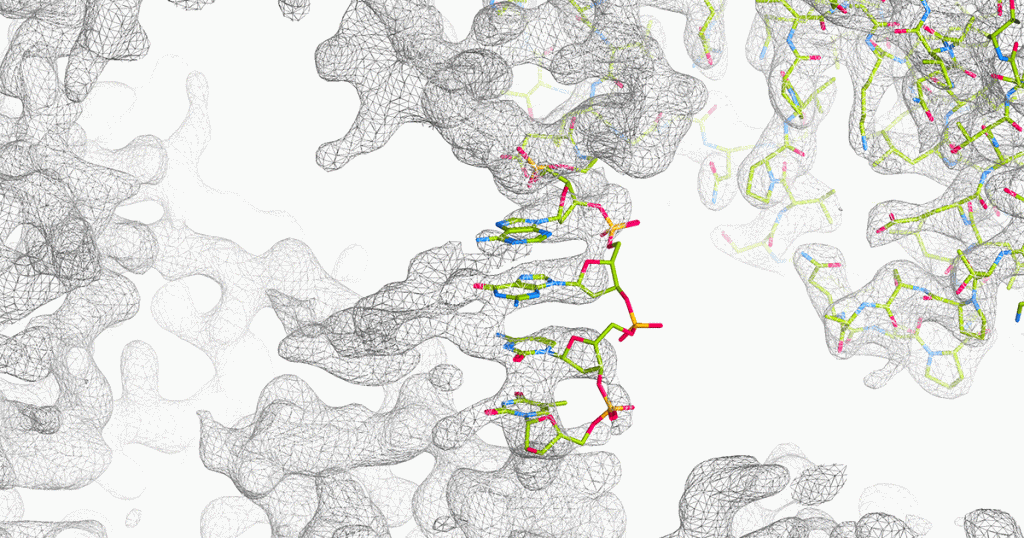
“The well-defined DNA-DNA interactions drove the assembly and crystallization process,” Han said. “As a result, the proteins not only adopted specific positions and orientations, but the atoms within each protein are also aligned in the exact same way throughout the crystal. When that happens, you can use single-crystal X-ray diffraction methods to determine their structure and see atomic-level details within the protein.”
Putting the method to the test
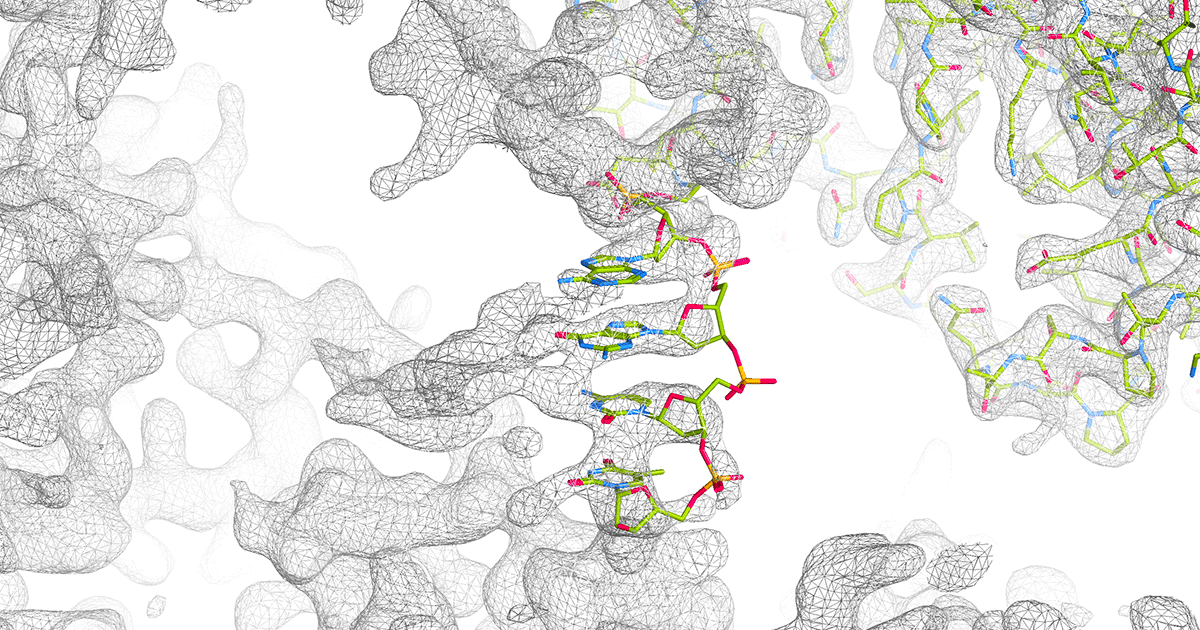
To further validate the approach, the team grew more than 1,000 protein crystals and determined the atomic structures of 28 distinct protein-DNA designs. Despite systematically changing DNA length and position, the resulting crystals consistently assembled into the designed architectures. That reproducibility, together with the direct visualization of DNA double helices linking neighboring proteins within the crystals, gave the researchers confidence that DNA—not chance—directed the assembly.
“These numbers show that we didn’t just get lucky,” Mirkin said. “We systematically demonstrated this approach across literally hundreds of possibilities and showed over and over again that it’s a reliable method. The DNA bond is a fundamentally new class of chemical bond, and this work shows how it can be used in ways that conventional chemical bonds cannot—to create a new type of material that yields new fundamental knowledge as well as technological breakthroughs that could significantly benefit society.”