
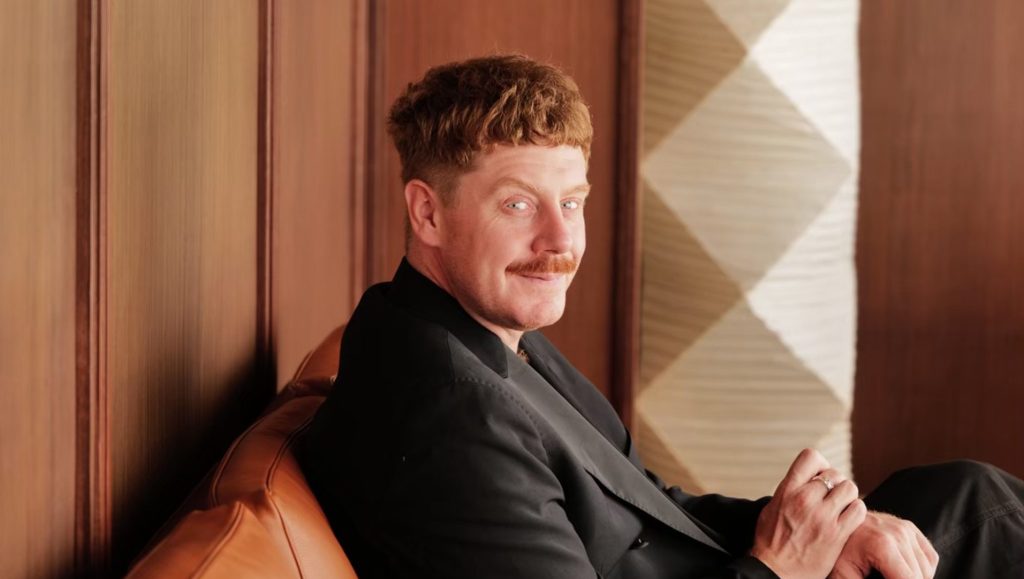
Röda Huset’s founder Hampus Thunholm is starting over in Bangkok, where he’s shaping the drinks programme at a high-volume rooftop venue called The Norm.

Not many people would be quick to leave a venue that ranks 35th on The World’s 50 Best Bars list, and neither was Hampus Thunholm. As co-owner and founder, Thunholm opened Röda Huset in 2021, and after half a decade spent establishing the bar as one of the world’s best, he was ready for a change.
“I was done with Stockholm,” he says. “I really didn’t want to live there, and if I was going to move from Scandinavia, I wanted something different. I wanted a big, big change.” He also had an eye on where the industry was heading. “If you look at the trends, a lot of things are going to happen in Asia in the next couple of years. I felt like I wanted to be a part of that.”
Looking to Asia took him to Bangkok – specifically, to The Norm, a rooftop venue operated by the Sugarray Group. He oversees food and beverage across the operation, which is a serious scale-up from Röda Huset, which had 18 seats. At The Norm, a busy Friday night means upwards of 600 guests and 1,500 drinks served.
“The Norm is the opposite of everything I’ve done for the past couple of years. It’s huge and high volume,” he says. “I saw it as a huge challenge, but also a great opportunity to get into the cocktail scene here.”
Sugarray Group has plans for further openings, but Thunholm’s focus is on The Norm for now. He’s currently planning four new menus for the bar, which are weeks away from launch.

From Stockholm to Bangkok
The assumption that Bangkok would offer easy access to exceptional produce has not proven straightforward. Thunholm explains: “People say: ‘Oh my god, you’re gonna have the best products in the world.’ That is true, but to get the best pineapple, the best mango, herbs, you really need to do lots and lots of research.”
The volume of produce moving through the city’s markets makes consistency difficult unless you have established relationships with quality suppliers. “You need to know who to talk to,” he says, adding that The Norm’s scale means he’s now looking for a high volume of produce. His research has included travelling across the country and attending multiple cooking classes a week to get to grips with the flavour profiles, which has helped him to secure five farms he’ll work with directly.
“If you want to have really high-quality stuff, you need to be at the market at 5am, picking out the best things,” he says. “I haven’t found another way. I was struggling for the first month – more or less nothing tasted as I wanted.”
It’s a completely different kettle of fish to working in Scandinavia, where tighter supply chain controls mean the baseline quality of produce is more consistent. “In one way, it’s much easier to get products in Stockholm because the control is much higher from the start,” he says. “But it’s impossible to get a better mango because they are not from there. Nothing can beat the freshness.”
Shifting from Scandinavian to Thai flavour logic has changed how Thunholm plans drinks, but not his palate. “Here, it’s more like flavour on flavour. If you look at the food, it’s lots of chilli, a lot of sugar, a lot of lime – loads of flavours combined. If you look at Scandinavian cuisine, it’s more about pureness. If I serve you a tomato, it’s gonna taste like a tomato. But here they want something more.”
While the approach and produce might be very different to what he applied at Röda Huset, he’s leaning on long-favoured techniques like fermentation and preservation, but now framed around Thai ingredients and flavour expectations. “I don’t think that I can come here and say: ‘This is a super Thai menu’, because I’m not Thai,” he admits. “I want to work with Thai flavours and hopefully present them in a new way. Flavours they recognise, but maybe in combos they haven’t thought about before.”

Paying respect to Thai flavours and culture matters to the team at The Norm. “They’re proud of serving things from Thailand,” he says. “I can really feel it when I present new drinks to the whole team. If I do something and they see where I got the idea from, but it’s presented in another way, you can see in their eyes that they’re proud.”
The venue’s size is also shaping what the drinks programme can be in practice. “Omakase cocktails need explanation; they need that kind of environment,” he says, recalling the 18 seats at Röda Huset. “A lot of the drinks we served there would not work in a more or less nightclub venue. It needs to be understandable in a different way – quick, and without taking away the only important thing, which is to serve tasty cocktails.”
Thunholm sold his stake in Röda Huset before relocating. The team there remain some of his closest friends and are keeping up his philosophy, which he believes is well-suited to the current moment in mixology. “They can change the cocktails and the way of serving,” he says. “I think it was time for Röda Huset to do that. I’m happy, they are happy – it’s good.”
His ambitions for The Norm are straightforward. “I really want to put down a high-volume rooftop bar on the cocktail scene in Bangkok,” he says. “I think it needs it, because they don’t have so many good rooftop bars if you look at quality cocktails. I really feel that if we do The Norm right, it will be a very cool venue – a little bit of a landmark for Bangkok.”
For more on Bangkok’s cocktail scene, check out the upcoming June issue of The Spirits Business.
Related news
Abstract Ice brings customisable craft ice to on-trade