
“Greeting to you on this, which will be one of the most important day in our history.”
– The first radiotelegraph message sent by King Vajiravudh (Rama VI)
It’s an odd name for a street, especially in Thailand. It’s called Wireless Road, or as the locals know it, “Witthayu Road”, and it sits along the length of Lumphini Park in Pathum Wan district.
The street name took inspiration from the Saladaeng Radiotelegraph Station, which was Thailand’s first wireless communication hub in 1913. Over a century ago, the area was a rice paddy field, which was a perfect spot for a radio telegraph station with its 60m radio mast, as the open area ensured any sending or receiving of radio waves was unobstructed.
King Vajiravudh (Rama VI), the reigning monarch at the time, saw the radiotelegraph station as a symbol for his country’s technological progress. In 1914, the king marked the inauguration of Thailand’s first wireless telegraphy with a message. It was a greeting and a declaration of the occasion’s importance.
Sadly, it was the rapid technological advancement that sent the Saladaeng Radiotelegraph Station into obsolescence. The area was repurposed for other uses, including serving as a base for the Old Cadet Academy and as the Suan Lum Night Bazaar, which closed in 2011. Grass grew wild. Only the radio mast remains, like a stubborn reminder of its past.
Construction for One Bangkok started in 2018. It was an ambitious project meant to position One Bangkok as an integrated district, the beating heart of Bangkok; an intersection of commerce, culture and hospitality.
Before the ground-breaking ceremony, a team of surveyors and an archaeologist discovered something beneath the ground. A “stone foundation of a century-old building”, remnants of the original Saladaeng
Radiotelegraph Station.
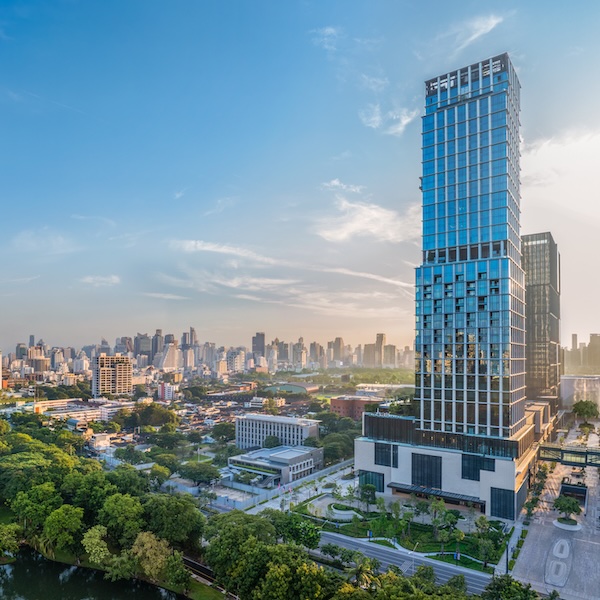
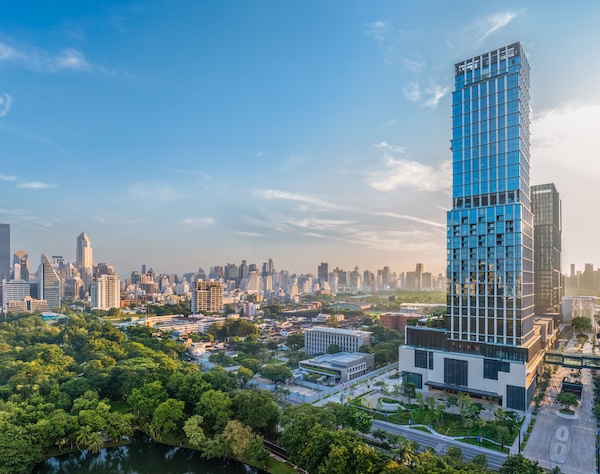
It is 2025, and one of the first seeds of One Bangkok’s construction has borne fruit: the Ritz-Carlton Bangkok. One of three luxury hotels in One Bangkok, the Ritz-Carlton Bangkok stands like a sentinel, a defiant digit. Its mirrored exterior extenuates the building’s modern sensibilities with ascending open-air terraces. The look of the hotel is designed by Skidmore, Owings & Merrill and A49. While contemporary on the outside, step within and you’re confronted with Thai grandeur, courtesy of Pia Interior.
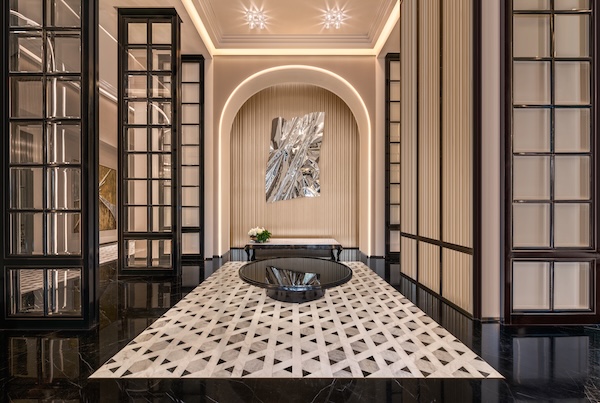
You felt your breath catch in your throat as you enter the lobby. High ceilings, an intricate floral centrepiece, hanging art, for a first impression, immediately, your expectations are met or surpassed.
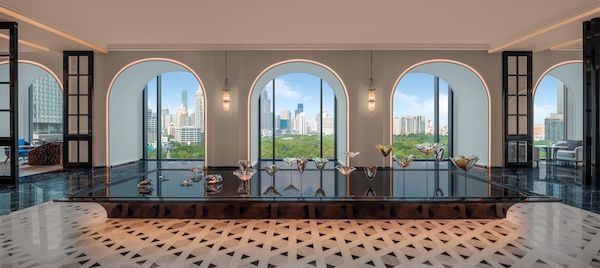
When the elevator opens to the lobby on the 8th floor, you’re greeted by two sights: one is a lily pond, where a glass sculpture (Re/Leaf:2024 by Thai artist Nathakorn Kanitvaranum) is affixed above a body of water. These glasswork flowers are inspired by water lilies, which symbolise peace. You will see the mark of peace throughout the hotel.
If you can tear your eyes away from the sculptural marvel, you’ll notice the sweeping view of Lumphini Park. You can either choose to sit in the alcoves by the windows or lounge at the cocktail bar, Caleō, for a tipple. Or do both, as there’s nothing like getting a little sloshed when you’re presented with such a view.
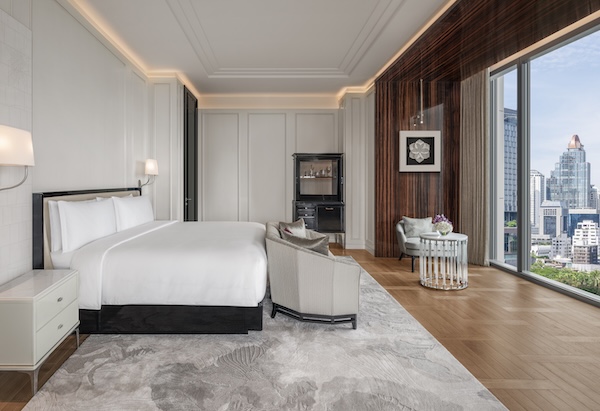
Upstairs, the rooms and suites start from a 50m² Deluxe Room to a generous 102m² Gardenia Suite. If you’re afforded the 127m² Marigold and Amaranth Suites, your bedroom will overlook Lumphini Park. (Hell, even the bathtubs of those suites look out into Lumphini Park.) Imagine waking up to the soft whir of the automatic blinds and curtains rising like you’re at an IMAX screening—what do you know, you’re slowly roused by real life. (Or maybe, you’ll return to slumber under the generous thread count, you do you).
Regardless of room sizing, you will never lose sight of the understated luxury. That pleasing water pressure? Courtesy of Kohler. Bath products that leave your skin redolent? Those came from Dyptique. That feeling of being dried off by a cloud? Would you believe those are Frette linen towels?
(There’s the 389m² penthouse which caps the building. It’s the apex of what the Ritz-Carlton Bangkok offers. And no, we didn’t get to stay in that.)
Not looking to venture out for that foot and body massage, like every other hotel, the Ritz-Carlton Bangkok has wellness covered. It’s a hushed retreat at the hotel’s spa, with five treatment rooms, a couple’s suite and a cocoon-like relaxation pod. Therapies blend traditional Thai techniques with contemporary wellness treatments. Outside, patrons can also laze by the pools at the garden terrace. And if you have kids, the hotel has the Ritz Kids Club, where your little ones can be kept occupied with activities while you can indulge in your own “me-time”, without the guilt.
Morning begins at Lily’s (the flower motif strikes again), the all-day dining restaurant, or at the Club Lounge on the 23rd for guests residing in Club-level rooms and suites. We urge you to try the Thai Tea Waffle (again, in the shape of a flower, thanks to a customised waffle maker) or a miniature croissant filled with Thai tea cream.
Helmed by David Toutain, Duet presents a tasting menu that explores the relationship between food and nature. Each course arrives with a card illustrated with botanical drawings and detailing the origins and philosophy behind the dish. What we like about Duet is the non-alcoholic pairing. Each botanical-infused and fermented-extracted zero-proof drinks mirror the complexity of the menu.
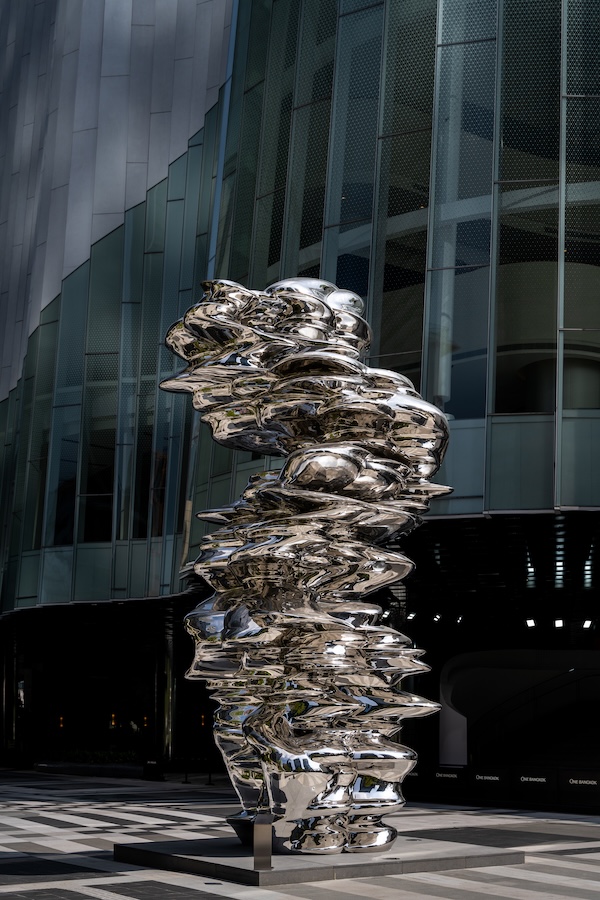
Okay, so at some point, cabin fever may set in. Go beyond the threshold of the Ritz-Carlton and traipse the grounds (or undergrounds) of One Bangkok. As above, so below; you’ll notice the artworks strewn around the district. The Art Loop of One Bangkok is a balm in city living. In the midst of glass and steel, the curated diverse artworks are a salve for the soul.
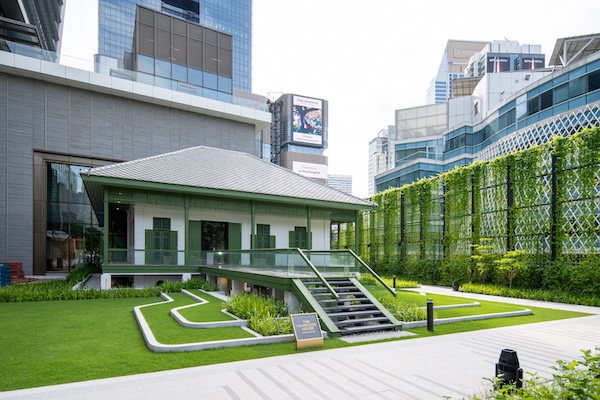
At some point of your stay, you’ll need to head to The Wireless House, located where the original Saladaeng Radiotelegraph Station once stood. Reconstructed from archival photographs of the radiotelegraph station, the Wireless House was built as a way to bridge the past and the present.
The structure sits above the stone foundations of the radiotelegraph station. Within, you hear the syncopated heartbeat of Morse code played out as relics from the past—broken porcelain; excised documents; a piece of disused equipment; a gambling tile—these Wall of Artefacts are pinned behind a glass panel, like a butterfly preserved.
The Wireless House is free to the public.
King Vajiravudh (Rama VI)’s radiotelegraphic message was a proclamation for Thailand to be a gateway for a new era of travel and exploration. He might not have seen it then, although he already knew that something great would take the place of the radiotelegraph station. A monument that sends a signal to the rest of the world.
From the dots and dashes sent through the wire, it reverberates through time. It’s faint, but you can still hear it. Listen, it’s a welcome.
“Greetings…”