
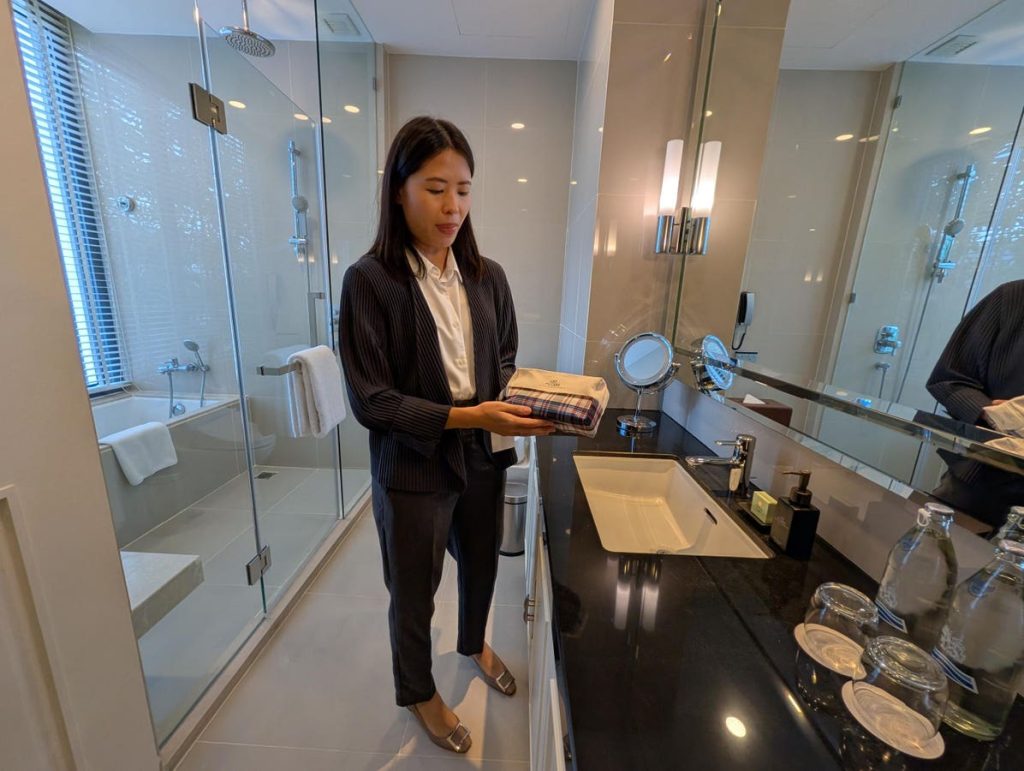
Nida Wongphanlert inspects an amenity bag made from recycled materials at 137 Pillars Suites & Residences.
Aren Elliott
Nida Wongphanlert is sitting in the rooftop lounge of the 137 Pillars Suites & Residences in Bangkok, high above one of the most frenetic cities on Earth. Behind her, the skyline stretches toward the horizon, a jumble of condo towers and cranes shimmering in the afternoon humidity.
But Wongphanlert, the hotel’s managing director, isn’t thinking about the view. She’s thinking about flowers.
Her hotel has just launched a Bangkok wellness tourism program that may represent the next frontier of travel: a workshop designed to improve guests’ mental health. An outside team of professionals leads visitors through a two-hour flower arranging session.
“They use psychology techniques to lead the workshop and let guests express what they feel inside,” says Wongphanlert.
Guests can book sessions as a small-group or private session. And the hotel isn’t stopping with its customers. It’s rolling out empathic listening workshops for its own leadership team. Wongphanlert says the mental health of her staff matters as much as that of the people they serve.
The timing is deliberate. Wellness, she says, isn’t just physical anymore.
“The newer generation is a lot more aware of mental well-being,” she says. “It’s not just about taking care of it. It’s about being proactive.”
If that sounds like a niche offering, consider where it’s happening. Bangkok, the most visited city in the world, has become one of the planet’s most ambitious wellness laboratories, for better or worse. And the experiments go far beyond the Thai massage that built the country’s reputation.
The rise of medical wellness and sleep therapy in Bangkok
A generation ago, wellness in Bangkok meant a $10 massage and maybe a steam room. Today, the city’s hotels offer sound healing, Reiki, and sleep programs engineered to defeat the brutal 11-hour jet lag from the U.S. East Coast.
For example, Rosewood Bangkok treats sleep itself as the headline wellness tourism amenity through its Alchemy of Sleep program. At The Siam, a riverside resort, guests can receive a traditional sak yant tattoo from a Buddhist practitioner as part of its spiritual wellness offerings. Aman Nai Lert Bangkok offers private Muay Thai training, cold plunges and hydrotherapy alongside a partnership with Hertitude Clinic, a medical wellness center offering health assessments and longevity programs.
The medical side of the equation is growing fastest. The St. Regis Bangkok converted its spa into a longevity hub, complete with a cryotherapy chamber and IV drips. Properties such as RAKxa Integrative Wellness and the Mövenpick wellness resort are combining hospital-grade diagnostics with five-star hospitality.
“The hospital business wants to get into the hotel business,” says Wongphanlert. “And the hotel business wants to get into the medical business. There are now a lot of things in between.”
Thailand’s wellness economy grew to $42.7 billion in 2024, according to the Global Wellness Institute, and the country’s wellness tourism spending surged 36 percent between 2023 and 2024, roughly three times the global average, bringing that market to $14 billion. Thailand now ranks 15th in the world for wellness tourism.
What is driving Thailand’s wellness tourism boom?
Sirikant Sittihai, director of spa and wellness at Capella Bangkok, says guests have fundamentally changed what they want from a hotel in Bangkok.
“Wellness is no longer viewed as an occasional indulgence, but rather as an essential part of everyday living and travel,” she says. “Travelers are prioritizing longevity, stress management, sleep quality, mindfulness and preventive wellness.”
Some of it is pop culture. Ari Lightman, a professor of digital media and marketing at Carnegie Mellon University’s Heinz College, points to the third season of “The White Lotus,” which popularized Thai wellness culture.
There’s a darker driver, too.
“Depending on how you measure it, we are all generally less healthy than we were 25 years ago,” Lightman says, citing rising rates of diabetes, hypertension and mental health issues.
A wellness vacation can feel like an escape hatch from an overstretched health care system.
The clients have noticed. Daria Guristrimba, CEO of Globe7, a travel advisor serving ultra-wealthy clients, says her customers arrive in major hubs more jet-lagged and stressed than ever, which shifts their priorities “from simple relaxation to deep, immediate recovery.”
She says one pre-wedding group recently spent a week in Bangkok meditating and doing sound therapy, she says, “with the intention of entering marriage with a higher consciousness and mental clarity.”
Carolita Urrestarazu, head of business development at the luxury travel design firm NUBA, says the result is a city where travelers can choose between traditional spa stays, recovery-focused programs, mindfulness retreats and medically integrated wellness journeys, “all within a single destination.”
Are luxury mental health and longevity treatments worth the cost?
Alexander Debelov, a longevity-focused traveler who has visited numerous wellness clinics around Bangkok, warns that some of the newest and most innovative spas in Bangkok are also among the most expensive. The treatments they offer, meanwhile, are fairly standard—although some, notably the Life Longevity & Biohacking Hub at the St. Regis, are standouts for combining medical and spa treatments.
Sometimes, the treatments are cutting-edge and worth the extra price. But most of the time, he adds, “the markup is hard to justify.”
That’s the issue with Bangkok’s wellness boom. There’s a market for it, but consumers have to be careful about their booking choices and clear-eyed about the results they expect. Some of these treatments are scientifically unproven.
The hotels that win, Debelov predicts, will be the ones that offer fair prices or something the standalone clinics can’t.
Which brings us back to the flowers. A two-hour arranging session led by a psychologist isn’t something you can get at a walk-in clinic on Sukhumvit. It’s quiet and personal—and leaves you with something you made yourself.
Wongphanlert says the trick is finding the right treatment to match to a guest.
“For example, sound healing doesn’t work for everyone,” she says. “That’s why there are so many different techniques nowadays.”
But she’s betting that in a city this loud, this hot and this relentless, a moment of stillness with a handful of stems might be the most healing treatment of all.