
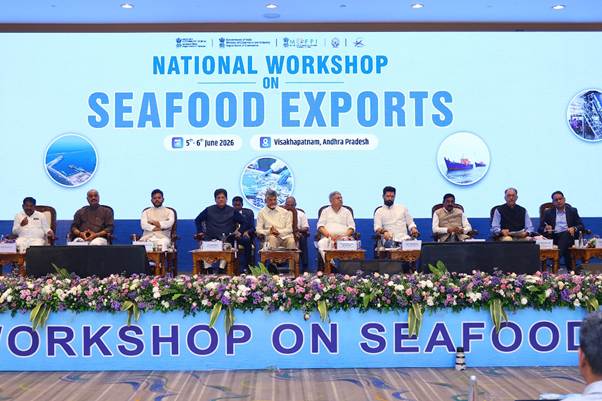
NEW DELHI : The Department of Commerce, Ministry of Commerce & Industry, in collaboration with the Department of Fisheries and the Ministry of Food Processing Industries (MoFPI), organised a two-day National Workshop on Seafood Exports in Visakhapatnam on 5–6 June 2026. The workshop served as a platform for deliberations on enhancing India’s seafood exports through value addition, sustainability, improved market access, innovation and infrastructure development.
The workshop was attended by Chief Minister of Andhra Pradesh Shri N. Chandrababu Naidu; Union Minister of Commerce & Industry Shri Piyush Goyal; Union Minister of Fisheries, Animal Husbandry & Dairying and Panchayati Raj Shri Rajiv Ranjan Singh; Union Minister of Civil Aviation Shri Kinjarapu Rammohan Naidu; and Union Minister of Food Processing Industries Shri Chirag Paswan.
Addressing the inaugural session, Shri Piyush Goyal highlighted the Government’s whole-of-government approach towards promoting seafood exports and noted that India’s marine products exports have increased by nearly 70 per cent in value terms over the last decade. He stated that India currently accounts for around 4 per cent of global seafood trade and called upon stakeholders to work collectively towards achieving seafood exports of USD 30 billion within the next five years through value addition, branding, quality enhancement, sustainability and diversification of export markets.
The Minister emphasised the need to increase the share of value-added seafood products, including ready-to-eat and ready-to-cook offerings, and encouraged exporters to leverage market access opportunities arising from India’s recently concluded Free Trade Agreements covering 38 countries. He reiterated the Government’s vision of establishing India as a globally trusted source of high-quality and sustainable seafood products.
Shri N. Chandrababu Naidu highlighted Andhra Pradesh’s leadership in fisheries and aquaculture and its significant contribution to India’s seafood exports. He reaffirmed the State Government’s commitment to making Andhra Pradesh a global hub for sustainable aquaculture and seafood exports through innovation, infrastructure development, branding and stakeholder collaboration.
Shri Rajiv Ranjan Singh highlighted the remarkable growth of India’s fisheries sector, with fish production increasing from 95.8 lakh tonnes in 2012-13 to nearly 198 lakh tonnes in 2024-25. He noted that despite global challenges, India’s seafood exports reached approximately ₹73,890 crore (USD 8.46 billion), with frozen shrimp continuing to be the country’s leading seafood export item. He highlighted the Government’s efforts under PMMSY and PMKSSY 2.0 to strengthen export-oriented fisheries infrastructure, traceability, value addition and sustainable aquaculture.
Shri Kinjarapu Rammohan Naidu underscored the importance of efficient logistics and air cargo infrastructure in supporting high-value seafood exports. He highlighted ongoing efforts to strengthen cargo infrastructure, improve multimodal connectivity and streamline cargo movement to enhance India’s export competitiveness.
Shri Chirag Paswan emphasised the immense potential for value addition in the seafood sector and called for greater focus on processing, branding, technology adoption and market diversification. He stressed the need to move from “volume to value” and “produce to product” while strengthening India’s position as a trusted global supplier of food products.
Secretary, Department of Fisheries, Dr. Abhilaksh Likhi highlighted the importance of coordinated efforts among stakeholders to strengthen India’s seafood export ecosystem. He underlined the role of infrastructure development, certification, innovation, value addition and market access in enhancing the sector’s global competitiveness.
The event brought together senior officials from the Central Government, States and Union Territories, representatives of key institutions including MPEDA, EIC, NFDB, NABARD, NCDC, NCEL and SFAC, as well as seafood exporters, processors, industry associations, startups, researchers, aquaculture farmers and other stakeholders from across the seafood value chain.
The event also witnessed the distribution of benefits to eligible beneficiaries under the Pradhan Mantri Matsya Kisan Samridhi Sah-Yojana (PMKSSY), Kisan Credit Card (KCC) and other Government schemes.
During the interactive session, stakeholders discussed key challenges across the fisheries value chain, including disease management, rising input costs, fishmeal availability, access to quality seed and broodstock, quarantine infrastructure, logistics, cold chain development, certification requirements, traceability and sustainability standards. Participants also highlighted the need to promote value addition, diversify export markets, support startups and MSMEs, and encourage sustainable fisheries practices.
The second day of the workshop featured a series of technical sessions on traceability systems, sustainable certification, value addition, export promotion, deep-sea fisheries, diversification of export opportunities and the potential for a Production Linked Incentive (PLI) framework for the seafood sector. Experts and stakeholders deliberated on strengthening compliance with international standards, enhancing processing and cold-chain infrastructure, promoting innovation, supporting startups and MSMEs, and improving market access for Indian seafood products.
Discussions also focused on harnessing the untapped potential of high-value deep-sea resources within India’s Exclusive Economic Zone, particularly in the Andaman & Nicobar Islands and Lakshadweep, as well as emerging sectors such as seaweed, ornamental fisheries, cold-water fisheries and trout farming.
The workshop concluded with a shared commitment among stakeholders to strengthen sustainability, traceability, value addition, export infrastructure and market access while fostering innovation, entrepreneurship and diversification across the seafood sector. The recommendations emerging from the deliberations are expected to contribute to a comprehensive roadmap for enhancing India’s global competitiveness in seafood exports and advancing the vision of Viksit Bharat 2047.