
GEORGE TOWN – When Malaysia hosted the Samsung-backed Counter-Strike 2 Championship in December to find the region’s best e-sports team in the popular video game, organiser Orange Esports bought 20 top-end gaming computers to ensure peak performance.
However, with the prices of computers soaring amid a global memory chip shortage, upkeeping these computers would have been too costly. The company has also had to shelve plans to upgrade its internet cafes until 2027 or beyond.
The last “bullet” had barely been fired at the multi-player, first-person shooter tournament when all 20 units were put on sale.
A global memory chip shortage has worsened since 2024 as producers pivot to feed the voracious – and more lucrative – appetite for artificial intelligence that has seen data centres mushroom worldwide.
In Malaysia, the cost of some forms of consumer-grade random access memory (RAM) and other storage devices has more than doubled in 2026 from a year earlier, driving computer and smartphone prices up by as much as 50 per cent.
Tech enthusiasts have dubbed the global memory chip shortage the “RAMpocalypse” or “RAMageddon”.
Despite the pain for consumers, the AI-driven memory boom has been a windfall for Malaysia’s semiconductor industry. Exports of integrated circuits – the chips used in electronics – rose more than 24 per cent in 2025 to RM389 billion (S$125 billion).
Malaysia Semiconductor Industry Association president Wong Siew Hai told ST in April that demand for high-bandwidth memory (HBM), a cutting-edge chip used in AI systems, is so strong that new orders may not be fulfilled until 2028 unless more capacity comes online.
“We don’t see this going away, there is nothing on the horizon that tells us this will end,” he added.
The lion’s share of the semiconductor sector in Malaysia serves back-end operations like packaging and testing, giving the country an estimated one-eighth share of the global semiconductor supply chain. Most of these players are based in Penang – the so-called Silicon Valley of the East. Together, they account for over 60 per cent of Malaysia’s electrical and electronics (E&E) exports.
E&E products include computers, telecommunications equipment and optical fibre components. In 2025, exports from the sector rose by 18 per cent, compared against the 6.5 per cent for Malaysia’s total.
The RM712 billion of E&E exports accounted for nearly half of the RM1.6 trillion in outgoing trade. Integrated circuits made up a quarter of exports, making them the biggest contributor.
Growth accelerated further in the first quarter of 2026, up 26.7 per cent year on year versus 12.7 per cent for overall exports.
UWC deputy chief executive Matin Ng told ST that order books have swelled from below RM150 million in 2024 to RM180 million the following year. Demand continues to climb, with orders reaching RM250 million as at mid-2026 thanks to the AI boom.
“Anything to do with AI is doing very well now and memory is a big part of that. The forecast numbers our customers are sharing show massive jumps to the point where we are offloading manufacturing to our local suppliers,” he said.
Even rapid expansion has not been enough. UWC has had to train and support smaller suppliers in Penang to help meet rising demand, while also expanding into northern Perak state and neighbouring Thailand. The Malaysian firm, an integrated engineering support services provider that primarily serves the semiconductor, life sciences and medical device industries, listed on the country’s stock exchange in mid-2019.
UWC is not alone. Many firms in Penang’s industrial parks have poured in cash – and taken on debt – to boost capacity since 2018.
The expansion began during US President Donald Trump’s first-term trade tensions with China, which prompted companies to diversify supply chains away from the country, benefiting electronics hubs such as Penang. His second term, which began in 2025, has seen higher tariffs and other trade barriers, but so far, semiconductors appear exempt.
These were not the only “black swan” events that benefited Malaysia’s chip sector. The global pandemic provided another boost: Covid-19 lockdowns saw demand for consumer electronics soar from 2020 to 2022 as remote work drove demand for electronics.
“You know the way Penang people do business? Very conservative and always net cash. Now I’m in negative cash because my order books have been picking up strongly but we are still looking into more expansion,” said UWC’s Dr Ng.

Malaysia’s chip sector, particularly Penang, is leveraging a foundation built during the Covid-19 pandemic and Mr Trump’s first presidency to bank on new AI-driven memory demand.
According to InvestPenang, the state’s investment promotion agency, the spikes in demand due to “Trump 1.0” and Covid-19 pushed “many companies to reform and reconfigure their supply chains and capacity”.
“These players have already done their expansion and reconfiguration in the last five to seven years,” InvestPenang chief executive Loo Lee Lian told ST in April.
The global memory market is dominated by a handful of players, several of which have a significant presence in Penang.
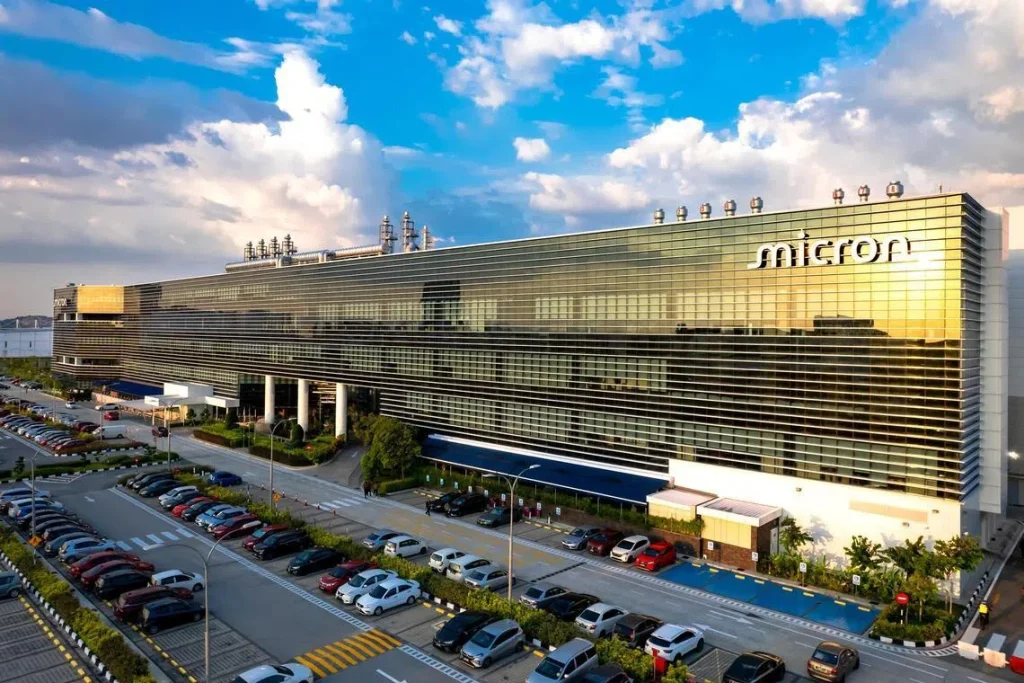
Western Digital, one of the world’s largest hard-drive makers alongside Seagate, has been in Malaysia since 1973 and along with its former subsidiary Sandisk arrived in Penang over a decade ago. Meanwhile, Micron, one of the “big three” memory makers along with Samsung and SK Hynix, has expanded aggressively in Penang since 2018, with a footprint of over 145,000 sq m.
Micron was reported in 2025 to have built up a local supplier network by spending over RM2 billion in five years on more than 700 vendors.
Rapid growth has forced the Penang authorities to be more selective about incoming investments because of limited land and labour availability.
According to Datuk Loo, these major players have also brought their supply chains with them, deepening the ecosystem in Penang to the point where the authorities have to be “careful with what to bring in” to optimise land use.
“If I have a project that says I want 100 acres of land and 20,000 direct labour – we have to be very careful with that. One of our big criteria is automation to reduce manpower requirements,” she said.
This reflects strong demand in the chip sector, which also benefits firms outside Penang. Assembly and test services provider Unisem, which has expanded beyond its Perak base to China, has grown its AI and data-centre business from a single-digit share of sales before 2024 to nearly one-fifth today.
Some facilities are running close to full capacity. But the company has room to expand: clean rooms at its new Gopeng site are ready for equipment, and additional land is available for another plant.
“Right in the middle of Covid, we expanded because our existing plant was congested,” Unisem chief operating officer Kevin Khoo told ST, referring to the Gopeng site that was ready at the end of 2023.
The pandemic spurred firms like Unisem to expand capacity, leaving them better positioned for the current surge in AI-driven demand.
“The lesson from Covid-19 is that if I had contingency for space, I would have captured market share. Subsequently, everyone was expanding. In Penang, they ran out of piling cranes and you had to wait your turn,” said Datuk Seri Wong.
To save time, some manufacturers “lay the foundation first” on purchased land even before finalising a deal “because that takes the longest time”, he added.
“Once the building infrastructure is done, the equipment can wait until you’re ready. You can still go (deliver the product) in six months.”
For Penang’s semiconductor industry, years of expansion driven by Covid-19 disruptions and shifting supply chains have left it unusually well placed for the latest boom: the global race to build AI.
-
Sign up for our weekly Asian Insider Malaysia Edition newsletter to make sense of the big stories in Malaysia.