
Türkiye is advancing a purpose-built amphibious support ship for Malaysia, aiming to restore the Royal Malaysian Navy’s ability to move forces and equipment across the region. This capability directly strengthens operational mobility, enabling rapid deployment of troops, vehicles, and aviation assets for both combat and crisis response missions.
The MRSS combines sealift, helicopter operations, and landing craft deployment in a single platform, allowing forces to project power ashore without relying on port infrastructure. This integrated design supports expeditionary operations, humanitarian response, and regional deterrence, reflecting a broader shift toward flexible, multi-role naval capabilities in Southeast Asia.
Related topic: Türkiye Offers LHD-230 Drone Carrier for Export with Amphibious Assault and UAV Operations.
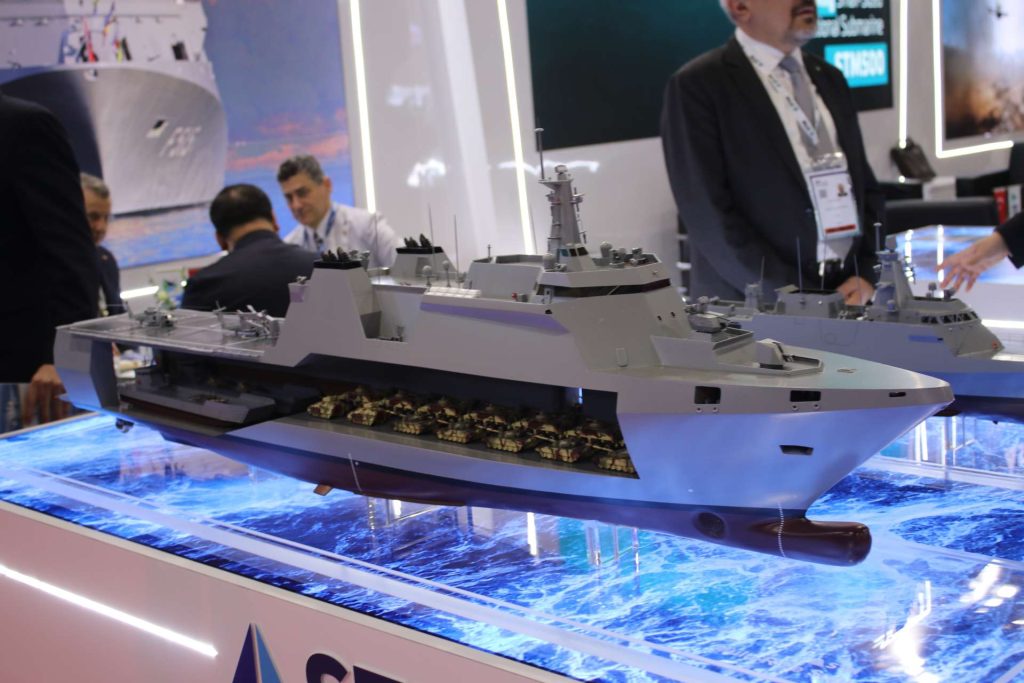
STM’s Multi-Role Support Ship (MRSS) model displayed at DSA in Kuala Lumpur, showcasing a medium amphibious support vessel designed for troop lift, vehicle transport, helicopter operations, and expeditionary logistics (Picture source: Army Recognition Group).
The ship sits in the medium amphibious class: 153.2 meters long, 24 meters wide, about 9,700 tons displacement, 18+ knots top speed, 8,000+ nautical miles of range at 14 knots, and 30 days of endurance. STM says it carries 150 crew plus 500 troops, two LCUs in the well dock, an 800-square-meter tank deck for 14 main battle tanks and nine assault amphibious vehicles, two 15-ton helicopters, and two 10-meter RHIBs.
The armament and mission systems are intentionally conservative, which is appropriate for the role. STM lists a 76 mm main gun, four 12.7 mm remote stabilized weapon stations and two chaff/IR decoy launchers, supported by dual X-band navigation radars, integrated communications, SATCOM, and a command system architecture that includes a combat information center, an amphibious operations center and RMN-compliant X-band SATCOM. In other words, the MRSS is armed for self-protection and limited littoral fire support, not for front-line surface warfare.
The project’s development logic is clear. STM introduced the design in 2025 as Malaysia was still refining its long-delayed MRSS requirement, and the company then brought the model again to DSA 2026 as part of a broader push built around the Turkish firm’s Malaysian footprint, especially the LMS Batch 2 corvette program. In June 2025, the RMN was still finalizing requirements, with the revised 15-to-5 plan envisioning two MRSS between 2026 and 2030 and a third between 2035 and 2040 if funded.
Operationally, the MRSS would give a user navy four capabilities that are hard to generate from smaller ships: tactical sealift, over-the-shore landing, afloat command, and crisis response. The well dock, 60-ton stern and side ramps, vehicle elevator, helicopter deck and hangar make it suitable for moving armor or marine forces from a rear base to a threatened island, sustaining them offshore, and landing them without port infrastructure. The medical complex with surgery, X-ray, intensive care and triage spaces also makes the ship valuable for disaster relief, evacuation and hospital support.
For a country such as Malaysia, Indonesia or the Philippines, that matters tactically because the ship can bridge dispersed archipelagic geography. A navy could use it to reinforce an outer island garrison, insert a battalion-sized rapid deployment element, operate helicopters for resupply or casualty evacuation, and remain offshore as a mobile command node during a contingency.
No country is currently known to operate STM’s MRSS. At present, it remains a proposal, albeit one shaped around a real Malaysian requirement. That is the main distinction between STM’s concept and some rivals. Official Damen data show the Enforcer family already represents a mature amphibious line, with 9,000-ton and 14,000-ton variants offering similar 18-knot speed and 8,000-nautical-mile reach, while PT PAL’s official material indicates its landing dock family has been built for Indonesia, exported to the Philippines, and is also associated with UAE work. STM, therefore, offers a more tailored but less proven solution.
Compared with those competitors, STM’s advantage is balance. The Turkish design is not trying to be a mini-LHD, and it avoids the cost and manpower burden of a much larger assault ship. Instead, it packages credible amphibious lift, helicopter support, command-and-control, medical capability and optional CBRN protection into a platform that should be more affordable for second-tier navies seeking presence, HADR utility and limited expeditionary power. If Malaysia or another regional navy wants a practical sea-basing tool rather than a prestige ship, the MRSS is a serious contender worth close attention.