
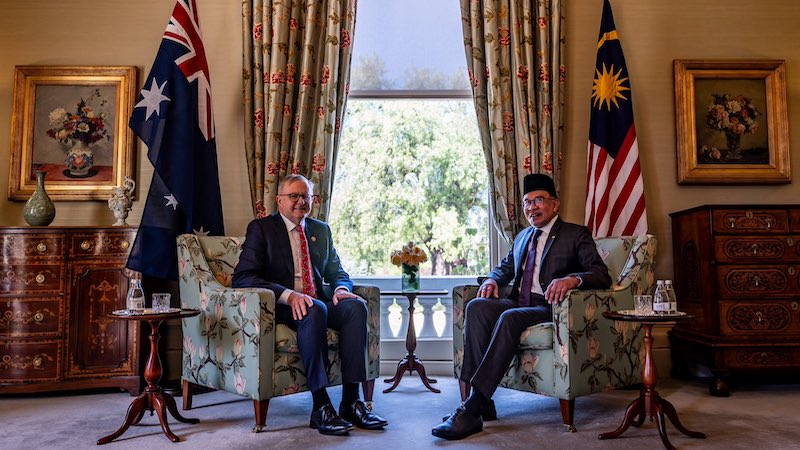
Australian Prime Minister Anthony Albanese’s visit to Malaysia from April 15 to 17 comes at a strategically pivotal intersection of interwoven economic and security needs for both countries.
While the immediate public emphasis is on energy and economic security amidst the fallout from the Iran conflict, the broader strategic importance of defence and security interdependence must never be understated.
The visit underlines the need to protect access to critical resources, especially LNG as a bulwark of fallback support for both Kuala Lumpur and Canberra while also advancing joint support in food security, investment and technology. Disruptions in the Strait of Hormuz have affected almost 40 per cent of Malaysia’s crude oil imports, and this is where Australia’s growing strategic importance has been further underscored, supplying about 96 per cent of Malaysia’s imported LNG.
Malaysia, meanwhile, accounts for about 17 per cent of Australia’s total fuel imports, underlining the strategic mutual interdependence especially in weathering the new geopolitical, energy and economic shocks.
However, if the visit is treated only as a response to these shocks, both sides will underuse it.
Strategic Convergence
The real long-term importance lies in the solid and history laden partnership that transcends economic ties alone, and both are not merely commercial partners.
Both are maritime states whose prosperity and security depend on shared aspirations for safe, secure and open sea lanes, legal predictability, and a rules-based regional order that discourages coercion. Economic ties have been growing, with total bilateral trade amounting to almost RM79 billion in 2025 and both were each other’s 12th largest trading partners in the same year.
This portrays the rising economic scale, but more importantly, both now sit at the intersection of energy security, maritime security, supply-chain resilience and defence cooperation that will determine the course of the future.
Malaysia today faces a more layered security environment than before, and for Australia, even more so. Both sides reaffirmed that defence cooperation is a fundamental pillar of the Comprehensive Strategic Partnership.
The Security Architecture That Still Matters
The Five Power Defence Arrangements (FPDA) remain central to this tenet, being more relevant than ever, as they are at the nucleus of the architecture of rules-based regional security. Established in 1971 by Malaysia, Singapore, Australia, New Zealand and the United Kingdom, it is a longstanding regional defence framework aimed at consultation and cooperation in support of the external defence of Malaysia and Singapore.
It remains vital now in serving as needed military deterrence and an act of support especially for Malaysia, in training real interoperability across air, sea and land, and it reinforces the core purpose of combined defence cooperation. In an Indo-Pacific environment moulded by rapid military modernisation and arms races, and more frequent grey-zone pressure, the FPDA remains ever more pertinent.
Malaysia hosts the Headquarters Integrated Area Defence System (HQIADS) at RMAF Butterworth, the permanent operational element of the FPDA, reflecting Malaysia’s enduring role in regional defence cooperation. Australia’s Operation Gateway conducts maritime surveillance patrols across the North Indian Ocean and the South China Sea. This complements efforts in contributing to maritime domain awareness and regional stability along sea routes that are vital to Malaysia as a maritime and trade-dependent nation.
The Indian Ocean carries about half of the world’s shipping container traffic and around two-thirds of oil shipments, while the Strait of Malacca carries about 25% of global traded goods, 23.2 million barrels of oil per day and 9.2 billion cubic feet of LNG, making it one of the world’s most vital maritime chokepoints.
Hence, the joint maritime domain awareness capacity is an active strategic node for surveillance, interoperability and regional awareness. This is especially critical for Malaysia, where maritime domain awareness is now one of the most important currencies of security, providing earlier speed of detection and appropriate responses.
Closer intelligence sharing between both countries is also key. A growing number of threats now develop below the threshold of open conflict, and these will need better situational awareness, earlier warning, and faster inter-agency coordination. A closer security relationship with Canberra, focusing on maritime intelligence, cyber resilience, capacity-building and professional exchanges, will help Malaysia address both conventional and non-conventional threats more effectively, speedily and with capable deterrent responses.
AUKUS, Deterrence and the New Indo-Pacific Balance
In the same regard, AUKUS remains an integral pillar not only for Australia’s own security needs, but also for the region. AUKUS is a trilateral security partnership launched in 2021 by Australia, the United Kingdom and the United States, pillared on supporting Australia with conventionally armed, nuclear-powered submarines with advanced cooperation in high-end defence technologies. Contrary to perception, AUKUS submarines are nuclear-powered, not nuclear-armed, meaning they use nuclear propulsion but do not carry nuclear weapons.
Also contrary to perception, AUKUS is not only confined to submarines alone, with parallel focus on advanced capabilities, including cyber, AI and autonomy, electronic warfare, undersea capabilities, quantum technologies, innovation, defence-industrial integration, and interoperability.
This is also important for the region as a more technologically capable Australia can contribute more to regional surveillance, deterrence, burden-sharing and resilience for the region.
With rising fears and wariness in the region from heightened risks and instabilities, especially in the South China Sea, the added leverage and deterrence provided by AUKUS will be key in the overall maritime domain awareness and integrated support to deter attempts to violate maritime law and the rules-based order.
Given rising energy volatility and the strategic importance of Malaysia’s oil and gas sector especially in the South China Sea, the need for a joint deterrence and security partnership has never been higher.
Energy, Rare Earths and Shared Stakes
Energy security is only one part of the resilience equation. Food security and resource security are now at the forefront apart from the obvious security partnership.
Malaysia and Australia are becoming more tightly interdependent in rare earths and critical resources because each holds a different but equally strategic piece of the supply chain. Australia brings higher leverage and capacity in the upstream weight, with about A$19 billion in proposed investment at later stages of development, and the government committing A$1.2 billion for a Critical Minerals Strategic Reserve.
Malaysia, meanwhile, holds a crucial downstream role through processing and separation capacity in the Kuantan Lynas Plant, linking to Mt Weld in Western Australia.
Lynas Malaysia in Kuantan is the world’s only significant producer of separated rare earth materials outside China, which is of great strategic significance for both Malaysia and Australia in a synergised ecosystem, amidst the new global chase for this critical mineral. Canberra has the minerals, while Malaysia has the processing strength, and neither side gains the full strategic value without the other. Hence, the closer ties in rare earths and critical resources form the core pillar of shared industrial resilience, supply-chain diversification and long-term strategic security for both countries.
The visit by PM Albanese will further bolster the joint needs by both sides to seek fallback options in one another away from the lingering complexity and risks from both the Ukraine and Iran conflicts and the threats to the supply chain assurance and routes.
In deepening food security, both are expected to step up. Australia is one of Malaysia’s major suppliers of halal beef and sheep meat, exporting 38,220 tonnes of halal sheep meat and 13,511 tonnes of halal beef and veal to Malaysia last year, valued at a total of more than RM1 billion, underscoring the deepening food security ties.
People-to-people ties continue to grow in a multi-faceted avenue, from higher education to tourism and culture. There are more than 500,000 Malaysian alumni of Australian institutions, and Malaysia was Australia’s 13th-largest source of international students in 2025, with nearly 15,000 Malaysian students studying in Australia.
Why Interdependence Now Matters More Than Ever
Albanese’s visit should therefore be used to reinforce a larger strategic message: that both must deepen synergy and cultivate joint returns. Malaysia-Australia ties matter because they have moved beyond courtesy, sentiment and diplomatic routine into the realm of hard strategic necessity in times of greater geopolitical threats. Both countries need open sea lanes, respect for maritime law, stronger deterrence, better intelligence sharing, more resilient supply chains, and a rules-based regional order backed not only by principles and past precedent but by credible capability.
In a region where disruption is no longer hypothetical, the value of Malaysia-Australia ties lies not in symbolism but in practical utility, real strategic need, and a deepening interdependence that will only grow more important.
This relationship gives both Kuala Lumpur and Canberra greater capacity, but more importantly it rests on a proven record of resilience that has endured past frictions and changing circumstances. That is precisely why this is the moment for both sides to strengthen a partnership grounded not only in trust and friendship, but also in clear necessity.