
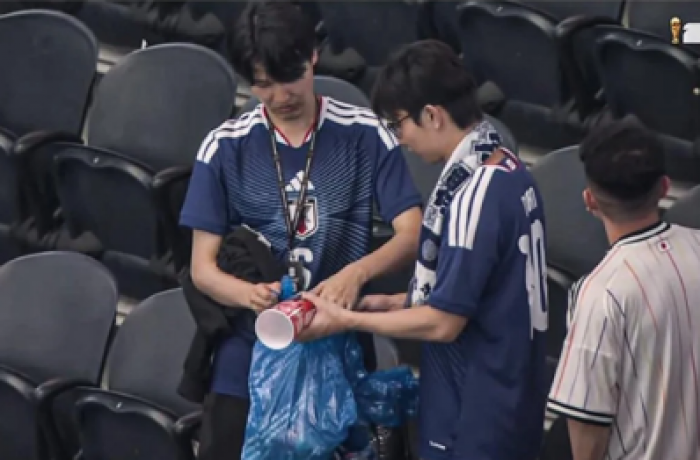
Tokyo (AsiaNews) – Images of Japanese fans cleaning stadiums at the World Cup have gone viral. Even the Fédération International de Football Association (FIFA) on X posted a video of Japanese fans cleaning up saying that this was done out of “Respect”. Yet those same images have been received somewhat differently in Japan.
The blue bags used by Japanese fans were not meant for collecting trash. Since the early 1990s, fans have brought coloured plastic bags to stadiums to wave, something called fukuro-ouen (bag cheering).
During the 1998 World Cup, the first for Japan, Japanese fans used bags for the first time to collect waste before leaving the stadium, an act that has been repeated in all subsequent editions of the World Cup.
The political implications
For this year’s matches, 15,000 bags with the word Japan Pride printed on them were prepared in advance.
Although no visible logo appears on them, Japanese forums claim that the supply is linked to APA Hotel, an official partner of the Japan Football Association (JFA).
The issue has given rise to several controversies, little discussed in the international media. “Japan Pride” is not only a slogan, but also the title of a controversial book, by the founder of APA Group, Toshio Motoya.
Also known by the pen name Seiji Fuji, Motoya is one of the leading figures of Japan’s nationalist right, very close to the more conservative wing of the ruling Liberal Democratic Party.
In 2017, Motoya published a book titled The Real History of Japan: Japan Pride. Both this book and a previous one (Theoretical Modern History II: The Real History of Japan) were distributed free in the rooms of all APA hotels, with copies in both Japanese and English.
The books sparked scandals that continued over the years since Motoya rejects the notion that Japan committed war crimes during World War II.
In his view, the “so-called Nanjing Massacre story”, as he put it, in China was “fabricated,” when in fact Japanese soldiers simply executed “infiltrated plainclothes (Chinese) soldiers”.
The International Military Tribunal for the Far East, established after the war, estimated that more than 200,000 were killed in six weeks during the Japanese occupation of Nanjing in December 1937.
Historians’ estimates vary (the lowest, backed by some non-negationist Japanese academics, put the figure at around 40,000; most international historians accept figures between 100,000 and 200,000), but for most historians, the negationist view promoted by Motoya has no documentary basis.
Motoya claims that he “spoke to prominent personalities from 81 countries” and that “none of them believes in things like the Nanjing Massacre”.
He also denies that women in Korea and other Asian countries were forced to serve as sex slaves in comfort houses set up by the Japanese Imperial Army, calling these stories “invented to dishonour Japan”.
The sexual enslavement of the ianfu (so-called comfort women as they are still referred to in Japan) is well documented in historical sources, Japanese military diaries, testimonies of survivors and international rulings.
Periodically these controversies create tensions among East Asian countries, especially at major sporting events.
In January 2017 an American traveller posted on Weibo a video showing Motoya’s book in the rooms of an APA hotel in Sapporo. The video reached 77 million views in two days and China demanded a boycott of the chain.
During the 2017 Asian Winter Games in Hokkaido, China and South Korea withdrew their athletes from APA hotels.
Also in 2017, before the Tokyo Olympics, Motoya openly stated that he had “no intention” of removing the books. “Would I remove the books during the Olympics just because they’re the Tokyo Olympics? That’s really stupid,” he said at a news conference.
The element that triggered the discussion at the 2026 World Cup is the coincidence, which has fuelled online speculation, between the title of the revisionist book (Japan Pride) and the slogan printed on the bags provided by the hotel chain to Japanese fans.
A widely shared post on Reddit, summed it up like this (with an inappropriate historical comparison): “If a European team handed out rubbish bags to its fans with the words ‘Our Pride’ written on them, provided by a hotel whose founder denies the Holocaust and wrote a book with the same title, it would be considered an immediate international scandal. In Japan, it’s called sports sponsorship.”
A long cultural tradition
Many Japanese fans are probably unaware of the meaning of the slogan on the bags, and the act of cleaning the stadiums has a deeper meaning and longer tradition.
In Japan, the vast majority of public schools do not have cleaning staff. Every day, children, from the age of six or seven, clean the classrooms, the corridors, the bathrooms, the stairs.
This is called souji no jikan – “cleaning time”, and is part of what the Japanese Ministry of Education calls tokkatsu, or “special activity”, which serves to form character, civic sense and collective responsibility.
Thus, cleaning stadiums at the end of the game is seen as a basic behaviour that is taught in school; for most Japanese, this is atarimae, i.e. “obvious”, “natural”, “as it ought to be”. For a Japanese fan, picking up trash before going out is simply what you do.
Sociologists believe that another mechanism is also in place. According to the famous philosopher and sociologist Ōsawa Masachi, the Japanese tend to be relatively indifferent to “justice on a large scale”, such as the world’s big problems, climate change, distant wars, but are extraordinarily sensitive to what is meiwaku, bothersome, which may be done to people who share the same space.
“In Japan,”, he told AFP, “even if one person starts picking up litter, those around them feel they simply cannot help but join in,” he said. “That’s because if they don’t, the people they are with will think they are a bad person.”
This mechanism is often described with the expression kuuki wo yomu (reading the atmosphere), i.e. the ability, almost a social obligation, to perceive the implicit expectations of the group and adjust accordingly. This does not mean that the act is devoid of authenticity.
For other experts there is also a historical dimension. Sociologist Randeep Rakwal of the University of Tsukuba traces this back to the 1964 Tokyo Olympics.
Postwar Japan, anxious to present itself to the world as a modern and democratic nation, launched a national campaign of public hygiene from above, which contributed to codifying cleanliness as an element of national identity, a value celebrated, exhibited, proudly claimed as a trait of Japanese culture.
Uchi and soto
In Japanese culture there is another concept that helps understand the practice even better: the distinction between Uchi (inside, “us”, the familiar and protected space) and Soto (outside, “others”, the external space).
In Japan, this distinction is not merely geographical or relational: it is one of the fundamental structures through which social experience is organised. In the domestic sphere, the Uchi is the family; in the workplace, it is the company; at sporting events, it is the team.
As a result, the American stadium where the match took place is temporarily reclassified as Uchi by Japanese supporters. In a space perceived as “proper”, one does not leave trash on the ground. It is kept clean exactly as a house should be kept clean.
Taking up the theories of anthropologist Mary Douglas, author of the great classic “Purity and Danger”, the cleaning of stadiums is not only courtesy to others, but also an act of identity affirmation, of presiding over the boundary between “us” and “the rest”.
In Japan the boundaries of Uchi and Soto are fluid, subject to continuous negotiation. What determines them, very often, is the gaze, the fact of being observed, a concept that sociologists describe as Seken no me: “the eyes of the social world”.
When there is an outside gaze watching and judging, the pressure to behave according to the Uchi code becomes more intense.
An act nurtured by Western exoticism
There is another level of reading, too, and it has to do with the exoticism with which the West portrays these episodes showing Japanese or East Asian cultures in general.
According to other views that appeared online a few days after the last football matches, the cleaning of stadiums, which was a spontaneous cultural habit, today has turned into a conscious tool of national self-representation. It’s not that the fans pretend to clean, they really clean.
But the act has become increasingly part of the way Japan presents itself to the world as a superior nation in discipline, civic education and courtesy, especially at a historic moment like the current one.
However, essayist Masaki Kubota, on the magazine Diamond Online, was blunt in 2022 in his critique. “When Japan resorts to moral and spiritual arguments to assert its superiority, it is usually because it is weak on other fronts.”
Cleaning stadiums becomes, in this perspective, a symbolic substitute for other kinds of power – economic, technological, diplomatic – that Japan does not possess or exercise with the same visibility.
To this internal dimension is added the external one: the role Western media plays in amplifying and mitigating the act.
At every World Cup or Olympics, the media coverage is the same and produces a narrative, according to online commentators, that also serves a Western need: that of having an idealised “other” through which to criticise one’s society.
Japan consumes these accolades as confirmation of its originality and cultural superiority, using this image – known in Japanese as tatemae, “pretence” that one shows to the world to represent oneself.
Criticism at home
And it is this mechanism of the other gaze has given rise to more criticism in Japan.
Some Japanese women on social media have pointed out that big events at home – Shibuya’s demonstrations during Halloween, summer fireworks festivals along the Sumida River – often leave streets covered in trash for hours.
Statistics from Tokyo’s Shibuya District show that at least 48 per cent of the rubbish left in the tourist area comes from Japanese residents, not foreign visitors.
Ōsawa himself has, to some extent, endorsed this interpretation: the mechanism of kuuki wo yomu is intrinsically dependent on the presence of an observing reference group.
The primary motivation in collecting waste at the stadium is not, according to him, cleanliness per se, but to avoid being seen as “annoying” (meiwaku) by one’s group. This implies that, when that group is not there, behaviour changes.
Hajime Moriyasu, manager of Japan’s national football team, has dismissed the criticism and proudly declared that “this is one part of the Japanese culture that we can be proud of in the world”, while many commentators point out that the tradition has been maintained for almost 30 years, even in very different conditions, win or lose.
The most incisive criticism in this regard was made during the 2022 World Cup in Qatar by the former chairman of the company Daio Paper, Ikawa Mototaka, another controversial figure in Japan, who labelled this behaviour as “slave mentality happy to be praised by foreigners”.
Such remarks reflect the frustration of depending on external recognition, of making a beautiful appearance at all costs in the eyes of the rest of the world.
Japanese women
The criticism did not end there. A new debate started in recent days thanks to a post on X gone viral, which parodied famous awareness posters of the Tokyo subway – stylised images of good civic manners – with a satirical variant: on the left, a fan proudly collecting waste at the stadium; on the right, the same man sitting at home, on the couch, smartphone in hand, while in the background the wife washes dishes with an overflowing basket of ironing clothes beside. Underneath, a caption: “Do it at home”.
The post got 59,000 likes and 13,000 shares. A related post surpassed 1.9 million views. And several women pointed out that Japanese men are the ones who devote less time to housework.
According to the OECD on time use (updated to 2021 for Japanese data), Japanese men spend an average of 41 minutes per day on unpaid work, the lowest among all monitored countries, while Japanese women spend an average of 224 minutes, 55 times, the largest gap recorded in all OECD countries.
To give a concrete example for comparison: in Sweden, Denmark and Norway (the countries with the lowest gap) the difference between men and women in domestic work is less than one hour per day. In Japan it’s almost three hours.
The difference is amplified even more when there are young children. In families with both working parents and a child under the age of six, Japanese mothers spend seven hours and 28 minutes a day working on care and household chores; the fathers, in the same situation, 1 hour and 54 minutes.
The Japanese Cabinet Office has even tried to quantify this asymmetry: women’s unpaid work is worth about 111 trillion yen, the equivalent of US$ 760 billion, almost a fifth of national GDP. That of men stops at 32 trillion yen, less than a third.
These data illustrate the paradox that Tamada’s post had raised with visual effectiveness: the Japanese whom the world admires for their care of shared spaces belong predominantly to one category, adult men, who at home contribute minimally to the care of the space closest to them, their own homes.
It should also be noted that the issue is more complex than the reactions on social media have shown.
The OECD data also indicate that Japanese male workers spend an average of 452 minutes a day on paid work, the highest figure among all OECD countries, almost an hour and a half more than the average.
The long working hours that Japanese corporate culture imposes on men (karoshi, literally “death from overwork”) leave little time for housework.
Research published in 2025 in the journal Gender, Work & Organization looks at the issue longitudinally, from 1991 to 2016: despite the expansion of policies that seek to find a balance between work and personal life and the increase in women’s participation in the labour market, the domestic division of labour has remained substantially unchanged.
There is also a specific term to describe the behaviour of men who refuse to contribute to household chores: furariimen (wandering man), husbands who deliberately prolong the journey from home to work, or stay out until late, to avoid having to do the dishes.