
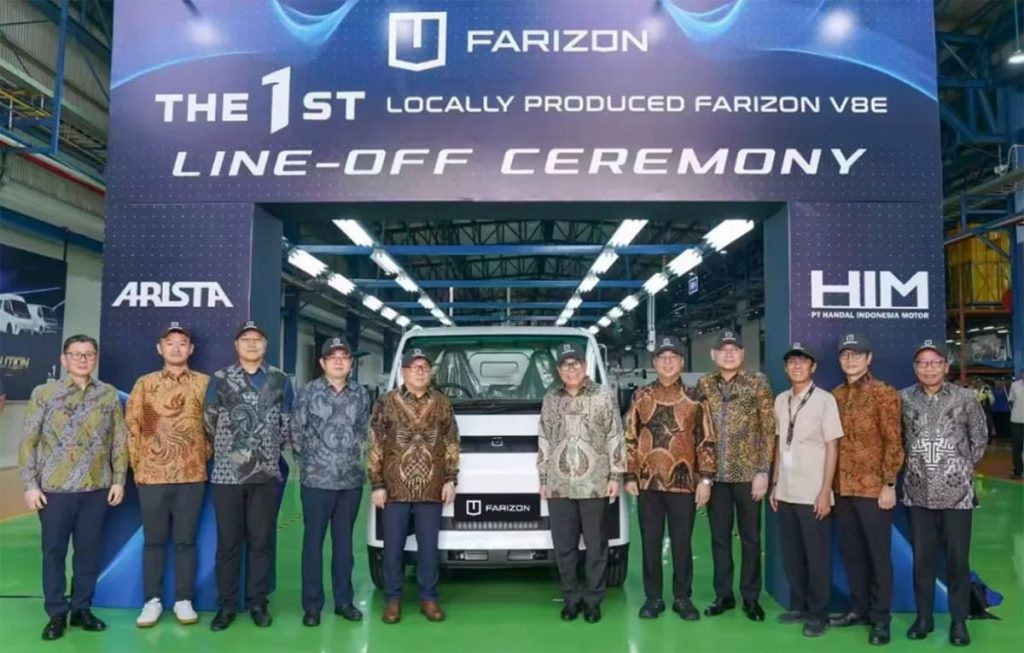

- The first locally assembled V8E all-electric logistics vehicle rolled off the line on August 13 at a plant about 80 kilometers southeast of Jakarta.
- It is Geely Farizon’s first overseas KD project, coming just months after the company entered Indonesia in January 2026.
Geely Farizon’s KD (knock-down) plant in Indonesia has officially started operations, making it the first overseas localized production project for Geely’s commercial new energy vehicle (NEV) unit.
The first locally assembled V8E all-electric logistics vehicle rolled off the line at the plant on August 13, the company said on Friday, marking the project’s entry into large-scale operation.
The plant is located about 80 kilometers southeast of Jakarta and can currently carry out local assembly of the V8E. The company said it will upgrade the production lines going forward and gradually broaden its localized product lineup.
Mike Fan, CEO of Geely Farizon New Energy Commercial Vehicle Group, Hartono Sohor, chairman of Indonesia’s Arista Group, and Denny Siregar, president director of Handal Indonesia Motor, attended the roll-off ceremony.
Compared with importing fully built vehicles, the KD approach shortens delivery cycles, streamlines supply chains and lowers overall operating costs. That is especially critical in Southeast Asia, where tariffs and localization requirements are tightening.

“Geely Farizon does not merely export vehicles to Indonesia. We aim to take root in the country, integrate into local industrial chains and build sustainable local-based capacity together with Indonesian partners,” Fan said.
“Relying on local manufacturing, we will build end‑to‑end capacity covering products, production, supply chains and after‑sales services, and develop vehicles adapted to local roads and market needs,” he added.
The V8E that rolled off the line has been calibrated for Indonesia’s urban road conditions, logistics scenarios and tropical climate. The vehicle has an 8.5-cubic-meter cargo compartment and an all-electric range of more than 400 kilometers.
The company positions it for urban last-mile delivery, urban-rural freight and intra-city logistics.
Geely Farizon entered Indonesia in January this year in partnership with Arista Group, launching its SV model there. In April, the V7E and a 16-seat passenger version of the SV were showcased at a local commercial vehicle expo.
At GAIKINDO Indonesia International Auto Show (GIIAS 2026) in late July, the V8E made its overseas debut. The company said the Indonesian KD project will serve as its strategic pivot in ASEAN.
At home, Geely Farizon is accelerating its push into intelligent and large-scale deployment. In June, it struck a partnership with Cao Cao Mobility, Geely’s ride-hailing subsidiary, aiming to deploy a cumulative 100,000 T6 robovans by 2030.
The company is also building autonomous taxis for WeRide (NASDAQ: WRD). The two plan to deliver 2,000 mass-produced GXR vehicles in 2026, with the upgraded model expected to roll off the line in the third quarter.

BYD launched 4 electric commercial vehicles in the UAE for use in the delivery and public transportation sectors.