
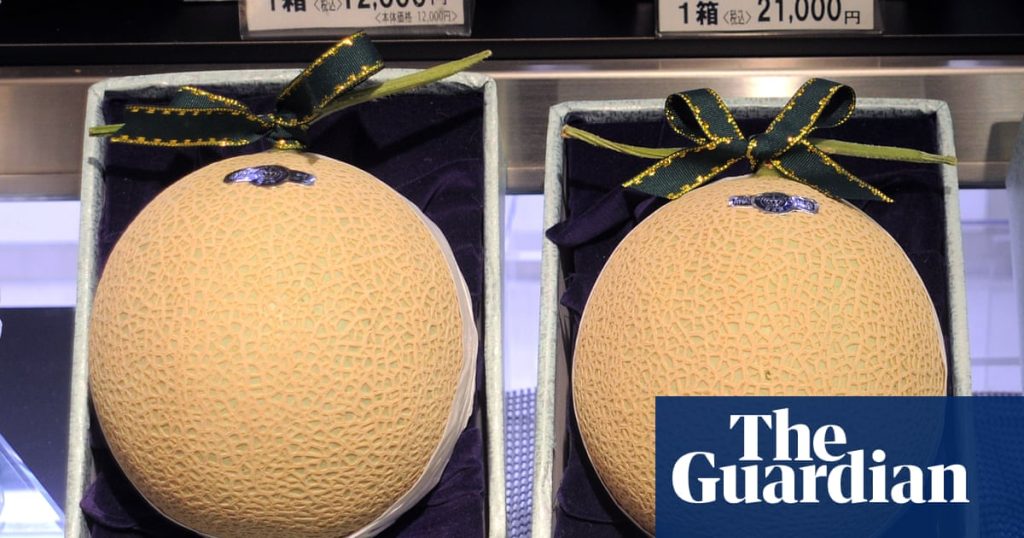
The melons at the centre of a national imbroglio involving the Australian prime minister have the sweetness of a watermelon, the snap of a honeydew and the perfume of a peach, according to fruit sellers.
Anthony Albanese maintains he has nothing to apologise for, after a joke he made regarding a gift he received from Japan’s prime minister.
While Albanese is facing scrutiny over his comments – and hand gestures – the fruit in question has received less attention. They are not only a prized delicacy but are a part of a significant Japanese cultural practice.
According to Melbourne fruitier Thanh Truong, also known as Fruit Nerd, there is a culture of fruit gifting in Japan that does not exist in Australia.
“We don’t have a culture of spending money on fruit like they do in other parts of the world,” Truong said. This is because, in Australia, fruits are understood as a “commodity”, something that should be priced accessibly for everyone, he said. Shizuoka Crown melons are a luxury good – priced between $50 and $150 a piece.
A variety of the muskmelon family, whose other members include rockmelon and the honeydew, they have become a prized gift in Japan due to the care involved in growing them. This process involves being hand-patted by growers, to give the fruit an even shape and exterior pattern.
Truong said that, for growers, “their attempt at perfection” is part of the fruit-gifting culture.
There is also only one crown melon grown per vine, which Truong said gives them maximum nutrients and a higher sugar level. Truong describes the taste as: “The sweetest watermelon you’ve had, with the texture of a honeydew and the perfume of the strongest kind of rockmelon or peach.”
In Japan, these efforts reflect the level of respect shown to the gift’s recipient. The melon is also supposed to give the recipient health and wealth, Truong said. This is very different to gifting somebody alcohol, which is more typical in Australia, he said.
Graham Gee, a senior buyer at the Happy Apple in Melbourne, said that in Australia we have year-round access to honeydews, rockmelons and other varieties of the muskmelon. But in Japan, the melon market is “very seasonal”, making it a “special occasion” when they do arrive.
The import of fresh melons from Japan into Australia was permitted at the beginning of this year, though melons from the Okinawa prefecture are still banned. But neither Gee nor Truong have yet to see them being sold locally.
“There is a beauty to it, and not everyone can appreciate it,” Truong said.