
Open as PDF
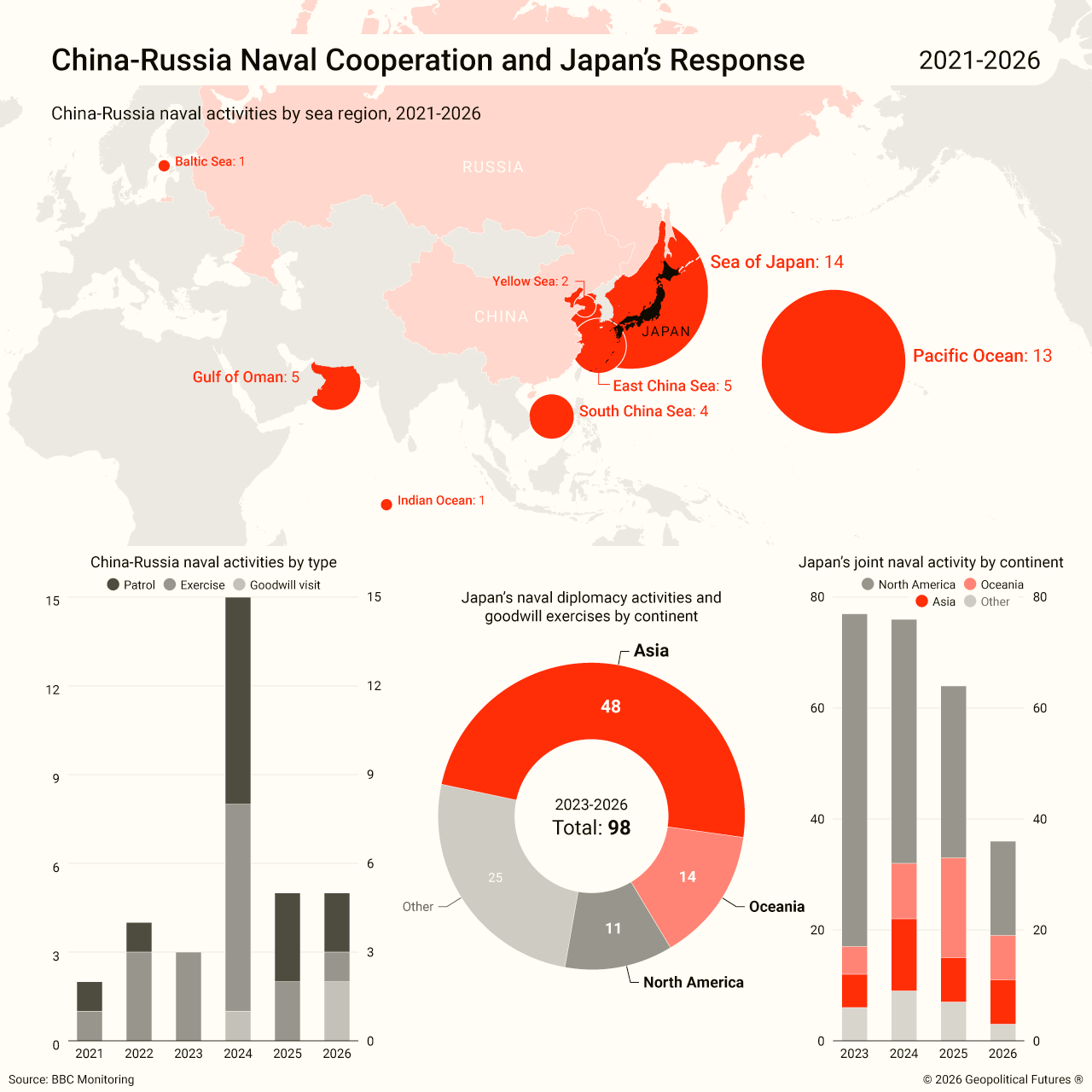
Recurring operations around Japan are improving China and Russia’s ability to coordinate pressure on the U.S.-led regional alliance system. Since 2021, China and Russia have conducted 14 joint naval activities in the Sea of Japan and 13 in the Pacific Ocean, making the waters around Japan the center of their maritime cooperation. The pattern combines sustained activity near Japan’s northern and western approaches with operations extending into the wider Pacific. Five additional activities in the Gulf of Oman, often involving Iran, show that their cooperation also extends into strategic waters beyond Northeast Asia.
This concentration reflects geography. Japan’s islands separate the Sea of Japan and East China Sea from the open Pacific and sit beside key passages used by both powers. Russian forces based at Vladivostok must transit straits adjoining Japan, while Chinese forces pass through gaps in the Japanese archipelago and first island chain to reach the western Pacific. Japan’s ports and airfields also support U.S. operations in Northeast Asia. These movements force Tokyo to monitor several approaches and extend pressure toward U.S. bases, reinforcement routes and allied sea lanes.
China and Russia retain separate interests and command structures, and their cooperation falls short of a formal alliance or integrated fleet. But complete integration is unnecessary. Repeated operations can provide enough familiarity for limited coordination in a crisis and complicate U.S. and Japanese planning.
Their cooperation is also accelerating Japan’s response. From 2023 through mid-2026, Japan conducted 98 naval diplomacy activities and goodwill exercises, nearly half with Asian countries, while its joint naval activity remained heavily oriented toward North American partners. Tokyo is building a wider regional network around the U.S. alliance, particularly through Australia, the Philippines, Indonesia and other Indo-Pacific states. The result is a tightening security competition in which China-Russia coordination and Japan’s expanding maritime network reinforce one another.