
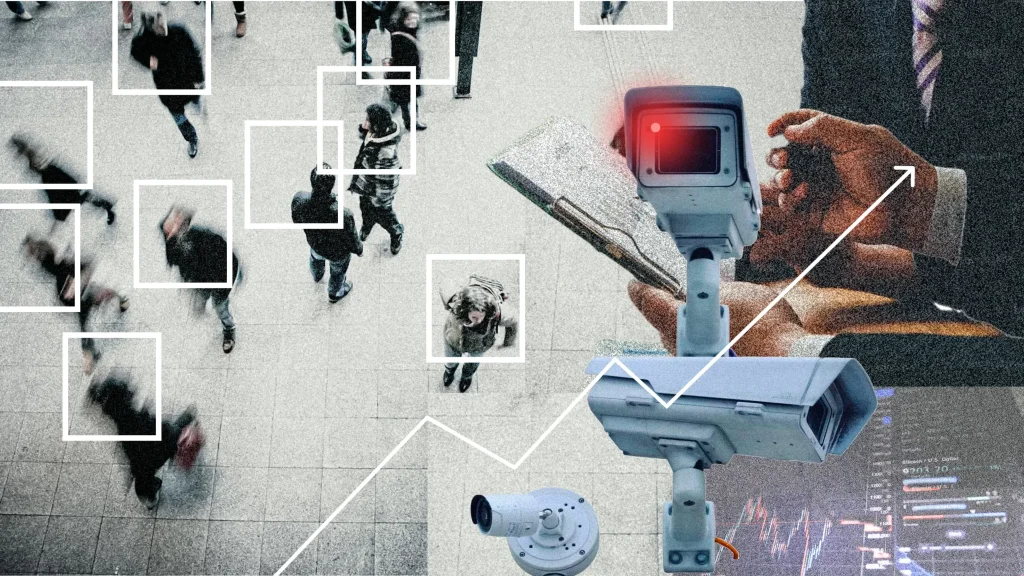
As Gen Z-led protests unfold across India, the state’s expanding surveillance apparatus has become a defining feature of the government’s response. Beyond raising urgent concerns about free speech and expression, it underscores a broader threat to democratic rights, civic participation, and the ability of citizens to dissent without fear. Numerous protesters have rightly questioned Delhi police’s continuous and indiscriminate use of multiple surveillance technologies. A petition challenging police surveillance of protesters is currently being heard in the Delhi High Court.
This dystopian level of mass surveillance has been made possible by the steady expansion of surveillance infrastructure across the country without being accompanied by any form of democratic deliberation, public transparency or regulatory oversight. India has some of the most surveilled cities in the world, with CCTV networks feeding into central command and control centers. The past few years have witnessed the introduction of AI-enabled smart cameras with live Facial Recognition capability across public spaces. Simultaneously, law enforcement and intelligence agencies are building an ever-expanding repository of centralized surveillance databases without any statutory basis, clearly defined objectives, public disclosures, and checks and balances.
Delhi Police have deployed photographers to photograph and film protesters, alongside AI-enabled CCTV cameras, AI-powered mobile surveillance vehicles, and smart glasses. A video of a Live Facial Recognition van recorded by independent journalist Ila Kazmi on July 23 at the protest site raised grave concerns about potential real-time profiling of protesters. A screen inside the FRT van appears to show details of protesters, including their images captured on surveillance cameras, their names, a matched photograph (a watchlist variable), and a match probability.
The Delhi police maintains criminal and suspect database(s) against which its facial recognition systems have reportedly been used to match surveillance footage, either live or retrospectively, including during the anti-Citizenship Amendment Act protests. However, the scale and nature of these databases cannot be conclusively established from the available public information.
However, if the live FRT system deployed by the Delhi police was able to identify the names of all protesters, most of whom are not likely to be a part of criminal or suspect databases, it could be possible that the Delhi police is using more universal national databases for matching (we cannot ascertain this at this point because of the short duration of the video). The official handle of the Cockroach Janta Party (CJP) has also raised questions about possible use of “national databases, Aadhaar records, and public registries” to identify protesters in real-time. This is an important question that deserves a clear answer from the government.
The use of untargeted real-time biometric surveillance in a public protest has no place in a democracy. It is even more invasive if it is interfaced with citizen demographic databases. This is arguably unconstitutional and infringes the fundamental right to privacy of citizens,, violating the three-part test of legality/statutory basis, legitimate aim, and proportionality laid down in the landmark Supreme Court judgment Puttaswamy v. Union of India.
On July 24, newspaper reports cited anonymous sources from the Delhi Police stating that the use of facial recognition at the protest site is limited to identifying potential offenders against a police database of “criminals, absconders, history-sheeters, and Bad Characters”. It is important to note that these police databases operate in complete opacity and are likely to overrepresent historically discriminated communities, including Vimukta communities, Dalits, Bahujan, Adivasi, and Muslim minorities. The ambiguous categories of “bad characters” and the maintenance of “habitual offenders” databases cannot be divorced from historical bias in Indian policing. A 2019 report by the Indian Express had also revealed the creation of a “habitual protesters” dataset by the Delhi Police. It is thus important to also ask whether the Delhi Police intends to add the photographs of the Gen Z protesters to a police database. This becomes imperative in a country where the state has always viewed protests through the lens of law and order.
However, the central question of whether the Delhi Police was using demographic databases to fetch real-time details of ordinary protesters remains. This is a particularly important question to keep asking, given the expanding, unchecked powers of law enforcement to access citizen information, particularly through the Home Ministry’s push towards greater adoption of the National Intelligence Grid (NATGRID), which was only available to central agencies. NATGRID can be used to search information across databases, including “driving license, vehicle registration, Aadhaar, airline data, bank records, FASTAG, passport”, and most recently the National Population Register. A proposal by CISF to integrate FRT cameras at six major airports into the National Intelligence Grid (NATGRID) to enable real-time suspect identification led to concerns around mass surveillance.
Furthermore, irrespective of the databases used to match images, the very use of live facial recognition in public spaces in itself constitutes an infringement of fundamental rights of citizens, as it treats every individual as a potential suspect. That is the reason other democracies, like those in the European Union, categorize it as an “unacceptable risk” under the EU AI Act and prohibit law enforcement use except for specific, limited objectives with prior authorization by independent judicial or administrative authorities.
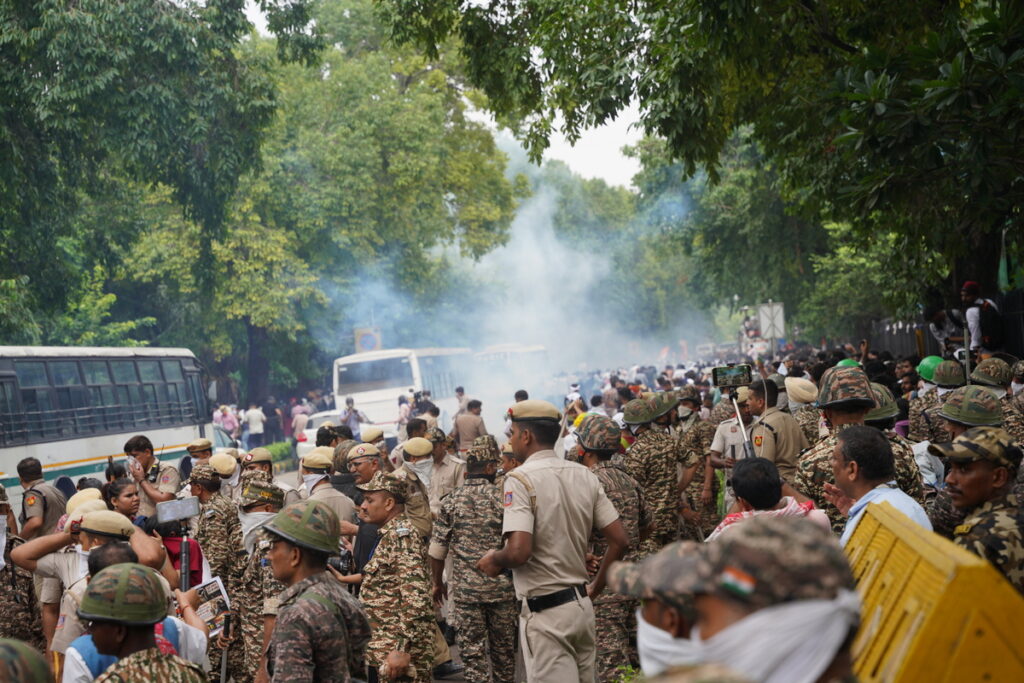
The authoritarian character of mass surveillance is most visible during moments of public protest and dissent. When protesters marched toward Parliament in New Delhi on July 20, they were met with brutal police violence, including batons, tear gas, shock batons, and pellet guns. Many have since documented and recounted their experiences, even as the police have denied using excessive force. In such circumstances, mass surveillance becomes another tool of intimidation, designed to deter people from exercising their democratic rights.
It is also important to recognize that the state does not treat all protesters equally. Muslim, Dalit, Bahujan, and Adivasi communities have long borne the brunt of disproportionate state violence, surveillance, and criminalization during protests.
Ultimately, the question extends far beyond these protests. If citizens exercising their constitutional right to assemble can be identified, tracked, and profiled in real time through opaque surveillance systems, India risks normalizing a surveillance state in which extraordinary powers become an ordinary feature of governance.
(Tavishi is the South Asia researcher at the Center for the Study of Organized Hate.)