
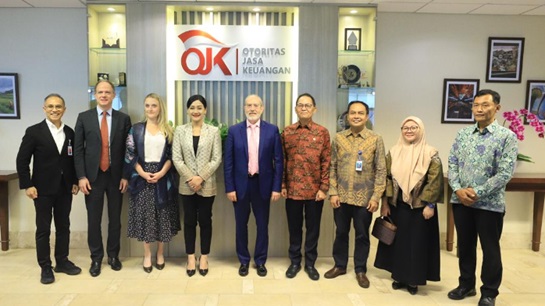
The Organisation for Economic Co-operation and Development (OECD) has commended the various reform measures being implemented by the Financial Services Authority (OJK) in the insurance and pension fund sectors to strengthen financial sector resilience, enhance consumer protection, and encourage healthy and sustainable industry development.
A statement released by the OJK said that the remarks were made by Mr Pablo Antolín, Head of Insurance and Pensions at the OECD, who is on a fact-finding mission. The OECD visit, from 5th to 11th June, is part of Indonesia’s accession process to full membership in the OECD. Mr Antolin is accompanied by Mr Timothy Bishop, OECD Senior Policy Analyst, and Ms Jessica Mosher, OECD Policy Analyst and Actuary.
Indonesia became the first ASEAN country to enter the OECD accession process in February 2024. The OECD currently has 38 member countries and is an international organisation that promotes the implementation of best practices and standards to support economic growth, financial stability, and public welfare.
Ms Friderica Widyasari Dewi, Chair of the OJK Board of Commissioners, stated that the fact-finding mission is a crucial opportunity to strengthen policy dialogue and showcase the various financial sector reforms Indonesia is undertaking.
“Indonesia welcomes the OECD Fact-Finding Mission as a crucial part of the accession process. We view this process not simply as an assessment, but as a strategic opportunity to benchmark against international best practices and accelerate reforms in Indonesia’s financial sector,” she said.
Ms Friderica explained that amidst various global challenges, the Indonesian economy continues to demonstrate strong resilience, supported by solid domestic consumption and investment. Meanwhile, the financial services sector is in a healthy, stable condition.
In the insurance sector, Risk-Based Capital (RBC) remains well above minimum requirements, at 476.11% for life insurance and 311.74% for general insurance. In the pension fund sector, total assets reached IDR410.14tn ($22.92bn) in April 2026 and continue to show a positive growth trend as a long-term institutional investor.
Mr Ogi Prastomiyono, Chief Executive of the Insurance, Guarantee, and Pension Fund Supervisory Agency (OJK), explained that Indonesia is implementing various structural reforms in the insurance and pension fund sectors in line with the OECD agenda and international standards.
According to Mr Ogi, one of the main agenda items is the implementation of the Policy Guarantee Programme (PPP), mandated by the Law concerning the Development and Strengthening of the Financial Sector (P2SK Law).
“The Policy Guarantee Programme will strengthen policyholder protection and increase public trust in the insurance industry. In the revised P2SK Law, approved by the Indonesian House of Representatives on 4 June 2026, the framework for insurance company resolution and liquidation has also been further strengthened and made an integral part of the implementation of the Policy Guarantee Programme by the Deposit Insurance Corporation (LPS),” Mr Ogi said.
In addition, the Financial Services Authority (OJK) continues to encourage the implementation of PSAK 117, which adopts IFRS 17, prepares for the implementation of the new risk-based solvency framework (New-RBC), strengthens the actuarial function, and develops the use of Artificial Intelligence (AI) and digital technology to support effective supervision of the insurance and pension fund sectors.
Mr Antolín stated that the OECD recognises several strengths in Indonesia, including efforts to address the protection gap through increased financial inclusion and the development of microinsurance, a strong regulatory and supervisory framework, reforms towards a risk-based solvency framework, the implementation of IFRS 17, strengthening actuarial capacity, and a comprehensive pension fund reform roadmap.
He said, “We observe various important reforms currently being undertaken by Indonesia in the insurance and pension fund sectors. This fact-finding mission aims to better understand how policies, regulations, and supervision are implemented in practice and how these reforms support the objectives of consumer protection and financial sector resilience.”
As part of this fact-finding mission, the OECD delegation is scheduled to meet with various stakeholders, including the Financial Services Authority (OJK), the Ministry of Finance, the National Disaster Management Agency (BNPB), the Environmental Fund Management Agency (BPJS Ketenagakerjaan), insurance and pension fund associations and industries, the actuarial profession, insurance and reinsurance brokers, consumer groups, and other industry players.
Through these activities, Indonesia hopes to demonstrate progress in insurance and pension fund sector reforms while also gaining constructive input from the OECD to strengthen financial sector resilience, consumer protection, and long-term economic development.