
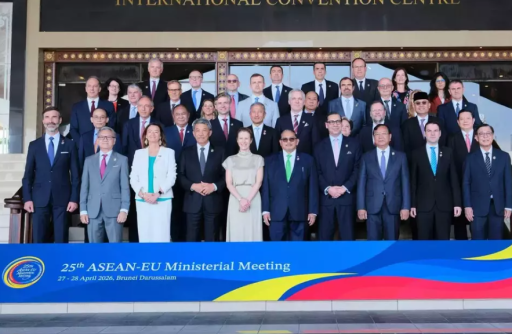
Indonesia has reaffirmed its support for ASEAN’s long-term ambition to establish a bloc-to-bloc free trade agreement (FTA) with the European Union (EU), as both regions advanced discussions during the ASEAN–EU Ministerial Meeting in Brunei Darussalam.
While no formal timeline has been set, both sides agreed to continue working toward a comprehensive trade framework, signaling renewed momentum for deeper economic integration between the two regions.
From bilateral deals to a regional framework
Indonesia’s Vice Minister of Foreign Affairs, Arrmanatha Nasir, said the proposed ASEAN–EU agreement is currently under development and would represent a strategic step in expanding market access.
“[A region-to-region deal] will expand market access for ASEAN and EU businesses. It’s going to be very strategic. Today, we see many countries wanting to close their own market,” he said on Wednesday, April 29, 2026.
He stressed that the initiative must deliver tangible economic benefits, rather than remain symbolic.
“Our cooperation must not be merely symbolic. It should be something that ASEAN and EU people can feel. An example is the FTA,” he added.
Momentum toward a unified framework has been supported by progress in bilateral agreements between individual ASEAN member states and the EU. Singapore and Vietnam were among the first to finalize such deals, while Indonesia is now in the final stage of its own negotiations.
The Indonesia–EU Comprehensive Economic Partnership Agreement (IEU-CEPA) is currently undergoing legal finalization, with completion expected in May 2026. Ratification is targeted for the second half of the year, with zero-tariff access for Indonesian exports projected to begin in January.
Negotiations involving Thailand and Malaysia remain ongoing, reflecting uneven progress across the region.
Building on existing agreements
Arrmanatha noted that ASEAN’s growing network of bilateral agreements could help accelerate broader region-to-region negotiations with the EU.
“The intent to create an FTA goes back a very long time, but ASEAN did not have a trade agreement with the EU back then. Now that we have some treaties in place and a few more to come,” he said.
He added that these agreements could serve as a foundation for a unified framework, potentially simplifying the process for countries that have yet to secure individual deals.
“So it should be easier for Cambodia and Laos to have a [region-to-region] accord without having to go through individual pacts,” he said.
A joint statement issued after the ministerial meeting confirmed that ASEAN and the EU will continue working toward an FTA “in the longer term.”
EU positions itself as a stable partner
EU foreign policy chief Kaja Kallas reaffirmed the bloc’s commitment to ASEAN, stating that “the EU is and will remain a reliable and predictable partner.”
According to the European External Action Service (EEAS), both sides emphasized the importance of maintaining a rules-based international order amid rising global economic fragmentation.
Future cooperation will prioritize economic resilience, improved connectivity, and stronger institutional coordination, even as formal FTA negotiations remain on a longer-term track.
Expanding economic ties
Economic relations between ASEAN and the EU continue to grow. Bilateral merchandise trade reached approximately $320 billion in 2025, while EU foreign direct investment into ASEAN totaled around $19.9 billion.
For Indonesia, trade with the EU reached $30.4 billion in 2024, with government projections suggesting the figure could more than double once the IEU-CEPA is fully implemented.
Toward deeper integration
The push for an ASEAN–EU free trade framework reflects a broader effort by both regions to strengthen economic cooperation amid global trade uncertainties.
While negotiations have yet to formally begin, recent developments suggest that ASEAN and the EU are gradually laying the groundwork for a more unified, structured, and long-term economic partnership.