
The contrast between the Manmohan Singh government’s management of India-Iran relations under US pressure and the Modi government’s abject capitulation is the clearest possible illustration of what strategic autonomy means in practice, as opposed to in rhetoric.
To understand the scale of what India has surrendered in abandoning India’s relationship with Iran, one must understand what that relationship actually was – in civilisational, cultural, strategic and concrete economic terms. This was not a notional friendship maintained by diplomatic courtesy. It was one of the most substantive bilateral relationships in the region, built across millennia of shared civilisation and reinforced by decades of strategic investment and economic interdependence.
Civilisational roots
The civilisational bond between India and Iran is among the oldest in the world. The Indus Valley and Mesopotamian civilisations traded across the Persian Gulf 4,000 years ago. Persian was the court language of Mughal India – the language of governance, literature and high culture – across the subcontinent for centuries. Around 15% of India’s Muslim population is Shia – a community with direct theological and cultural ties to Iran.
The Sufi traditions that shaped north Indian music, poetry, and spiritual life moved through Persian intermediaries. The literary traditions of Urdu – India’s own language – are rooted in Persian. Even Union external affairs minister S. Jaishankar has noted in his public remarks, Persian long remained central to India’s courtly and administrative life, reflecting the depth of India–Iran civilisational ties–even into the period of British expansion.
Even in the modern era, formal diplomatic relations were established with Iran on March 15, 1950 – among India’s earliest post-independence bilateral ties. The relationship was institutionalised through the Friendship Treaty of 1950, the Tehran Declaration of 2001, the New Delhi Declaration of 2003, and a series of subsequent agreements that built an increasingly dense architecture of friendship and cooperation.
What Iran gave India
Iran’s strategic importance to India cannot be reduced to any single dimension. It was simultaneously an energy partner, a connectivity gateway, a counter to Pakistan’s diplomatic manoeuvrings in the Islamic world, and the western anchor of India’s Central Asian strategy. Each of these dimensions was concrete, irreplaceable and built through decades of sustained diplomatic and economic investment. What Iran gave India was perhaps more than any country could offer.
Energy
For most of the period between 1990-2018, Iran was either the second or third largest supplier of crude oil to India. At its peak, Iran supplied over 425,000 barrels per day – approximately 23.5 million tonnes per year, representing 16.5% of India’s total crude import basket. Iranian crude was not simply available; it was specifically advantageous. Iran offered freight discounts, favourable payment terms, and crucially, settlement in rupees rather than dollars – meaning India could pay for its energy imports without depleting its foreign exchange reserves or subjecting its energy security to dollar-denominated market volatility. Iranian crude, including heavy grades, was highly compatible with several Indian refineries – such as the Mangalore refinery – which became major consumers of Iranian oil due to its technical suitability and favourable commercial terms.
The Farzad-B gas field in the Persian Gulf was, beyond oil, a symbol of the potential depth of India’s energy partnership with Iran. In 2008, a consortium led by ONGC Videsh Limited – India’s national overseas oil investment arm – discovered the Farzad-B gas field in Iran’s Farsi offshore block. The field’s reserves are estimated at around 21–23 trillion cubic feet of natural gas, with a substantial proportion – often cited at roughly 60% – considered recoverable. The Indian consortium invested around $400 million in exploration. It offered a $6.2 billion development plan, with projected production of 1.1 billion cubic feet of gas per day. This was a gas field that could have provided India with long-term energy security while cementing the bilateral relationship at a level comparable to India’s most significant global partnerships.
The Farzad-B story became, under Modi, a parable of comprador paralysis. As US sanctions on Iran intensified after 2018, India – incapable of asserting the independent relationship that former Prime Minister Manmohan Singh had maintained – allowed the negotiations to stall. In May 2021, Iran, tired of Indian delay, awarded the Farzad-B development contract to a local Iranian company. India lost a $400 million exploration investment, a $ 6.2 billion development opportunity, and the gas reserves that would have diversified its energy supply for decades. The field that Indian engineers had discovered and Indian capital had explored now belonged to others.
The counter to Pakistan
Iran’s strategic value to India was not limited to energy. In the context of the Organisation of Islamic Cooperation (OIC) – the 57-member body that Pakistan has repeatedly attempted to deploy against India on the Kashmir issue – Iran’s friendship was a concrete diplomatic shield. In 1994, Iran refused to back a Pakistan-driven OIC resolution on Kashmir that was reportedly supported by several Western countries at the UN Human Rights Commission. This was not a trivial act. A Shia-majority Iran choosing to shield India from Pakistan’s pan-Islamic diplomatic offensive was a direct demonstration of the relationship’s strategic depth.
The gateway to Central Asia
Iran’s most irreplaceable strategic value to India lay in geography. Iran is the only country that gives India a land route to Afghanistan, Central Asia, and from there to Russia and Europe, which does not pass through Pakistani territory. This is not a minor convenience. Pakistan’s sustained hostility to India – and its consistent use of its transit territory as leverage – makes every alternative connectivity route of existential strategic importance. Iran, positioned between Pakistan and the Central Asian landmass, is the key to India’s continental reach.
The Chabahar Port, located on Iran’s south eastern coast along the Gulf of Oman, about 170 kms from the Gwadar Port in Pakistan, developed and operated with Chinese involvement under the China-Pakistan Economic Corridor – was the physical expression of this strategic logic. India invested $120 million in grant assistance for port equipment and committed a $250 million line of credit for its development.
In 2018, India Ports Global Ltd took operational control of the Shahid Beheshti terminal at Chabahar Port. In May 2024, a 10-year development and operations agreement was signed, with India committing up to $370 million in investment and financing. By 2024, the port had handled cargo linked to multiple countries – including Russia, Brazil, Germany, Bangladesh, Thailand, Romania, the UAE, Kuwait, and Australia – emerging as a node in an expanding multi-directional trade network.
More significant than the port itself was the International North-South Transport Corridor (INSTC) of which Chabahar was the anchoring southern terminal. The INSTC – a 7,200-km multi-modal network connecting Mumbai with Moscow via Tehran and Baku, combining sea, rail and road routes – was conceived in 2000 and signed by India, Iran and Russia. Fully operationalised, it would reduce cargo transit time between India and Russia from 40 days to approximately 20, and cut transport costs by 30%. For a country whose trade with Central Asia, Russia and Europe is constrained by the absence of a reliable overland route that bypasses Pakistan and China’s preferred chokepoints, the INSTC was not a luxury. It was a strategic necessity. And Chabahar was its foundation.
Alongside the INSTC, India was committed to financing the Chabahar-Zahedan railway – a $1.6 billion project that would connect the port with Iran’s inland rail network and extend the transportation corridor toward Afghanistan and the Central Asian republics. India also built the Zaranj-Delaram highway in Afghanistan – a 213-km road connecting the Afghan border town of Zaranj (accessible via Chabahar) to Delaram, from where the Afghan ring road provided connections to Kabul and Kandahar.
This highway, completed in 2009 by India’s Border Roads Organisation, was the concrete expression of how the India-Iran-Afghanistan connectivity triangle worked: Chabahar was the port, the Chabahar-Zahedan railway the inland link, and the Zaranj-Delaram highway the Afghan extension.
The entire architecture was designed to accomplish something of the first strategic importance: to give India a presence in Afghanistan and Central Asia that was independent of Pakistani goodwill and competitive with Chinese connectivity initiatives. China’s Belt and Road Initiative runs east-west across Central Asia. China’s CPEC connects Xinjiang to Gwadar port. India’s answer – the only answer India has – runs north-south through Iran via Chabahar. Abandon Chabahar, and India abandons its only viable strategic counter to Chinese dominance of Central Asian connectivity.
The bilateral trade architecture
Beyond energy and strategic connectivity, India and Iran built a substantial bilateral trade relationship. India’s exports to Iran – rice, tea, sugar, pharmaceuticals, electrical machinery, organic chemicals – represented important markets for Indian agricultural and manufactured goods. Iran exported organic chemicals, pistachios, almonds, and petrochemical products to India. At its peak, bilateral trade reached approximately $17 billion annually when oil was included. Even after sanctions reduced the oil component, the non-oil trade remained significant – $2.33 billion in 2022-23, with India maintaining a trade surplus. The Joint Commission on Bilateral Trade – established in 1983 – met annually or biannually to review and expand cooperation. A Double Taxation Avoidance Agreement was in force. An extradition treaty had been signed. The institutional architecture of a mature bilateral economic relationship was in place.
India’s previous sovereign foreign policy
The contrast between the Manmohan Singh government’s management of India-Iran relations under US pressure and the Modi government’s abject capitulation is the clearest possible illustration of what strategic autonomy means in practice, as opposed to in rhetoric.
When the United States and European Union imposed sweeping sanctions on Iran in 2011-12 – cutting Iranian banks from the SWIFT global financial messaging network and threatening secondary sanctions against third countries that continued trading with Iran – India faced precisely the same pressure that it faces today. American officials made clear that continued Indian purchases of Iranian oil and continued development of Chabahar would invite consequences.
Manmohan Singh’s response was to treat this as a problem of sovereign economic management, not as an American instruction to be obeyed. He called a press conference and publicly declared that India would continue importing Iranian oil despite sanctions. He then announced a trade delegation to Tehran. His government built the institutional architecture of sanctions-resistant trade: a rupee payment mechanism through UCO Bank, by which Indian refineries would deposit the rupee equivalent of oil purchases into an Indian account, against which Iran could draw for its own imports from India. This arrangement allowed the trade to continue without dollar transactions, circumventing the sanctions architecture precisely because it was designed in New Delhi to serve Indian interests, not in Washington to serve American ones.
At the height of Western pressure, Singh sent then Vice-President Hamid Ansari – a former ambassador to Tehran – to attend President Rouhani’s inauguration in August 2013. The message was deliberately calibrated: India had not abandoned Iran. It was conducting itself as a sovereign state with an independent assessment of its interests. Ansari did not need to make a speech. His presence at the inauguration said everything.
Singh’s template was not principled and effective. India continued receiving Iranian oil at discount prices. The refinery infrastructure remained operational. The bilateral relationship survived the sanctions period with its fundamental structure intact, leaving India positioned to deepen the partnership when sanctions were eventually lifted under the Obama-era Joint Comprehensive Plan of Action (JCPOA) in 2015.
The Modi Capitulation: Step by Step
The dismantling of this carefully constructed relationship under Modi has followed a pattern of incremental surrender, each step individually rationalised as “pragmatic,” the cumulative effect representing a comprehensive strategic disaster.
2018 – The First Capitulation: When Trump withdrew the United States from the JCPOA in May 2018 and reimposed sweeping sanctions on Iran, the Modi government faced the same choice that Singh had faced in 2011.
In 2019, bowing to American pressure and the threat of the CAATSA (Countering America’s Adversaries Through Sanctions Act) sanctions – India halted all crude imports from Iran. Iran, which had been India’s second-largest oil supplier at 16.5% of the import basket, was abruptly removed. India did not build rupee payment mechanisms or deploy the sovereign ingenuity that the Singh government had demonstrated. It simply complied, at a cost of billions in higher oil prices and the loss of the specific advantages – freight discounts, rupee settlement, refinery compatibility – that Iranian crude provided.
The Farzad-B gas field followed. As sanctions made it impossible to conduct the technical studies prerequisite for commercial negotiations, India allowed the negotiations to drift. In May 2021, Iran awarded the contract to a domestic company. India had discovered the field, invested $400 million in exploration, proposed a $6.2 billion development plan, and lost it entirely.
2024 – Signs of Revival, Then Collapse: In May 2024, India and Iran signed a formal 10-year agreement for the development of Chabahar port – a significant development that the Modi government correctly presented as an achievement. The US State Department expressed “concern” about the deal, but India initially held its position. In October 2024, Modi met Iranian President Masoud Pezeshkian on the sidelines of the BRICS summit in Kazan – apparently reaffirming the bilateral relationship.
2025-2026 – The Final Surrender: The sequence of events from late 2025 onward constitutes the most comprehensive destruction of a strategic relationship in post-independence Indian foreign policy history.
In September 2025, the US Secretary of State revoked the waiver on American sanctions that had protected India’s Chabahar port operations – a waiver that had been in place since 2018 specifically to allow India to continue developing the port.
The revocation was consistent with Trump’s “maximum pressure” policy on Iran. Rather than contesting this, or building the sanctions-resistant architecture that the Singh government had deployed, India began its exit. The board members of India Ports Global Ltd – the government entity operating Chabahar – quietly resigned. All references to the government nominees were removed from the company’s records. The IPGL website was taken down. India transferred $120 million to Iran to settle its financial obligations – not to continue the project but to wind it down.
The US Office of Foreign Assets Control granted India a six-month winding-down exemption, valid until April 26, 2026. India did not contest its expiration.
In the Union Budget 2026-27, the Modi government allocated zero funds for Chabahar port development. The port that India had built over two decades, the cornerstone of the INSTC, the strategic counter to Gwadar and CPEC – received not a single rupee. As analysts noted with bitter precision: the port India built to counter China may end up being operated by China. The strategy of 20 years may deliver its exact opposite.
India’s bilateral trade with Iran, which had reached $17 billion at its oil-inclusive peak, collapsed to $1.68 billion in 2024-25. India, which had once been one of the world’s largest foreign investors in Iran, was now winding down its last operational commitment.
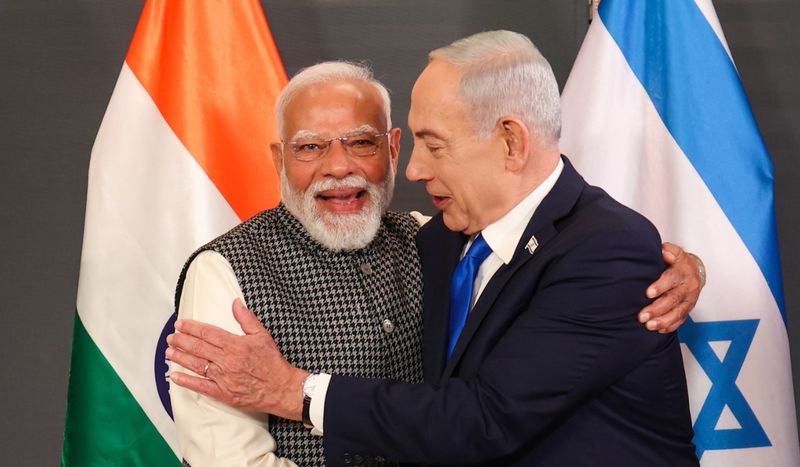
Modi visited Israel in February 2026; within two days of his departure, a joint US–Israel strike on Iran killed Supreme Leader Ali Khamenei along with numerous senior military and political officials. The Indian government neither condemned the attack nor issued a condolence message on Khamenei’s death.
During the visit, Modi declared that India stands firmly with Israel and will continue to do so. This statement came despite ongoing proceedings at the International Court of Justice concerning Israel’s conduct in Gaza, and arrest warrants issued by the International Criminal Court on November 21, 2024 against Benjamin Netanyahu for alleged war crimes and crimes against humanity, which ICC member states are obligated to act upon within their jurisdictions.
The strategic costs are irreversible in the short term
India has lost its only independent overland gateway to Afghanistan and Central Asia. The INSTC corridor – which could have been India’s answer to China’s BRI – has no southern anchor. The Farzad-B gas field that Indian engineers discovered produces gas for Iranian domestic companies. Afghanistan and Central Asian states have drawn their own conclusions about Indian reliability. Pakistan has strengthened its position with Tehran. China’s regional infrastructure dominance faces less competition. And India has sacrificed the energy diversification that Iranian oil provided – switching to more expensive Gulf and American supplies that increase India’s energy costs and its dependency on the dollar system.
And these costs do not include the cost of the US-Israel war on Iran, the outcome of which remains uncertain.
Anand Teltumbde is former CEO of PIL, professor of IIT Kharagpur, and GIM, Goa. He is also a writer and civil rights activist.
This article went live on May third, two thousand twenty six, at forty-eight minutes past three in the afternoon.
The Wire is now on WhatsApp. Follow our channel for sharp analysis and opinions on the latest developments.