
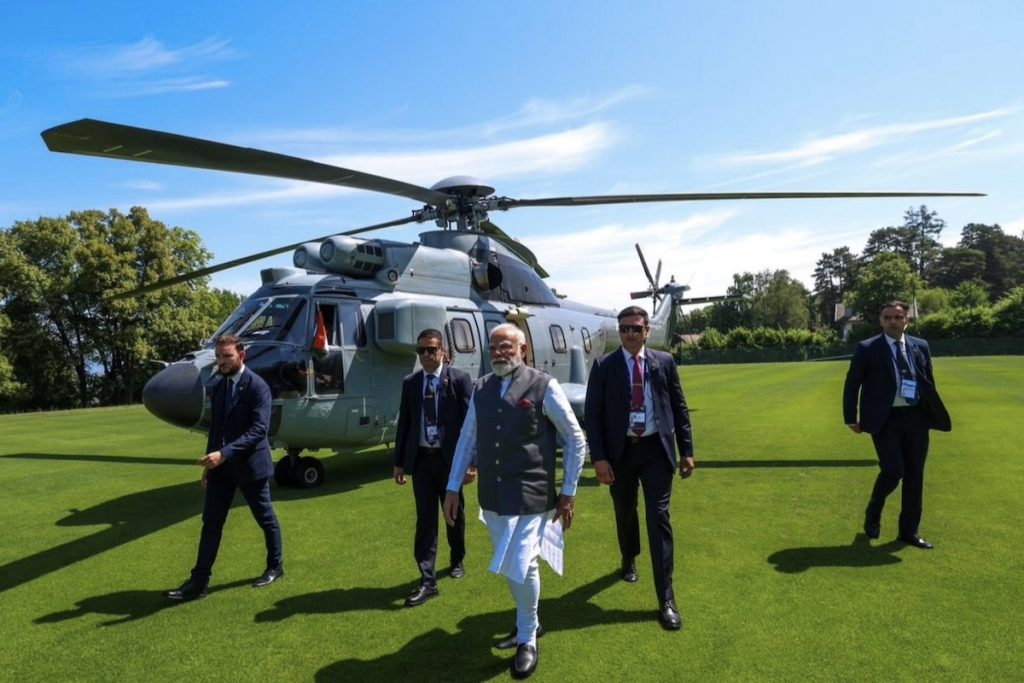
The 2026 G7 summit, in Evian, France, marks India’s 13th participation as a guest nation and Prime Minister Modi’s seventh appearance as India’s representative since 2019.
These repeated invitations highlight a central reality: India is too important to be excluded from major global conversations, even though it remains outside the world’s most exclusive club of advanced industrial democracies.
Since 2003, when France first invited India, its consistent presence at the G7 raises two questions: Why is India a consistent invitee to the G7 despite not being a member? And if its importance as a large democracy and fast-emerging open and liberal economy is acknowledged, then why does it remain outside the grouping?
The answer lies not only in what the G7 offers India but also in what the forum represents in a rapidly changing international order.
For the 2026 summit, the explanation is rooted in India-France bonhomie and burgeoning India-Europe ties. France is arguably India’s closest strategic partner in Europe.
French President Emmanuel Macron’s visit to India earlier this year for the AI Impact Summit, the launch of Bharat Innovates in France and the two countries celebrating 2026 as India-France Year of Innovation underscore the growing Indo-French convergence in AI and advanced technology, defense, civil nuclear cooperation, space and Indo-Pacific strategic dynamics.
From the Rafale fighter aircraft deal to joint naval exercises and maritime security cooperation, and deepening cooperation in green energy, labor mobility and Human Resource Development, Indo-France relations have reached new heights in recent years. Inviting India to the French-hosted G7 summit was, thus, widely anticipated, signaling how sincere New Delhi and Paris are about their Special Global Strategic Partnership.
Yet the reasons go beyond bilateral relations. India is also viewed as an important voice of the Global South and currently holds the 2026 BRICS Presidency. Unlike the G7 states, India occupies a unique position: it is simultaneously a rising power, a developing country that represents the Global South, and a major stakeholder in the existing international system.
This unique identity allows New Delhi to articulate concerns regarding development finance, food security, debt sustainability, climate justice, energy transitions, and the reform of international institutions in ways that resonate with a broad range of developing countries. India demonstrated its role as a true representative of Global South during its G20 presidency in 2023
India’s inclusion also invites comparison with China. Despite being the world’s second-largest economy, China is not a regular invitee to the G7, and relations between the two remain strained. India’s recurring presence shows how the grouping views the two Asian giants differently.
While concerns about China’s assertiveness, strategic rivalry with the West and economic coercion have grown in recent years, India is increasingly seen as a benign power that supports a rules-based international order while maintaining its strategic autonomy.
As a robust democracy with a liberal and open economy, expanding security cooperation with Western powers, and a preference for reform over disrupting existing institutions, it is a more acceptable partner for the G7 than China.
This raises another question: Does repeated participation lead India to eventual G7 membership? The short answer is yes and no. The significance of potential Indian membership is often overstated – and that is the key point.
First, India already has extensive engagement with all G7 economies through bilateral, minilateral, and multilateral frameworks. The US, Japan, France, Germany, Canada and other G7 members hold important positions in India’s diplomatic and economic landscape. India’s strategic partnerships, trade, defense, and technological collaborations do not depend on G7 membership.
Second, the G7 is not a formal international organization. Unlike the United Nations, World Trade Organization, or the European Union, the G7 lacks a treaty basis, permanent secretariat, legally binding obligations, or enforcement mechanisms.
It functions mainly as an annual consultative forum among advanced industrial democracies to coordinate positions on global economic and political issues. For India, this means participation offers access and influence, but not membership-based obligations or structural change.
Historically, the G7 emerged during 1975 amid the oil shocks and economic turbulence confronting Western industrialized economies. Initially comprising six members before Canada’s inclusion in 1976, it reflected a period when economic power was concentrated within the transatlantic community and Japan.
The world it represented was one in which the West accounted for most global output and exercised disproportionate influence over international institutions. That world has changed profoundly.
The center of economic gravity has shifted toward Asia, especially the Indo-Pacific region. Emerging economies now account for a growing share of global GDP growth, international trade, and technological innovation.
India and China have become major economic actors, while countries like Indonesia, Brazil and Saudi Arabia have growing influence in their regions. Meanwhile, Western-led institutions have seen their ability to shape outcomes unilaterally decline.
The rise of alternative platforms shows this transformation. The G20 and BRICS have become the leading forums for international economic cooperation because they include both developed and developing economies.
Regional organizations and issue-specific coalitions increasingly complement traditional Western institutions. The G7, while still influential, no longer dominates global agenda-setting.
This does not mean the G7 is irrelevant. It wields considerable economic power, accounting for 45% of global GDP, dominates advanced technology sectors, remains a major investor and aid provider, and shapes norms relating to finance, digital governance, and sanctions. Decisions reached among G7 members can shape international markets and broader geopolitical trends.
However, the G7’s influence today is mainly political and normative rather than institutional. For India, participation offers prestige, access, networking opportunities, and a chance to influence discussions, but it does not bring immediate economic gains or structural advantages.
Nor does participation amount to membership, which remains distinct from the benefits of regular engagement. Nevertheless, there are compelling reasons for India to continue engaging actively with the forum, even without membership.
The G7 provides India a valuable platform to engage Europe collectively. Four Western European powers — France, Germany, Italy and the United Kingdom — along with the EU, participate in the grouping.
Historically, India’s foreign policy prioritized its immediate neighborhood, major powers, and the Indo-Pacific. Europe held a secondary place. Over the past decade, New Delhi has invested more systematically in strengthening relations with its European partners.
The India-EU FTA is now a reality. India has expanded strategic dialogues with France and Germany, enhanced defense cooperation with several European countries, and increasingly sees Europe as a source of investment, technology, and diplomatic support. The G7 complements these efforts by enabling high-level engagement in a concentrated setting.
For the G7, India’s presence serves an important function. Including India enhances the forum’s relevance and legitimacy in a multipolar world. Critics, including US President Donald Trump, have questioned whether the G7 reflects contemporary geopolitical realities.
The participation of major non-member states like India helps counter perceptions that the grouping is an outdated club of Western economies disconnected from the wider world. Ultimately, India’s engagement with the G7 is less about joining the club and more about shaping the conversation. It allows New Delhi to advance its interests, project its voice, and reinforce its role as a bridge between the Global North and the Global South.
For India, engagement must not become dependence. New Delhi’s foreign policy is guided by strategic autonomy: maintaining productive relations with competing centers of power without entering rigid alliances.
Ultimately, India’s rise will not depend on securing a seat at the G7 table. Its economic transformation, demographic potential, technological capabilities, and geopolitical choices will shape its trajectory more profoundly than membership in any informal grouping. The G7 is a useful platform, but not a decisive one. India’s future would not be guaranteed by inclusion, nor constrained by exclusion.
Repeated invitations should not be seen as merely ceremonial. Since India participates regularly, it should capitalize on these opportunities more effectively—whether by advancing its positions on climate finance, advocating reform of multilateral institutions, attracting investment, strengthening technology partnerships or articulating the concerns of the Global South.
If the question of membership ever genuinely arises, India would then be able to decide from a position of confidence and strength. Until then, the G7 remains what it has increasingly become for New Delhi: a platform to be utilized, not an institution that defines India’s choices.
Rahul Mishra is a senior research fellow at the German-Southeast Asian Center of Excellence for Public Policy and Good Governance, Thammasat University, Thailand, and pssociate Professor at the Centre for Indo-Pacific Studies, School of International Studies, Jawaharlal Nehru University, New Delhi, India. He can be reached at rahul.seas@gmail.com and followed on X at: @rahulmishr_