
image:
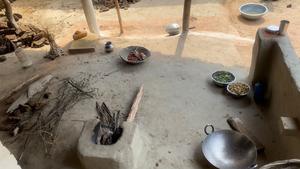
Traditional cooking arrangements, rural Uttar Pradesh. Credit: Dr Charumita Vasudev.
Credit: Dr Charumita Vasudev.
The COVID-19 pandemic pushed some households in India into difficult and often unsustainable coping strategies, forcing trade-offs between immediate survival and long-term stability, according to new research by Lancaster University and the Indian Institute of Technology, Kanpur (IITK).
The study documents how vulnerable families in India coped with food insecurity during the pandemic. It highlights how interviewed families sometimes went without food, medicine, and other essentials to cope with the fallout of the pandemic.
The research draws particular attention to how circular/recent migrant workers were most at risk among those interviewed, with limited alternative support systems available. The study examines how vulnerable households that depended on daily wages coped when COVID-19 disrupted their livelihoods.
Findings underscore the importance of local social networks and government support in coping with crisis.
The study highlights how additional government entitlements, particularly through the Public Distribution System (PDS), proved to be a critical lifeline for households with limited access to alternate income sources.
The research team spoke with 86 families between December 2022 to March 2023. Families spoke of ‘impossible choices’ they faced during the pandemic. These ranged from limiting food diversity to taking loans, delaying non-critical medical expenses and temporarily withdrawing children from school to facilitate everyday food expenses.
The new study, ‘Diverse coping strategies for food security: A qualitative study of economically precarious households in India in the context of COVID-19’ is published today in PLOS One.
The research team carried out 343 interviews in Uttar Pradesh and Goa.
From these interviews, a subset of households experiencing severe and continued COVID-related adversities were chosen to understand the impact of the pandemic on different members of the household including men, women and children aged seven years and older.
The study found that migration status and existing structural inequalities, such as poverty, critically shaped families’ resilience.
Coping capacity during COVID-19 depended less on income loss than on access to government support and social networks, both of which were rarely available for migrant workers, especially the more recent migrants.
Stressing the inter-dependence of rural and urban economies, the study discusses how COVID-19 triggered a wave of reverse migration (migrants returning to their native places) to rural areas.
This created intense pressure on already stressed rural economies and worsening inequalities.
As employment became irregular, the first strategies adopted by the interviewed households were to ‘smooth consumption’.
This meant shifting to less preferred foods, reducing expensive items, like dairy and meat, and limiting portion size with potatoes and cereals becoming primary fallback options.
This, says the research, can raise serious concerns about the nutritional impacts of the pandemic.
Women, who often enacted ‘maternal buffering’, were especially likely to absorb impacts of food scarcity themselves by cutting down on their own meals to ensure children and men had ‘enough’.
Families sharing homes began cooking jointly to conserve cooking fuel to ensure children did not go hungry. Some children were sent to live with grandparents/relatives when managing finances became difficult.
As lockdowns further compromised livelihoods, more severe strategies such as borrowing money for food, skipping meals, selling assets, and reverse migration to rural areas were adopted.
Some urban migrants within the study settings assumed they would have easier access to food in their rural homes due to agricultural stocks and established social networks.
However, for those with more limited resources, reverse migration placed additional pressure on single earning members, making it more difficult to provide for larger households.
Local social networks embedded in hierarchies of caste and class also proved essential when livelihood opportunities were scarce. During the COVID-19 pandemic, the Indian Government expanded support under the Public Distribution System (PDS) – a key food security scheme providing subsidised cereals and other staples to eligible households.
Cereal allocations were doubled, and additional items such as oil and chickpeas were introduced to promote dietary diversity. Complementary schemes were also launched to address heightened food insecurity amid livelihood disruptions.
These allocations, says the research, were crucial for maintaining access to food among vulnerable families in this period of crisis, highlighting the value of government support.
However, as PDS entitlements are typically tied to place of registration, many migrant workers were unable to access rations at their destination, reflecting longstanding challenges around portability.
Households without valid local PDS registrations, particularly recent migrants, remained highly vulnerable during disruptions.
One household of seasonal migrant brick kiln workers reported that their registration was linked to their home state, rendering them ineligible for local allocations at their place of work.
In the absence of formal support, they relied on daily meals provided by a local hospital in partnership with a non-governmental organisation.
According to the research: “The study underscores the importance of understanding context-specific household strategies to inform policies that aim to build long-term resilience.
“Conflicts, disease outbreaks and global interdependencies that disrupt global supply chains are becoming increasingly common.
“In this context, it is imperative for governments, communities and households to be better prepared for crisis events like COVID-19.”
Lead author Dr Charumita Vasudev said: “In an increasingly uncertain world, it is important to understand that household responses to global threats are not just about the crisis itself, but the existing structural inequalities and vulnerabilities that people are already coping with.
“Public policies like the PDS form the backbone of household’s resilience strategies. They, thus need to account for contextual vulnerabilities to ensure that short-term coping during crisis does not risk deepening of inequalities in the longer term.”
Article Title
Diverse coping strategies for food security: A qualitative study of economically precarious households in India in the context of COVID-19
Article Publication Date
10-Jun-2026