
Twelve years into the Narendra Modi-led Bharatiya Janata Party (BJP) government in New Delhi, and the unthinkable happened.
A minister in the Union Cabinet, Education Minister Dharmendra Pradhan, was forced to resign under massive pressure from student protesters demanding “accountability” for the leak of question papers for the National Eligibility cum Entrance Tests (NEET) on May 3.
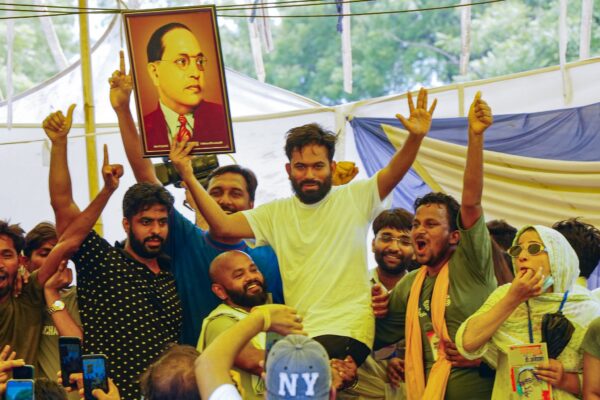
Pradhan’s resignation came 36 days after the Cockroach Janata Party (CJP) launched its indefinite mass protests at New Delhi’s Jantar Mantar calling for exactly that outcome. It is a major victory for the CJP, an online satirical campaign started by Abhijeet Dipke in May 2026, in response to a derisive comment by the chief justice of India equating unemployed youth to cockroaches. Dipke’s online campaign went viral, garnering an online support base of over 2 million.
But few would have expected then that the CJP, which morphed from an online protest into a mass Gen Z protest on June 6, would force the Modi government to bend.
Since 2014, when the Modi-led BJP came to power backed by an overwhelming majority, his government has ruled with an iron hand, crushing all forms of dissent and ruthlessly targeting its opponents, be it opposition politicians or others. Three successive election victories had further cemented the perception that the Modi government was invincible.
That aura of invincibility, carefully cultivated for over a decade, has now cracked, with Gen Z students forcing Pradhan to step down.
The CJP’S first reaction on X (formerly Twitter) to the minister’s resignation was clear: “Democracy Wins.”
“I am a Cockroach,” a 20-year-old student protester in Kolkata told The Diplomat,. “We students had one main demand — accountability. And we have achieved that,” she said, elated over Pradhan’s resignation.
India’s Gen Z protest has succeeded in introducing the word “accountability” into the political discourse in the country. Under Modi and his confidante Home Minister Amit Shah, accountability had practically disappeared.
In 2015, when the Congress Party called for the resignation of then-Foreign Minister Sushma Swaraj for facilitating fugitive Lalit Modi’s travel papers to Portugal, Defense Minister Rajnath Singh said: “This is not the UPA government, this is the NDA government. Ministers do not resign here.” BJP leaders repeated this thereafter to fend off demands for a minister’s resignation. Accepting moral responsibility is perceived by the BJP as a sign of weakness.
This was not the case when the Congress-led United Progressive Alliance was in power (2009-2014) and the BJP, then in opposition, demanded and secured the resignation of several top Congress ministers. Unlike the UPA, Modi and the BJP did not, at any cost, want to set a precedent in which cabinet ministers would be held liable for actions under their government’s watch.
Before Pradhan, the only minister in the Modi government to have resigned was M. J. Akbar, the junior foreign minister in 2018, who was accused of sexual harassment during his time as an editor.
The Gen Z protesters were undeterred by the BJP’s rigid reluctance to take responsibility for scams and scandals. Fixing “accountability” was a buzzword during the protests. The CJP wanted authorities to be held responsible, especially for the 21 students who took their lives following the NEET paper leak.
Over the past decade, the Modi-Shah duo had managed to quell agitations and topple governments in opposition-ruled states. It used central agencies to intimidate opposition politicians into joining the BJP. This template had succeeded in providing stability to the BJP-led National Democratic Alliance government, in office since 2014.
Many commentators have noted that Gen Z is fearless and irreverent as a generation. It doesn’t care for nor worship those in authority. Unfettered by concepts like “respect for elders” that limited millennials when dealing with authority, Gen Z speaks without fear.
In response to the paper leaks, Modi called on his ministers to “get more active on Instagram,” as if that was a solution to the problem. Dipke wrote on X, “This is why a PM should be educated,” a reference to Modi’s lack of education.
The biggest casualty of the protests is Modi’s strong man image. The Modi regime and Modi himself had gone to great lengths to conjure an image of him being almost “non-biological,” with a manly “56-inch chest,” a heroic figure within the country and much-sought after leader abroad.
Gen Z lampooned this personality cult through slogans, memes, and limericks, poking fun at the “56-inch small monkey” and heckling him to flee.
While the CJP’s stated demand was for the education minister’s resignation, it was Modi who was the target of songs, slogans, reels, posters, memes, and graffiti. Modi’s image has taken a beating. This possibly hastened the government’s decision to concede the protesters’ demand.
This does not bode well for the Modi–Shah regime.
Modi was among the first Indian leaders to leverage social media, which played an important role in his coming to power in 2014. He has often gloated about his huge following on social media. Gen Z have now used the same social media space and mainly Instagram to demolish Modi’s strong man image.
The other big takeaway of the Gen Z victory has been the discrediting of the BJP’s media management framework. The BJP’s control of the news media, especially TV channels, which have a wide audience outreach, has played an important role in disseminating propaganda so far. But this “lap dog media” was thoroughly discredited by the protesters. The latter did not allow them to set the narrative, and even though news channels tried to defame the protesters as anti-nationals, funded by foreign agencies, peopled by vandals and thugs, the students fought back by posting reels and real-time videos, showing the real picture on the ground.
The stark difference was evident, especially when the government brutally cracked down on the protesters on July 20. While pro-government channels portrayed it as violence by students, independent journalists laid bare the inhumane use of pellet guns and batons on students, leaving them with bloody injuries. In fact, this use of excessive force boomeranged on the regime, drawing in sympathizers ranging from cinema actors to opposition leaders.
The government’s media management strategy in response to the farmer protests of 2021, the anti-CAA protests of 2019-20, and other protests did not work this time around. Even the BJP’s “IT cell,” which relentlessly trolls opposition protests, proved no match for Gen Z creativity.
The Modi regime’s inability to gauge or tackle Gen Z anger stands exposed.
Youth account for 30 percent of India’s electorate. The Modi government cannot afford to ignore student frustration with the education system and unemployment — issues that it has been diverting attention from.