
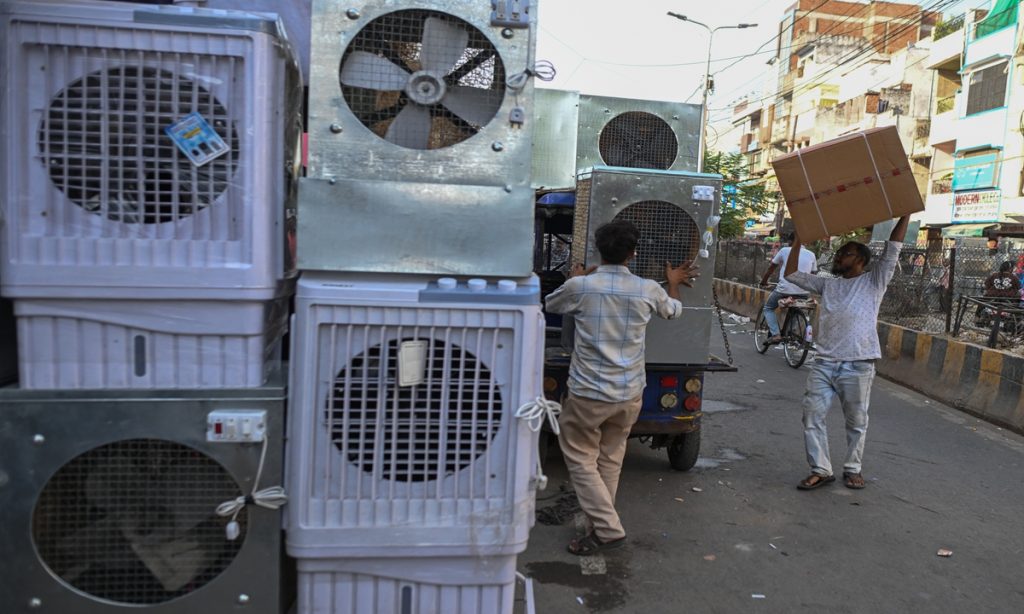
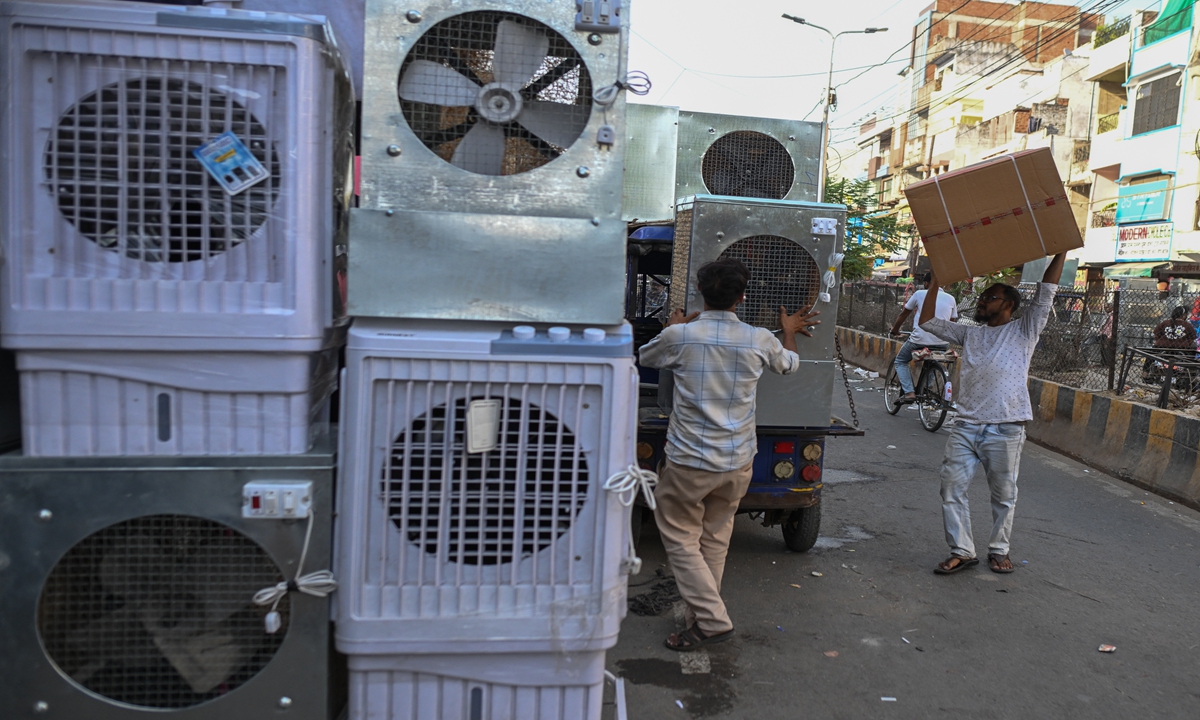
People unload air coolers from a delivery truck at a wholesale market amid rising temperatures and heatwave conditions in Allahabad, India, on May 21, 2026. Photo: VCG
One month has passed since the issuance of a May 8 order by India’s Department for Promotion of Industry and Internal Trade, which linked compressor imports in the current fiscal year to a percentage of volumes imported in fiscal 2025.
Under the new rules, India has extended conditional import exemptions for compressors, which allow Indian manufacturers to import compressors for refrigerators up to 40 percent of fiscal year 2025 import volumes and for air-conditioners up to 30 percent, both for capacities of up to 2 tons, according to Press Trust of India (PTI).
The order was issued as India’s demand for cooling appliances is about to enter its annual peak, and with domestic compressor capacity still far from sufficient, the order has naturally fueled growing concern and warnings within the industry. Chief executives of India’s air-conditioner and refrigerator manufacturers said that the move may have been aimed at conserving foreign exchange and accelerating localization, but they warned that the sector was unprepared for such restrictions at a time when demand has surged amid a heat wave, the Economic Times reported last month.
India has been gripped by extreme heat these days, with temperatures in many areas breaking records and fueling an unprecedented surge in market demand for cooling devices, amplifying the supply chain risks the new order has created.
New Delhi’s intention behind the restrictions on compressor imports is obvious. By erecting trade barriers, India aims to force domestic industry upgrading and gradually reduce its dependence on imported supplies. However, this approach completely ignores the fundamental nature of the compressor industry – a sector that is technology-intensive and capital-intensive, and demands years of accumulated technical and production know-how. In this context, the move is severely out of step with India’s industrial reality, where domestic capacity remains grossly insufficient, inevitably creating market contradictions and supply chain risks.
Compressors are the irreplaceable heart of air conditioners and refrigerators. Their production requires the long-term accumulation of multiple advanced capabilities – precision manufacturing, materials science, and variable frequency control, to name just a few. After decades of consolidation, the global compressor industry has formed a highly concentrated supply chain.
Although India’s import order does not explicitly target China, the objective fact is that China, relying on its complete full industry-chain layout, mature production processes, and stable delivery capacity, has been a major supplier of India’s compressor imports. The advantages of Chinese companies in this field were built step by step through economies of scale, continuous technological iteration, and a complete upstream and downstream ecosystem.
A glaring capacity gap further undermines the justification for the import curbs. According to Indian media reports, India’s annual air conditioner compressor manufacturing capacity is 7 to 8 million units against demand of about 15 million units. For refrigerators, annual demand is estimated at 14.5 to 15 million compressors, against domestic production capacity of 8.5 to 9 million units. Slashing core component imports under such a supply shortage is essentially a disruption to the existing industrial supply chain.
For years, the Indian government has sought to accelerate domestic manufacturing through various administrative measures. While the pursuit of industrial self-reliance is understandable, its aggressive and hasty policy approach has largely overlooked the specific development requirements of the compressor industry.
Furthermore, the timing of the policy only worsens the situation.
The government chose to impose these import restrictions precisely when demand for cooling appliances is expected to peak under scorching heat waves. This is not industrial upgrading – this is making consumers and businesses pay the price for policy.
Industrial upgrading can never be achieved through arbitrary administrative intervention. It relies on systematic and long-term efforts, including sustained technology introduction, professional talent training, infrastructure improvement, and market incubation.
Replacing market-oriented allocation with administrative quotas and substituting industrial accumulation with trade barriers will never help India realize genuine industrial independence. On the contrary, such counter-market moves will stifle industrial vitality, disrupt market order, and hinder the long-term healthy development of India’s manufacturing sector.
In the face of scorching heat waves and soaring needs for people’s livelihoods, ensuring a stable supply of cooling appliances and protecting basic living standards must come first. Protectionism and hasty administrative intervention will only defy industrial logic, locking India’s manufacturing sector into a vicious cycle of isolation and stagnation. With core component capacity falling short, the pragmatic choice is clear: engage in international industrial cooperation and use mature overseas supply chains to keep the market stable.