
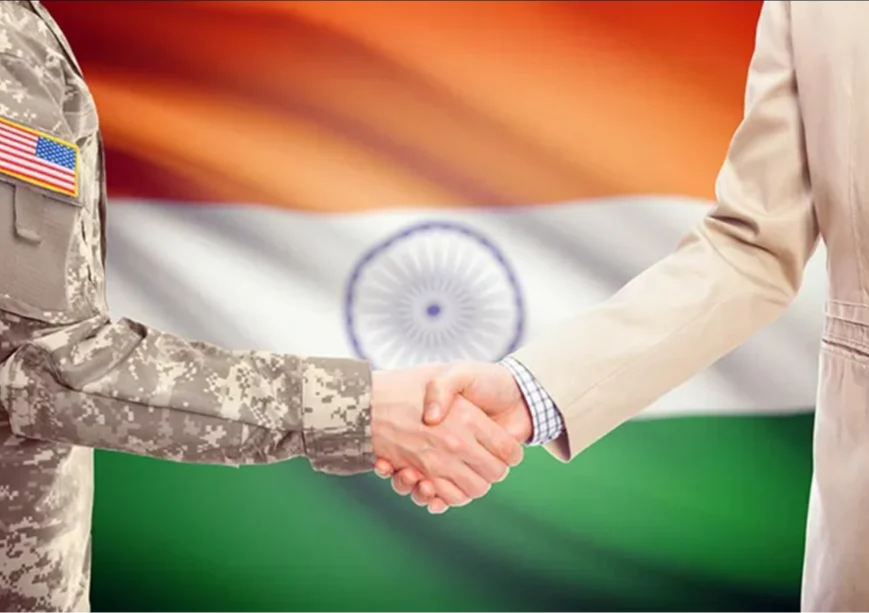

US Undersecretary of War for Policy Elbridge Colby’s March 2026 speech in India matters not because it introduced a new US approach, but because it clarified what the bilateral relationship has already become. Over the last several years, the defence partnership has evolved from one important pillar of cooperation into a central stabilising force in US-India ties. Trade frictions, political distrust, and renewed Indian concern over US signalling on Pakistan all strained the broader relationship. But the defence track kept moving. Exercises continued. Dialogue mechanisms remained active. A new ten-year defence framework was signed. Co-production and operational coordination stayed on the agenda. That continuity matters because it reveals where the relationship is now deeply institutionalised.
Today, Washington increasingly sees India less through the language of broad strategic aspiration and more through the harder logic of balance, capability, and military utility. That framing matters because it aligns more closely with how India has long understood itself, as a strategically autonomous power willing to partner, but not subordinate. The US-India military relationship has acquired enough density, continuity, and institutional weight to anchor the broader partnership even when other areas come under strain. If managed well, that defence core can also become the main foundation for restoring momentum after the setbacks of the last year.
When the relationship came under political pressure, the defence track proved more resilient than the diplomatic atmosphere surrounding it.
Three features of the current US approach stand out. First, it places India at the centre of the regional balance of power. Second, it defines the relationship in explicitly interest-based terms. The United States wants strong partners pursuing their own national interests, not dependent states. For India, that is a significant message because it validates strategic autonomy rather than treating it as an obstacle. Third, it places defence cooperation at the centre of the relationship’s next phase, emphasising interoperable capability, practical military coordination, and co-production in areas such as logistics, maritime awareness, anti-submarine warfare, and advanced technologies. Taken together, those three clarify a new hierarchy: India is strategically central, the partnership is grounded in hard interests, and defence is the main vehicle through which that convergence can now be operationalised.
The larger analytical question, then, is whether the evidence supports that hierarchy. In October 2025, the United States and India signed the renewed Framework for the US-India Major Defense Partnership. The framework expands interoperability across land, sea, air, space, and cyberspace. Notably, it also prioritises maritime security and maritime domain awareness, expands operational coordination, deepens information sharing, and advances joint development and production of defence capabilities. It also gives formal continuity to the 2+2 process and to INDUS-X, linking military cooperation more closely to industrial and technological collaboration.
That framework also matters because it came at a moment of stress. By early 2026, the broader relationship had absorbed real damage. Trade disputes sharpened Indian scepticism of Washington. US signalling on Pakistan aggravated long-standing concerns in Delhi. India also continued widening some of its external options, including through diversified defence procurement. Those constraints are real and should be acknowledged directly. But the more important analytical point is that defence and security cooperation still largely held its course. When the relationship came under political pressure, the defence track proved more resilient than the diplomatic atmosphere surrounding it.
That resilience is the result of a longer maturation process. The US-India defence relationship today is not what it was a decade ago, and certainly not what it was two decades ago. Over that time, the two countries moved from limited defence contact to a structured and expanding military partnership. India has concluded roughly US$24 billion in defence deals with the United States since 2008 and now participates in exercises with the United States more than with any other country. Those exercises have also increased in scope, frequency, and complexity, including the first tri-service Tiger Triumph exercise and increasingly advanced iterations of Yudh Abhyas, an annual joint military exercise designed to improve interoperability and joint tactical skills. The same record also points to the foundational agreements that changed the mechanics of cooperation: COMCASA, the Industrial Security Annex, and BECA. Those agreements enabled secure communications, sensitive industrial coordination, and geospatial information sharing. In other words, they created the operating architecture for a more serious military relationship.
Buying from multiple suppliers does not by itself mean the bilateral relationship is weakening. A better measure is interoperability: whether the two countries’ forces can operate more easily together, sustain shared systems, exchange information more effectively, and plan around common contingencies when interests converge.
This is why the relationship should no longer be judged primarily through the lens of sales totals alone. Defence trade is important, but it is not the single best measure of strategic depth. India will continue to diversify its procurement profile. That is normal for a major power committed to strategic autonomy. Buying from multiple suppliers does not by itself mean the bilateral relationship is weakening. A better measure is interoperability: whether the two countries’ forces can operate more easily together, sustain shared systems, exchange information more effectively, and plan around common contingencies when interests converge. By that metric, the relationship is moving forward, not backwards.
The 2025 framework makes that explicit. It places interoperability at the centre of the partnership and calls for expanding logistics cooperation, sharing best practices on common equipment, increasing the frequency and complexity of exercises, and enhancing collaboration in military training and education. That is a more consequential benchmark than mere procurement value because interoperability compounds over time. Repeated exercises, familiar systems, secure communications, and professional education create habits of coordination that are difficult to reverse. The relationship becomes embedded not only in platforms, but in institutions and people.
The industrial side of the relationship reinforces that trend. US-India defence ties are increasingly about shared production and capability development, not just transfers of finished platforms. Pentagon reporting in July 2025 stressed US hopes to complete pending sales, expand defence industrial cooperation and coproduction, and strengthen interoperability. It also listed the wide range of US systems already integrated into India’s inventory, including C-130Js, C-17s, P-8Is, Chinooks, MH-60Rs, Apaches, Harpoons, M777s, and MQ-9Bs. These are systems that strengthen training relationships, maintenance relationships, doctrinal familiarity, and operational habits over time.
Washington increasingly understands that the path to a stronger defence relationship is not Indian dependence on US supplies, but an embedded ecosystem of shared production, technology cooperation, and capability growth.
The next phase of the relationship matters even more because it moves beyond acquisition into co-development and industrial partnership. The 10-year framework explicitly envisions joint development and production in Intelligence, Surveillance, and Reconnaissance (ISR), undersea domain awareness, air combat and support, munitions, mobility, and advanced technologies. It also backs the idea of India as a regional logistics, maintenance, and overhaul hub. Washington increasingly understands that the path to a stronger defence relationship is not Indian dependence on US supplies, but an embedded ecosystem of shared production, technology cooperation, and capability growth. That point is especially important for India, which will continue to seek diversified procurement while also trying to build a more self-reliant defence base. A mature partnership should be able to accommodate both realities at once.
One of the most important lines in the framework is its call to deepen collaboration in military training and education. That points to a deeper kind of interoperability. Officers who train together, study together, and build relationships early in their careers shape how future coordination works in practice. This dimension is often overshadowed by major platform sales, but analytically, it may prove more durable. Interoperability is not only technical. It is institutional and human.
There is also a broader strategic reason why defence has become the anchor of the bilateral relationship. It is the area where convergence is clearest. Both countries want an Indo-Pacific in which no single power dominates. Both place high importance on maritime security, regional balance, and practical capacity.
None of this means the defence relationship is frictionless. There are still regulatory barriers, procurement differences, and bureaucratic delays on both sides. A prolonged political downturn could eventually affect the defence track more seriously, and India’s diversification is real. While the current political mood does not indicate a continued downward trajectory, the moment still merits caution. Washington also still has work to do to rebuild trust after the shocks of 2025. But the defence track does not need to solve every bilateral problem to anchor the relationship. It only needs to remain the area of strong strategic convergence, deep institutionalisation, and strong forward motion. At this point, it clearly is all of the above.
If Washington wants to push the relationship back to a stronger footing, defence is the most reliable channel through which to do it. That means moving faster on co-production, reducing bureaucratic drag on defence industrial cooperation, and continuing the expansion of military education and training. It also means managing the political context more carefully, especially with regard to Pakistan.
The policy implication follows directly. If Washington wants to push the relationship back to a stronger footing, defence is the most reliable channel through which to do it. That means moving faster on co-production, reducing bureaucratic drag on defence industrial cooperation, and continuing the expansion of military education and training. It also means managing the political context more carefully, especially with regard to Pakistan, so that strategic cooperation does not carry avoidable political costs for New Delhi. India, for its part, should see in this moment a real opportunity. A US approach increasingly driven by security interests, industrial resilience, and balance-of-power logic suits India far better than one centred on ideological alignment or alliance discipline.
The bilateral defence relationship has matured into a consequential, institutionalised, and expandable aspect of the partnership. In a year when other aspects faltered, this is the one that held. If US-India ties are going to regain momentum and grow stronger from here, they will have to do so, in part, through the channel that has already proven it can withstand pressure: defence.
Riaan Dhankhar is a US-Nehru Fulbright Scholar based in New Delhi, where he researches US policy in the Indo-Pacific and the US-India bilateral relationship.
The views expressed above belong to the author(s). ORF research and analyses now available on Telegram! Click here to access our curated content — blogs, longforms and interviews.