
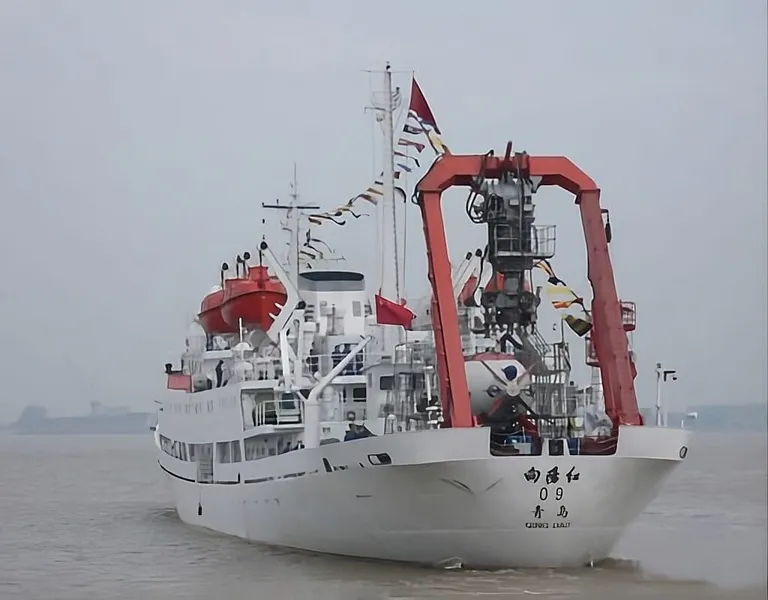
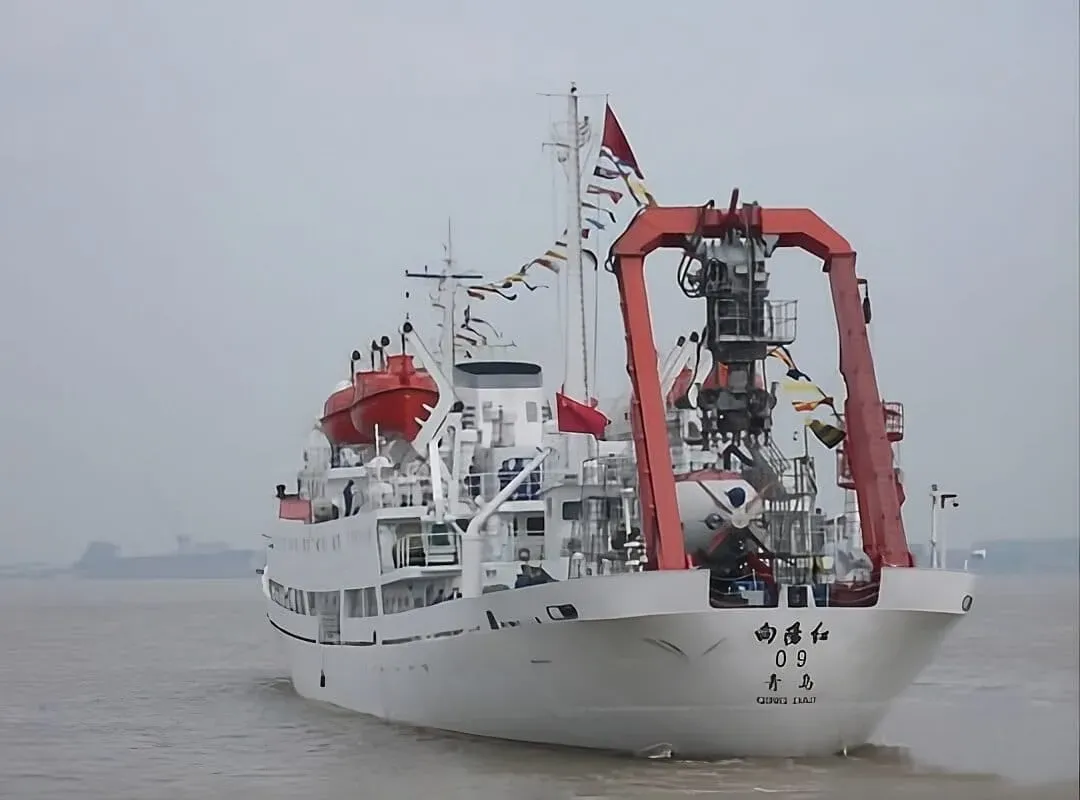
We didn’t initially set out to investigate China’s deep-sea mining fleet, but as our research into other aspects of the burgeoning industry developed over our year-long partnership, it became clear that an investigation into the alleged dual-use of the country’s deep-sea mining fleet was imperative.
Shortly after we embarked on our joint project, geopolitics around the deep-sea mining landscape began to shift dramatically. In February 2025, China signed an agreement with the Cook Islands government to collaborate on deep-sea mining research and exploration. At the same time, they were pursuing a similar deal with Kiribati, marking a notable expansion of Chinese influence in the Pacific.
Meanwhile, deep-sea mining efforts were gathering pace in the United States. In March 2025, The Metals Company, a Canadian deep-sea mining firm, had announced its intention to file a mining application in the U.S., despite already holding an exploration license with the International Seabed Authority (ISA), the UN-associated deep-sea mining regulator. Critics argue that such a move would violate international law and constitute a breach of its obligations to the ISA. A month later, the Trump administration released an executive order calling for the U.S. government to unilaterally accelerate its deep-sea mining plans in both national and international waters, citing one of the main reasons as to “counter China’s growing influence over seabed mineral resources.”

As a nonprofit journalism organization, we depend on your support to fund more than 170 reporting projects every year on critical global and local issues. Donate any amount today to become a Pulitzer Center Champion and receive exclusive benefits!
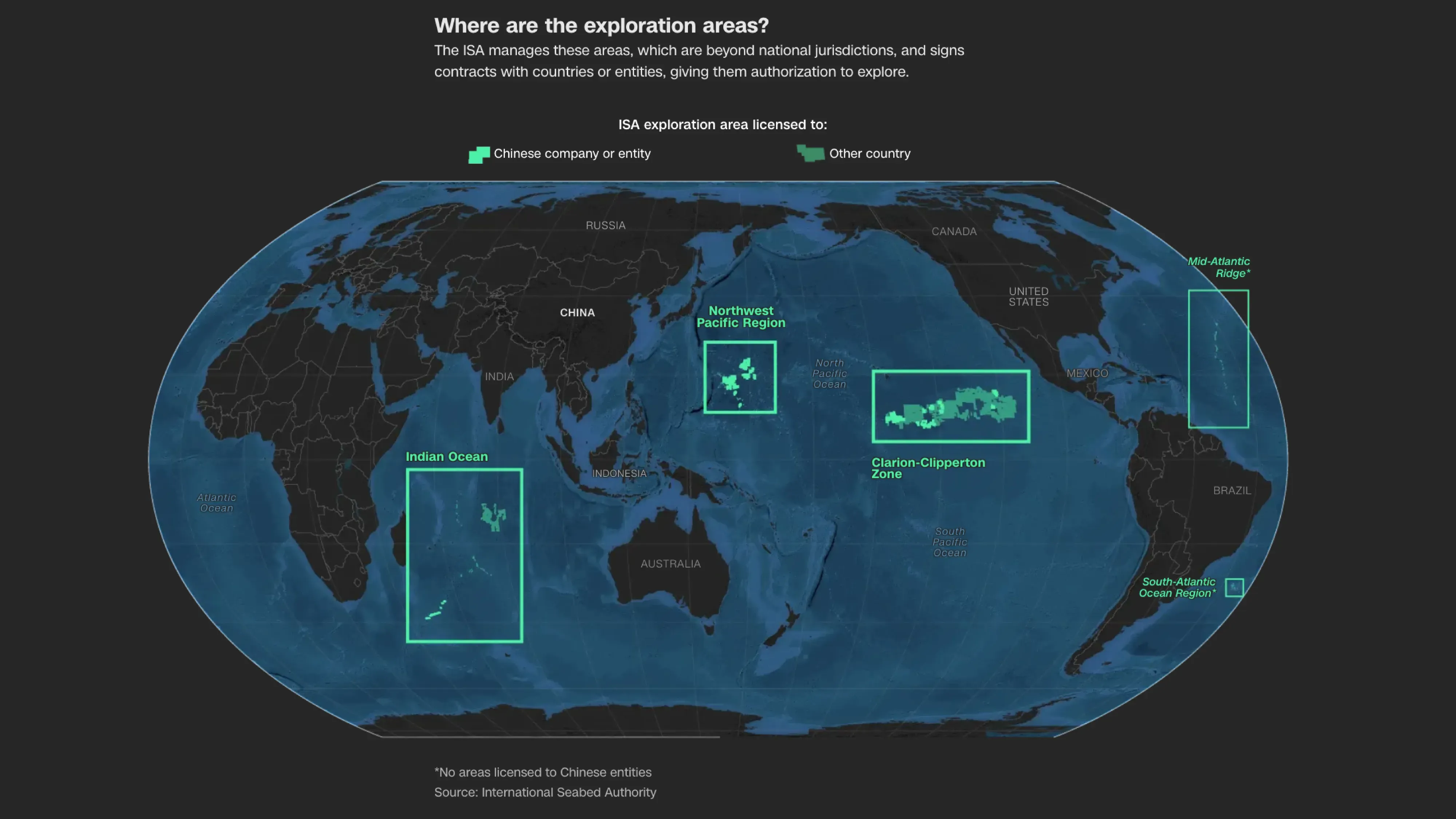
China holds the largest number of exploration contracts through the ISA and is also its biggest financial contributor. It also operates the world’s largest oceanographic research fleet. Against this backdrop, we kept returning to a central question: was China’s pursuit of deep-sea mining driven solely by access to mineral resources, or was it also shaped by broader geopolitical strategy? We established a theory that China’s interest in seabed mining was motivated by both of these things, and that some of its vessels were engaged in both deep-sea mining work and strategic surveillance.
Working as a collaborative team, we merged our distinct expertise to uncover complex maritime insights.
Together, we analyzed five years of Marine Traffic data, submitted targeted public information and freedom of information requests, and established relationships that provided crucial feedback and supported our findings. Supported by data editors from our respective organizations and the invaluable help of the research and data team at the Pulitzer Center, we transformed raw data and those expert reviews into a comprehensive, cross-verified investigation.
Expert guidance
We started with what was already in the public domain, engaging with with experts who had written about the alleged dual nature of China’s oceanographic fleet. This included Darshana Baruah of Indo-Pacific Defence and Strategy at IISS–Asia in Singapore, Liselotte Odgaard of the Washington D.C..-based Hudson Institute, and Pooja Bhatt of the Jindal School of International Affairs in India. We also engaged with researchers from the Washington-based Center for Strategic Studies (CSIS), whose foundational work on the dual use of China’s oceanographic fleet Indian Ocean in 2024 not only supported our thesis but also whose expertise helped us navigate some of our original thoughts around our approach and provided additional feedback at another juncture in our investigation.
Next, we needed to identify China’s vessels involved in deep-sea mining research. We did this by looking at ownership information from Chinese deep-sea mining companies, state media and Chinese news sources, and a recent publication by Ryan D. Martinson of the U.S. Naval War College’s China Maritime Studies Institute. Ultimately we landed on a list of eight vessels based on data showing whether they had spent time in ISA exploration sites contracted to Chinese companies (and one reserve area designated by a Chinese company to the ISA) over the past five years.
We analyzed five years of vessel-tracking data from MarineTraffic, a global maritime intelligence platform to identify these vessels’ patterns and any activity that suggested unusual activity to further investigate.
We began by focusing on the following criteria for our analysis:
- visits to known Chinese military ports
- voyages and loitering in other countries’ exclusive economic zones (EEZs)
- periods when vessels turned off Automatic Identification System (AIS) tracking , which is a radio signal with identification and location data that active vessels are supposed to emit
We used QGIS, a geographical data visualization and analysis tool, to map out our initial data points and also accessed vessel track data on the newly launched Deep Sea Mining Watch platform, which provided a user-friendly interface to support our own work.
This vessel track data revealed several notable insights.
Over the past five years, these eight vessels spent a combined 814 days, operating in or near areas licensed or reserved for exploration by the ISA, underscoring China’s strong interest in deep-sea mining. At the same time, the data led to a key finding in our investigation: only about 6.4% of the vessels’ total operating time was spent within ISA-designated exploration zones. The vast majority of their activity occurred outside these areas.
But what were these ships doing in other parts of the ocean?
When we identified activity that appeared to be worth investigating, such as a vessel loitering in another country’s EEZ or appearing to disable their Automatic Identification System (AIS) — a mandatory, automated maritime tracking system — we cross-referenced those timings with any news or developments that might already be in the public domain, looking for information in local media or from reputable local analysts to gain clues.
We also took a selection of routes, movements and AIS-off events to more than a dozen naval, civil, and academic analysts, screenshooting or showing them the maps in real time, so that they could verify what we had identified and provide additional context and insight into routes’ significance.
For data on the AIS-off events and movement near undersea cables, we obtained additional data support from Starboard Maritime Intelligence, a platform utilized by government agencies, defense forces and critical infrastructure operators to analyze maritime risks.
At the same time, maintaining a strong focus on the environmental implications of the deep-sea mining industry was essential to our story, particularly for the readers at Mongabay. We drew on existing scientific research and interviews with environmental experts, who outlined potential impacts on both the seabed and the wider marine environment, some of which could be long-lasting or irreversible.
Lessons from the voyage
Ultimately, distinguishing whether Chinese vessels are conducting scientific research or gathering military intelligence relies on expert interpretation of data. To back up our thesis, we took multiple specific findings to our multiple experts, sometimes many times, to check and recheck.
One of the most important parts of our work was taking preliminary findings to multiple subject-matter experts to fact-check data and uncover new leads.
At times, our experts offered conflicting interpretations of the data, so we would return to the drawing board to re-evaluate, remembering that it is far better to have a finding challenged — or even dropped — at the pre-publication stage than to face a correction later.
We found that if a lead was shrouded in conflicting opinions, we should walk away from it all together.
We also engaged experts during the hypothesis stage to build rapport and set the tone for our investigation. By the time we had specific data points to highlight, our sources were already invested in the project, with many incredibly helpful in providing deep-dive feedback.
We sought a global and multidisciplinary panel, consulting over a dozen experts across several continents, balancing naval intelligence with academic rigor to ensure a 360-degree view. But one limitation was that we couldn’t include everyone in the final copy. We struggled with this, as all of our experts had such rich and important perspectives to bring, but we were ultimately bound by the limitations of space.
We also acknowledged that we didn’t both need to be data scientists to produce data-driven journalism; the collaboration on this story was key. We partnered with colleagues in both of our newsrooms who were able to support our technical needs and who helped with mentoring on some steps throughout the process.
While we utilized QGIS after training with the Pulitzer Center’s data team, tools like the Deep Sea Mining Watch platform, as well as Kpler and Google Earth also offered powerful, accessible alternatives.
Working as a collaborative team
We were introduced through one of Elizabeth’s colleagues, Erik Hoffner, Mongabay’s impact editor, who had met Kara at a Society of Environmental Journalists (SEJ) conference in Philadelphia in 2024, during her Ted Scripps Fellowship in Environmental Journalism. After an initial call, we quickly decided that we wanted to work together, driven by a shared interest in telling stories about deep-sea mining. At the same time, we recognized that CNN and Mongabay are very different platforms, and that a single, identical story may not necessarily work for both.
While our published pieces ended up being similar, we worked towards what was most appropriate for our respective platforms and audiences. The CNN story took a deeper dive into the geopolitics, particularly surrounding China’s vessel movements in the South China Sea. Mongabay devoted more attention to China’s overall role in deep-sea mining, analyzing vessel activity in mining zones, highlighting the extent of Chinese exploration areas, and expanding on the environmental stakes.
Our two stories also presented this work differently, with CNN’s visual production a visually rich, highly interactive feature and Mongabay’s incorporating beautifully designed static graphics throughout, with some interactivity focused on one of the vessels.
Working collaboratively comes with its challenges, especially when balancing the demands of our respective newsrooms, but what carried the project through was clear and consistent communication, mutual respect for each other’s work, and a shared determination to see the project to completion. It also helped that we genuinely enjoyed working together.