
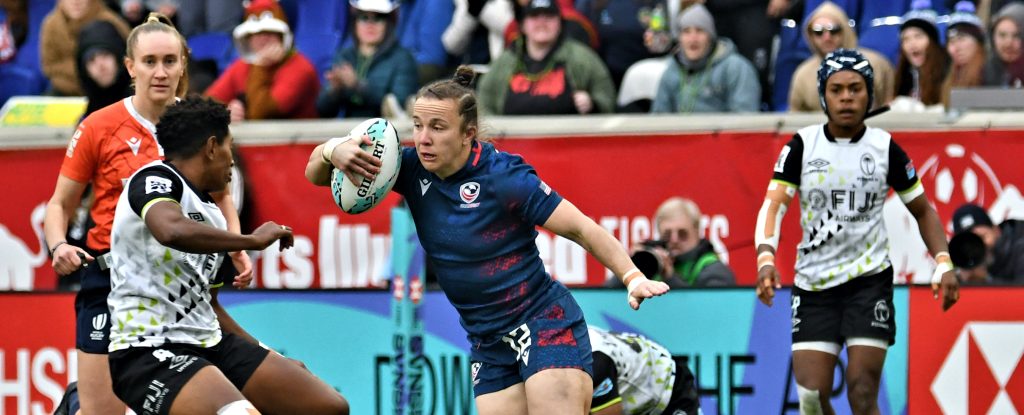
Hong Kong beckons now for the USA women’s 7s team and there’s a special aura around that event.
“I think what’s really unique for me, and something that we’re talking about a lot this week, is that we have a 2008 women’s team, one of that, really important generations of USA women’s 7s, who won Hong Kong in 2008 and coached by Jules McCoy,” said Head Coach Emilie Bydwell. That was all the the people that I came into rugby looking up to: Amy Daniels, Ellie Karvoski, Ines Rodriguez … I can name them all, but it would take too long. These women were just so incredible. And they were just such like the GOATs; they were playing outside the stadium. And now we get this opportunity to come back to Hong Kong 7s. I think that is really special.”
[We’ll add some of the other names from that team: Christy Ringgenberg, Jenn Starhey, Teena Mastrangelo, and future NASA astronaut Jess Watkins … that group was indeed a special group.]
That 2008 team ended up taking 3rd in the first ever women’s 7s World Cup a year later, and did, indeed, have to play their games in the muddy outside fields, until the final, which they won in the stadium. It was a landmark event in the push to make Rugby 7s an Olympic sport. Winning Hong Kong, after all, was for decades the pinnacle.
“This team gets to come and be here and be in the forefront of it because of what those women did, and so I think that is really special, because you don’t have that at every tournament,” said Bydwell. “You know, “We don’t have this legacy at every tournament the same way that we do in Hong Kong.”
Steps Forward
As for what’s next, now the SVNS Series expands. There will be 12 teams in each event, meaning each pool will be, supposedly, easier.
What the USA showed last event in New York was that they won the game they should win convincingly, 47-0 over Japan. They won the game they needed to win in impressive fashion 24-0. They lost to the top two teams in very close matches, matches they felt they could have won. And they won the third-place game, which has been a stumbling block for them.
“It was definitely a step forward,” said Bydwell. “And I think what was really interesting about the regular season was how much we’ve changed as a team in terms of how we’re trying to play and what our playing philosophy is, what our game model is. We really tried to use the first six tournaments to collect as much data as possible around what types of key performance indicators, or what were the things that tell us are we playing the way that we want to play.”
Such as? Such as defensive disrupt rate. Were the Eagles able to disrupt their opponents’ possessions? Were they able to create turnovers, and, crucially, were they able to convert those turnovers into points?
In Vancouver and New York they doubled their turnovers-created rate, and doubled the amount of points scored off those turnovers. In 7s, every possession is a scoring chance, so a turnover and score is a potential 10-point to 14-point turnaround. In games that are often decided by that margin or less, turnovers or precious … or devastating.