

Matthew Yip grew up in a Hong Kong flat with no bedroom of his own. His father drove a bus. His mother kept the house. Money was tight enough that when Matthew started university, he wasn’t taking tutoring jobs for pocket change; he was taking them to stay enrolled. What’s interesting is what happened next. Sitting in lectures, he kept losing the thread, not because his professors were bad, but because he’d decided mathematics didn’t actually transmit that way. “This was not because they taught poorly,” he says, “but because mathematics has a unique learning mode.” So he started teaching the way he wished he’d been taught, and a tutor’s side hustle slowly hardened into a thesis about everything wrong with how the subject reaches students.
That thesis is now Matthew Yip’s life’s work. Known to students and peers as “Prof. Mathewmatician,” the Hong Kong educator has spent his career arguing that math instruction fails most learners by design, and building tools meant to fix it.
A Classroom Problem He Couldn’t Stop Seeing
Ask Matthew Yip what’s broken and he doesn’t reach for abstractions. He points at the mechanics. Standardized curricula, he argues, move at one speed for students who learn at many. “Teachers usually provide only a brief period for students to grasp concepts before moving on, leaving students with minimal time to review or ask questions.” He’s equally pointed about internal school assessments, where, in his telling, the incentive runs backward: a teacher who wants every student to pass simply writes an easier test, and the grade stops meaning anything.
Mathematics Olympiads frustrate him for the opposite reason. They function as contests rather than measurements, he says, often age-restricted, frequently stuffed with questions past the syllabus, and structured so that a few right answers win a medal. The result rewards whoever could afford the most preparation. For a man who funded his own education by tutoring, that last part lands personally.
Building the Fix Instead of Describing It
Plenty of educators diagnose. Matthew Yip built. His central project is the Global Mathematics and Mathematics Olympiad Graded Assessment Test with Competition, an evaluation system he founded to do something the standard exams don’t: assess students at every grade with a detailed grading ladder, open to any age, with a free preparatory course attached so a student’s family income stops dictating how well they can prepare. The free-prep piece is the tell. It’s the part of the design that maps directly back to a kid who couldn’t pay for an edge.
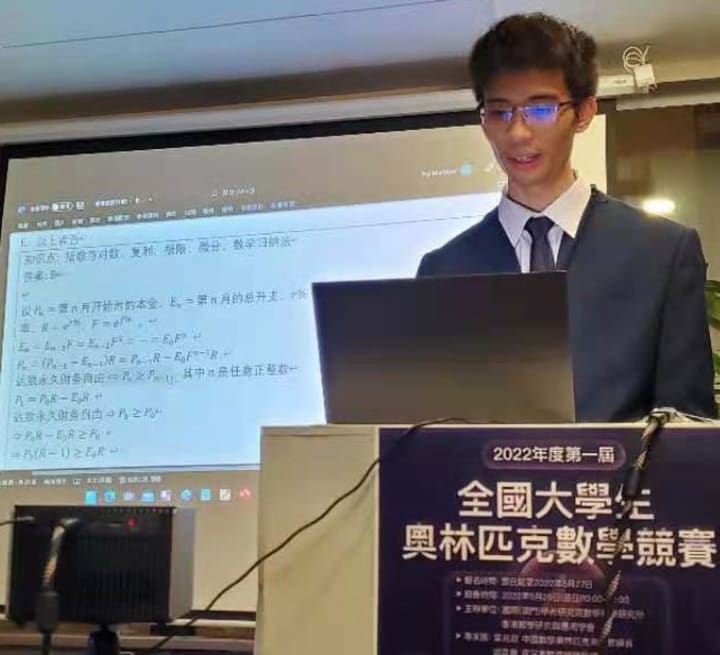
Alongside it sits the “Mathewmatician’s Dictionary,” a self-paced learning system that folds textbooks, notes, exercises, and assessments into one track. The rule baked into it is strict and revealing: a student cannot advance to the next topic until they’ve solved every problem in the current one without help. “Students must be able to fully rely on themselves to complete all the math problems in a topic before moving on,” he explains, the logic being that shaky foundations are what quietly sink students two chapters later.
His coaching record runs underneath all of it. Matthew Yip has served as a senior trainer for Mathematics Olympiad coaches, worked with the China and World International Mathematics Olympiad committees, and led the Hong Kong representative team at the International Hope Cup Mathematics Invitational. He’s also a trainer in abacus and mental arithmetic, the old-school speed-calculation discipline, and by his account devised a method for computing nth roots on the abacus. He’s published books in the field, including a primary-level problem collection and a high-school Olympiad series, the kind of material he says simply wasn’t on the market.
The Recognition, and What He Does With It
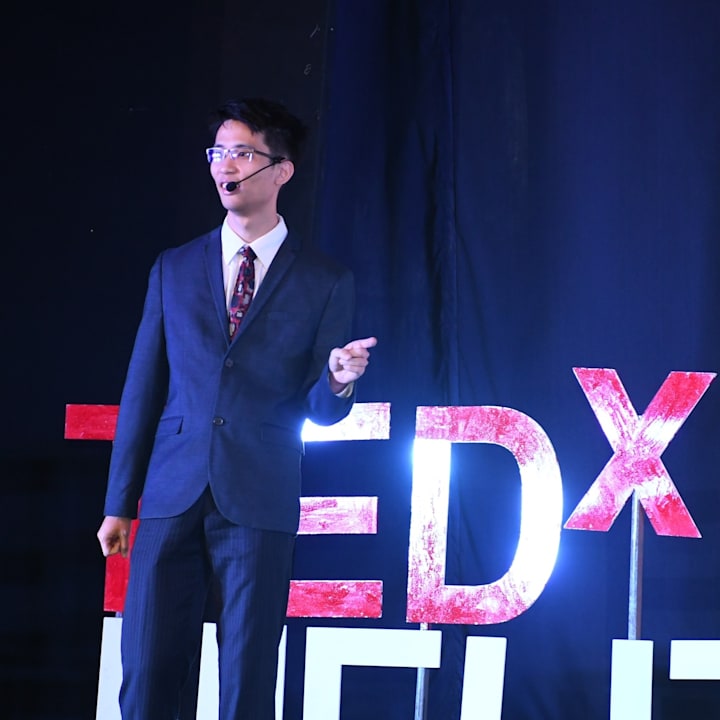
The accolades have followed, and they are not small in number. By his own count Matthew Yip has gathered more than fifty international awards and honors across his career. He has been named Top Mathematics Educator by the International Association of Top Professionals, a recognition that put his face on a Nasdaq billboard in Times Square. He has been recognized by The Times Group as one of its Power Icons in mathematics education, named among Passion Vista’s leaders to look up to, and cited by a string of business and education outlets as a figure to follow. He describes being honored with a Lifetime Achievement Award and invited as a guest speaker in connection with the UK Parliament, and says he has been interviewed by more than two hundred media outlets over the course of his work.
What’s worth noticing is how Matthew Yip talks about all of it, which is mostly as fuel rather than finish line. The recognition, in his framing, exists to give his ideas reach. “Before that, I have to be well known to be able to promote my solutions,” he says of his ambitions for the field. “Therefore, I constantly equip myself to meet opportunities when they come.” The awards, in other words, are a means of getting a hearing for the assessment system and the learning tool. The work is still the point.
Time Over Money, and a Weakness He’ll Name
Matthew Yip is unusually direct about how he runs his own life, including the parts that don’t flatter him. His operating principle is that time outranks money, full stop. “There are far more people who die of old age than of hunger,” he says, his way of arguing that trading your hours chasing material comfort inverts the point of having them. He describes himself as frugal on purpose, spending less effort earning so he can spend more building.
He’ll also tell you where that focus costs him. “My weakness is that I focus too much on achieving my personal goals, sometimes ignoring minor emergencies, which affect my relatives and friends or the people I work with.” It’s a rare thing in a personal-brand profile, a subject volunteering the downside, and it does more for his credibility than any citation could.
What He’s Actually Betting On
Matthew Yip’s stated endgame is sweeping: a world where rigid degree tiers give way to skills measured directly through public assessment, where strong students accelerate and struggling ones are allowed to master fundamentals without being pushed forward, and where automated tools handle enough of the teaching load that the best educators are freed to advance the field itself. He sees AI, and eventually AR and VR, doing real work in how math gets explained, and says his team is steadily testing which tools actually help rather than chasing the trend for its own sake.
Whether the formal credential system ever bends the way he wants is an open question, and a big one. But the smaller bet is already on the table and easier to judge: a kid somewhere, with no money for a tutor and no bedroom to study in, sitting down with a free prep course and a system that won’t let them fail forward. That’s the student Matthew Yip was. It’s clearly the one he’s still building for.