
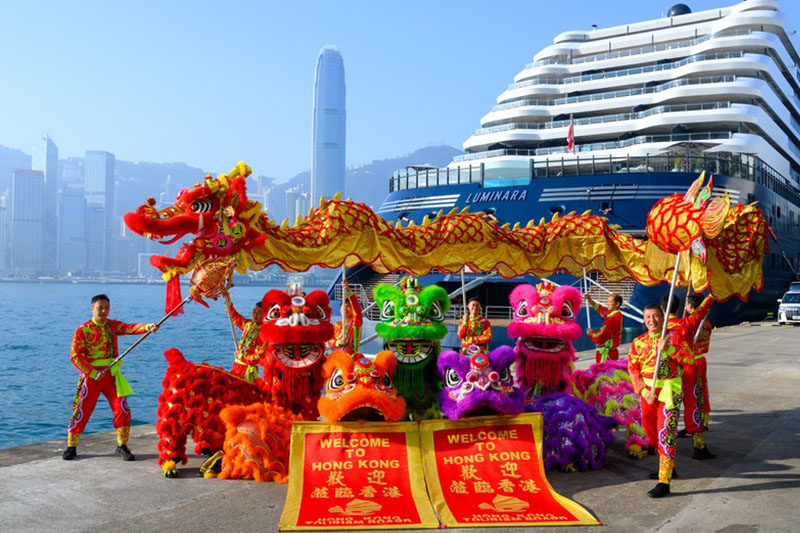
Hong Kong is investing in infrastructure and pointing to busy events agenda to cement its status as a cruise hub in Asia, according to Marilyn Tham, general manager of mega events, MICE and cruise at the Hong Kong Tourism Board.
Following a strong 2025 that saw a 20 percent increase in the destination’s cruise passenger arrivals and calls, Hong Kong is targeting more turnaround operations, as well as fly-cruises for 2026 and beyond.
Tham said the initiative is backed by the city’s connectivity and infrastructure, which recently saw enhancements to its international airport.
“We are connected with more than 200 airports around the world, and 170 of these cities are visa-free,” Tham told Cruise Industry News.
“This is very important for Hong Kong positioning itself as an Asian cruise hub with seamless connectivity,” she added.
Regional access is also an asset for Hong Kong, with a high-speed rail network now connecting the port to cities like Shenzhen and Guangzhou in less than an hour.
Tham also highlighted the Hong Kong-Zhuhai-Macau Bridge, which links the western Guangdong province in under an hour, allowing easy passenger transfers to the Kai Tak Cruise Terminal.
While global macroeconomic challenges and fluctuating fuel costs remain hurdles, Tham noted that Hong Kong’s strategic geography offers cruise lines flexible deployment options that can mitigate risks.
“In terms of itinerary planning, there are lots of choices to anchor Hong Kong as a multi-destination starting point,” Tham said.
“Going north, we can always bundle Japan and Korea. Going south, we have Vietnam and the Philippines,” she explained.
Tham also noted that the expansion of the mainland Chinese cruise market and the introduction of new large domestic ships by brands like Adora Cruises are not a competitive threat, but a significant deployment opportunity for Hong Kong.
“It is an opportunity for us to have new ships coming into the city because, as they expand, they will definitely consider including Hong Kong in their itineraries,” Tham said.
Tham said that in addition to international arrivals, the city can also welcome guests from China, highlighting the growth potential of the Asian cruise market.
Ports in the region need to work together for that, Tham added that cruise penetration in Asia is still sitting at less than one percent compared to roughly five percent in the U.S. market.
To entice lines to homeport and boost onshore spending, the tourism board is promoting Hong Kong as the “Event Capital of Asia.”
Tham said the strategy involves aligning cruise deployments with major cultural and sporting events, offering exclusive experiences to passengers.
Tham pointed to the city’s arts and culture scene, anchored by the newly developed West Kowloon Cultural District, which features the contemporary M+ Museum and the Palace Museum.
During major events like Art Basel in March, the city works with boutique and luxury lines to bundle exclusive activities for guests, she added.
Cruise lines are also intentionally scheduling calls in Hong Kong to coincide with the city’s New Year’s Eve fireworks display.
Beyond events, Hong Kong appeals to a diverse audience through a series of attractions and special features, Tham noted.
Examples include two major international theme parks, Disneyland and Ocean Park, as well as cultural sites like the Tian Tan Buddha, she said.
“There is so much to experience onshore. We will continue to foster very close collaborations with international and Chinese cruise lines to prioritize Hong Kong in their Asian itineraries,” Tham added, noting that while turnaround calls are the city’s priority, “everyone is welcome.”