
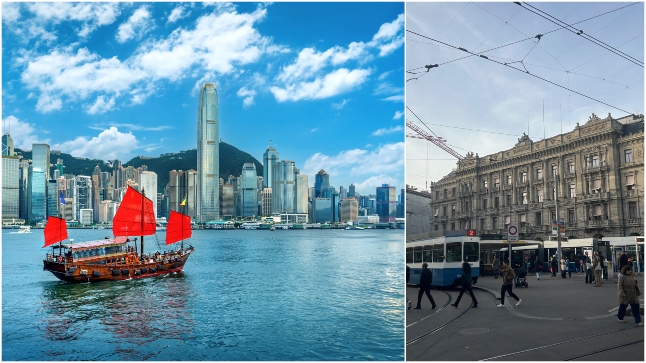
Global Wealth Report: Hong Kong Overtakes Switzerland
The balance of power in international wealth management is shifting: for the first time, Hong Kong has overtaken Switzerland as the world’s largest cross-border booking centre. Nevertheless, a new BCG study still sees Switzerland playing a key role — particularly as a safe haven in geopolitically turbulent times.
Global financial wealth rose by 10,7 percent in 2025 to 333 trillion dollar. Including real assets, total global net wealth reached 550 trillion dollar. According to the latest Global Wealth Report 2026 by Boston Consulting Group (BCG), this marked the strongest growth since 2021.
The main drivers were equity markets and strong demand for gold. At the same time, geopolitical tensions, trade conflicts and uncertainty surrounding reserve currencies intensified wealthy clients’ search for geographic diversification and political stability.
Hong Kong Attracts Capital Primarily from China
Of particular relevance to the Swiss financial centre: in 2025, Hong Kong surpassed Switzerland for the first time as the world’s largest cross-border wealth booking hub. According to BCG, both locations manage around 2,9 trillion dollar in cross-border assets. However, while Hong Kong recorded growth of 10,7 percent, Switzerland expanded by 7,6 percent.

The list of the world’s ten largest financial centers. (Graphic: BCG/Global Wealth Report 2026)
This development does not come as a surprise to Michael Kahlich, BCG partner in Zurich and co-author of the study. It had long been expected that Hong Kong would eventually replace Switzerland as the leading booking centre — although not until 2027.
«China has weakened in recent years, which is why we had also expected lower growth this time. But we are now seeing a clear recovery, which is why the change at the top already happened in 2025,» he said.

Michael Kahlich of BCG. (Image: provided)
Hong Kong’s momentum is primarily driven by capital inflows from China as well as a strong IPO and equity market environment. According to the study, more than 60 percent of managed assets now originate from mainland China. In Singapore, Asia’s second major financial hub, the figure stands at just under 30 percent.
Middle East Continues to Favour Switzerland
According to BCG, Switzerland nevertheless remains a central global hub for international wealth — particularly for assets from Western Europe, the Middle East and Latin America.
Kahlich does not see Switzerland’s leading position under threat. «Switzerland is and remains the benchmark in wealth management. When people talk about wealth management, they quickly think of Switzerland rather than Asia,» he said. Swiss financial institutions are also benefiting from — and contributing to — the boom in Hong Kong and Asia more broadly.
Geopolitical uncertainty in particular is reinforcing Switzerland’s traditional role as a safe haven. Kahlich explicitly refers to increasing «flight-to-safety» inflows from more volatile regions such as the Middle East.
By 2030, the study authors continue to expect average annual growth of around 6 percent in Switzerland’s cross-border business. According to Kahlich, it is currently difficult to estimate to what extent this growth will depend on developments in the Middle East.

The differences between Hong Kong and the Swiss financial center. (Chart: BCG/Global Wealth Report 2026)
Market Consolidation Continues
The BCG study also highlights increasing concentration in the global wealth management market. The ten largest booking centres now account for almost 90 percent of all new cross-border wealth inflows. At the same time, they hold more than 80 percent of existing cross-border assets.
Alongside Hong Kong and Switzerland, Singapore, the United States, the United Kingdom, Luxembourg and the United Arab Emirates rank among the dominant locations.
According to BCG, two global wealth clusters are increasingly emerging: an Asian network centred around Hong Kong and Singapore, and a Western-oriented network led by Switzerland, the United States and the United Kingdom.
EAMs: Pressure on Smaller Firms Is Rising
The study also places special focus on independent asset managers. According to BCG, independent wealth managers now control a substantial share of HNW assets in Switzerland. Assets managed by FINMA-regulated EAMs and IAMs are estimated at between 1 and 1,1 trillion dollar.
However, the authors see rising pressure on smaller providers. Higher compliance costs, stricter regulatory requirements, and investments in technology and cyber resilience are weighing particularly heavily on smaller firms. At the same time, succession issues among founder-led businesses are becoming an important driver of consolidation.
«In Switzerland, we expect a silent market shakeout. In the coming years, some medium-sized and smaller asset managers are likely to disappear, with clients returning to the banks,» Kahlich said.
AI Is Transforming Wealth Management
The study identifies artificial intelligence as another key development. According to BCG, AI systems are already creating financial plans, automating compliance processes and supporting portfolio decisions.
The study authors describe this as a structural transformation of the business model rather than merely a productivity gain.
«AI will fundamentally change banking. The new systems enable bank advisers to deliver more, faster, and more tailored offerings to clients,» Kahlich said.
For established Swiss banks and wealth managers, this is likely to require additional investment in technology, advisory expertise and digital infrastructure — particularly in competition with Asian and American platforms.