
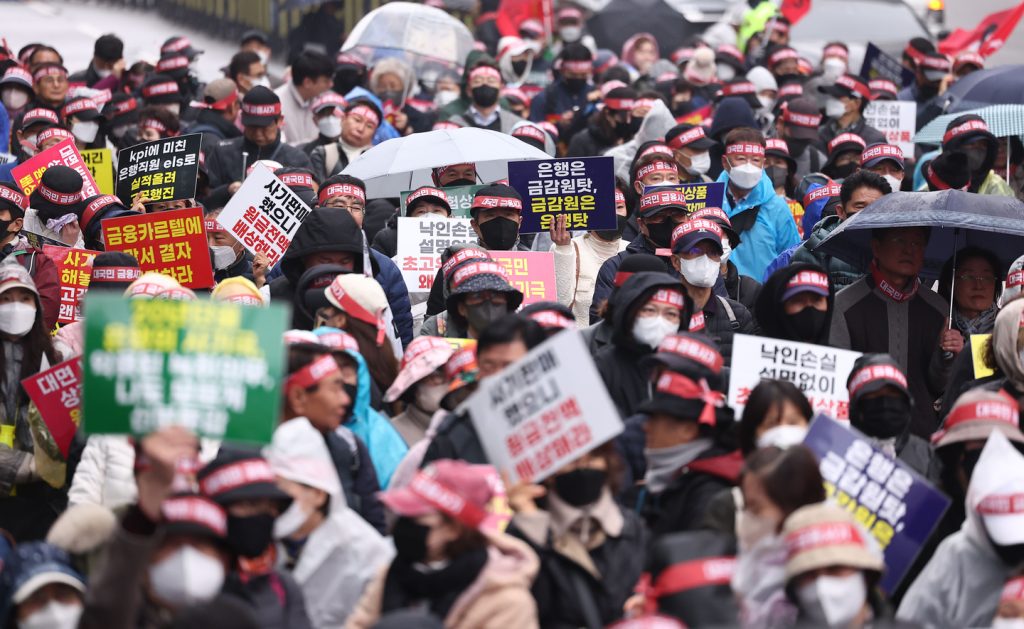
![Investors protesting against Hong Kong Hang Seng Index ELS products hold a rally in front of KB Kookmin Bank’s headquarters in Yeouido, western Seoul, on March 29, 2024. [YONHAP].](https://koreajoongangdaily.joins.com/data/photo/2026/04/29/b4f08f5a-6d9d-42f5-acdb-56a0642fdd86.jpg)
Investors protesting against Hong Kong Hang Seng Index ELS products hold a rally in front of KB Kookmin Bank’s headquarters in Yeouido, western Seoul, on March 29, 2024. [YONHAP].
Banks are winning a string of court cases over losses tied to Hong Kong-linked equity products, and the decisions are now making regulators think twice before handing out billion-dollar fines.
In 2024, investors suffered large losses in equity-linked securities (ELS) tied to Hong Kong’s Hang Seng Index — a stock market index tracking major Chinese companies listed in Hong Kong — after the index fell sharply and triggered preset loss thresholds known as knock-in barriers. Similar risks had appeared before, but the 2024 losses were more severe because many ELS products matured while prices were still low, locking in losses. Victims claimed it was a “financial fraud against the public.”
ELS are structured financial products, sold by banks, that offer returns linked to stock market performance but can incur losses if markets fall below certain thresholds.
The JoongAng Ilbo’s analysis of seven initial court rulings on claims for unjust enrichment and damages related to bank sales of Hang Seng ELS products showed that banks won in every case reviewed, the paper found on Wednesday.
Courts consistently cited investors’ self-reported risk tolerance and prior ELS investment experience as the basis for limiting bank liability.
In one case, an investor in their 80s lost approximately 146.3 million won ($99,000) of a 380 million won investment in ELS products linked to the Hong Kong Hang Seng Index and other underlying assets after Hong Kong markets plunged in 2021.
The investor reportedly sued the bank, claiming it had recommended a high-risk product to an older customer without adequate explanation.
The court, however, noted that the investor had self-reported as an “aggressive investor willing to accept high risk” on the investor information form, and recognized a track record of 19 prior investments in similar equity-linked trust products that had generated returns — leading the court to conclude that the investor had sufficiently understood the product structure and its risks.
In a second case, an investor who lost approximately 500 million won of a total 1.1 billion won invested across two banks was denied damages after the court pointed to the investor’s self-reported statement that they had “a very high level of understanding of financial investment products, expected returns exceeding market rates, and could accept losses of 40 percent or more of principal.”
Their investment history, which showed 71 counts of investing in high-risk products from two banks, further led the court to find the banks bore no liability.
Over 90 percent of ELS investors were repeat investors, according to the JoongAng Ilbo’s findings.
![A render depicting banks and equity-linked securities [JOONGANG ILBO]](https://koreajoongangdaily.joins.com/data/photo/2026/04/29/cc75315e-64f7-494c-ac40-b08e1aa0b9fa.jpg)
A render depicting banks and equity-linked securities [JOONGANG ILBO]
A third investor in Suwon, Gyeonggi, who lost approximately 170 million won of a 350 million won investment also lost the case after the court recognized the investor’s self-reported “high-yield investment profile” and the fact that the investor had visited the bank branch three times, proof of sufficient deliberation, before signing up for the product.
Even a case where mis-selling was partially acknowledged did not end differently.
An investor in Changwon, South Gyeongsang, lost their case even though the bank had acted improperly — staff had filled out documents on the investor’s behalf and a branch manager had repeatedly pushed the investment.
The court ruled against the investor anyway, reasoning that four prior profitable investments in similar products meant the investor knew what they were signing up for.
The financial industry has taken note of what it sees as a solidifying trend of bank victories in Hang Seng ELS-related civil litigations.
“Some cases are still on appeal and there are instances where banks have lost, but the majority of cases have resulted in bank wins,” a banking industry source confirmed to the JoongAng Ilbo.
The pattern of rulings appears to be influencing the financial regulator’s stance on the issue as well.
The Financial Services Commission on Wednesday declined, for a second time, to put to a vote a proposal to fine five banks — KB Kookmin, Shinhan, Hana, NH Nonghyup and SC First — a combined 1.4 trillion won for mis-selling Hong Kong Hang Seng Index ELS products to investors.
Analysts say that regulators are worried the banks would challenge the fines in court — and, given how civil cases have been going, might actually win.
The fact that banks have already carried out substantial voluntary compensation over the past three years under Financial Supervisory Service guidelines also plays against the government stepping up.
The case nonetheless carries considerable symbolic weight, as it is the first time a large-scale fine under the Act on the Protection of Financial Consumers, which took effect in 2021, is being considered.
The act allows for fines of up to 50 percent of revenues derived from a violation — far stiffer than the penalty-based sanctions that preceded it.
And, with President Lee Jae Myung having emphasized the strengthening of punitive fines, a light penalty from the regulators could invite accusations of a slap on the wrist.
But regulators remain cautious for now.
“The introduction of the Act on the Protection of Financial Consumers has made punitive fines possible, but it has also significantly increased litigation risk,” a Financial Services Commission official said.
This article was originally written in Korean and translated by a bilingual reporter with the help of generative AI tools. It was then edited by a native English-speaking editor. All AI-assisted translations are reviewed and refined by our newsroom.
BY KIM DA-YOUNG [[email protected]]