
Close Menu
Simply Invest Asia
  • Home
  • About us
  • Explore industries/sectors
    • Automobile
    • Aviation
    • Banking
    • Biotechnology
    • Chemical & Fertilizer
    • Entertainment and Media
    • Food Processing
    • Healthcare
    • Iron and Steel
    • Leather
    • Mining
    • Oil and Gas
    • Pharmaceutical
  • Explore by countries
    • China
    • Dubai / UAE
    • Hong Kong
    • India
    • Indonesia
    • Japan
    • Malaysia
  • Explore cities
    • Bangkok
    • Beijing
    • Chongqing
    • Delhi
    • Dubai
    • Guangzhou
    • Jakarta
    • Kuala Lumpur
  • Why Asia
Facebook X (Twitter) Instagram Threads
Trending:
  • South Korea's Aero K cuts routes, lets staff take leave – ch-aviation
  • Japanese Yen struggles nears two-week low vs USD after Japan CPI
  • RAKxa | Vogue
  • ‘Stop sharing data with China’ and ‘Shoot and kill’
  • Rapid deterioration of Iran-UAE ties threatens a critical trade lifeline
  • Hong Kong story – chinadailyasia.com
  • Honda to Cease Automobile Sales in S. Korea at End of 2026
  • YouTube to remove underage accounts, stop ads targeting kids in Indonesia – Asia News Network
  • Indian workers struggle with stagnant wages amid rising costs – Asia News Network
  • Strategic Significance of EAM S. Jaishankar’s Visit to the UAE During West Asian Ceasefire
  • Oxfam’s living wage for HK set to rise to HK$64 per hour from Oct
  • Q1 2026 net profit jumped 60.19% on 7.06% revenue growth, led by premium product sales — TradingView News
  • Bukit Bintang Roads To Close In Stages From 22–28 April, Full Closure 29 April–2 May
  • AAP targets BJP over ‘deteriorating’ law and order situation in Delhi
  • Second phase of 139th Canton Fair kicks off -Xinhua
  • From scientist to silk farmer: India’s silk industry renewal
  • Ban sharing medical data with China, ministers told after massive UK Biobank breach
  • KAMIKURA: Mythos of oil, gas – The Daily Targum
Friday, April 24
Facebook X (Twitter) Instagram
Simply Invest Asia
  • Home
  • About us
  • Explore industries/sectors
    • Automobile
    • Aviation
    • Banking
    • Biotechnology
    • Chemical & Fertilizer
    • Entertainment and Media
    • Food Processing
    • Healthcare
    • Iron and Steel
    • Leather
    • Mining
    • Oil and Gas
    • Pharmaceutical
  • Explore by countries
    • China
    • Dubai / UAE
    • Hong Kong
    • India
    • Indonesia
    • Japan
    • Malaysia
  • Explore cities
    • Bangkok
    • Beijing
    • Chongqing
    • Delhi
    • Dubai
    • Guangzhou
    • Jakarta
    • Kuala Lumpur
  • Why Asia
Simply Invest Asia
Home»Explore by countries»Dubai / UAE»Strategic Significance of EAM S. Jaishankar’s Visit to the UAE During West Asian Ceasefire
Dubai / UAE

Strategic Significance of EAM S. Jaishankar’s Visit to the UAE During West Asian Ceasefire

By IslaApril 24, 20267 Mins Read
Share
Facebook Twitter Pinterest Threads Bluesky Copy Link


48

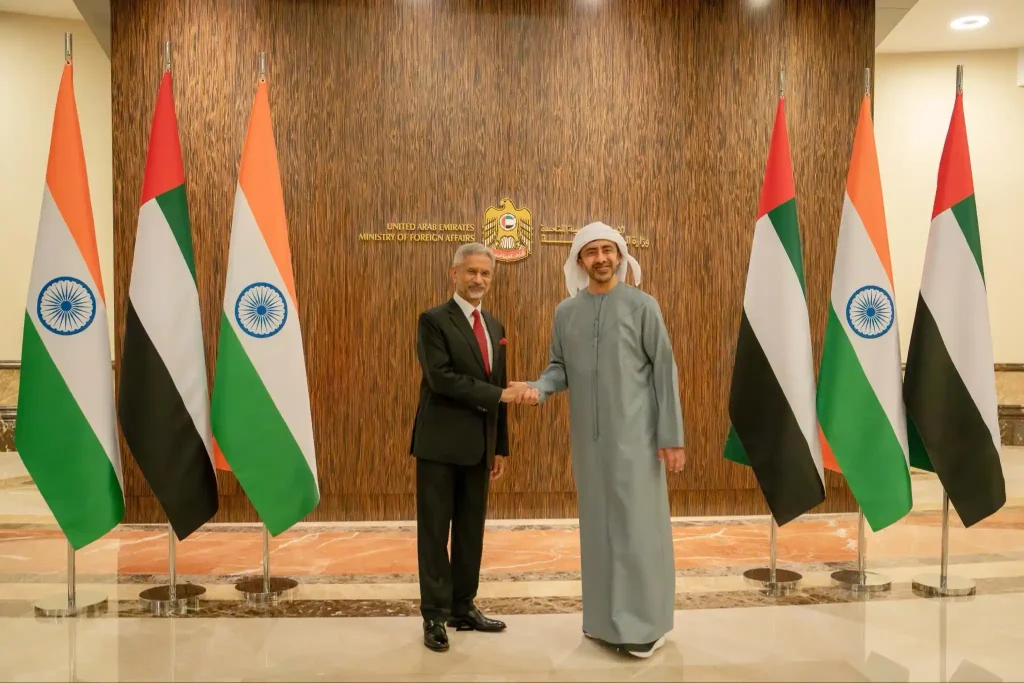
External Affairs Minister S. Jaishankar’s visit to the United Arab Emirates (UAE) at a time of heightened instability, a fragile ceasefire, and the reopening of the Strait of Hormuz in the West Asian region is both strategically timed and diplomatically layered. The visit must be understood not as a routine bilateral engagement but as a calibrated geopolitical intervention reflecting India’s role as a stabilizing actor in a turbulent region. This visit is also significant in the context of India’s energy security imperatives, diaspora concerns, and recalibration of its broader West Asia policy. Further, the timing of the visit is also critical. The recent escalation in conflict in the West Asian region has raised significant concerns about maritime security, energy flows, and the safety of expatriate populations. The temporary closure—and now reopening—of the Strait of Hormuz underscored the vulnerability of one of the world’s most critical energy transit routes. Nearly one-fifth of global oil supply passes through this narrow waterway, making any disruption not merely a regional concern but also a global economic shock. For India, which imports a substantial proportion of its crude oil from the Gulf, the stability of the Strait of Hormuz is important for its economic functioning. In this context, S. Jaishankar’s visit signals India’s proactive diplomatic engagement in ensuring that such disruptions are transient and do not escalate into systemic crises.

The UAE, in this context, emerges as India’s pivotal partner. Over the past decade, India-UAE relations have undergone a qualitative transformation, evolving from transactional economic ties to a comprehensive strategic partnership. The UAE’s role as a regional stabilizer, mediator, and economic hub makes it a critical interlocutor for India. EAM Jaishankar’s visit during a period of ceasefire indicates India’s intent to leverage its strong bilateral ties with Abu Dhabi to both assess the ground realities and coordinate responses to emerging geopolitical risks. It also reflects a recognition of the UAE by New Delhi as part of its diversified diplomatic outreach.

The reopening of the Strait of Hormuz has significant strategic consequences. It suggests that despite the volatility, there remains a mutual understanding amongst the regional actors about the catastrophic consequences of prolonged disruption. For India, this development provides immediate relief in terms of energy supply continuity, maritime security and respite for rising insurance costs. At the same time, EAM Jaishankar’s visit also indicates that New Delhi is not merely reacting to events but is seeking to institutionalize mechanisms that can mitigate future risks. This includes discussions on maritime security cooperation, intelligence sharing, and possibly coordinated naval presence in critical sea lanes. India’s increasing naval engagements in the Indian Ocean region are also part of a broader strategy to secure free and open sea lines of communication, and the Gulf region is key to this calculus.

Another critical dimension of this visit is the Indian diaspora in the UAE, which constitutes one of the largest expatriate communities globally. During periods of conflict, the safety and probable evacuation of Indian national—if required—was of paramount concerns. Jaishankar’s presence in the UAE during this sensitive period serves both as reassurance to the diaspora and as a signal to host governments of India’s commitment to its citizens abroad.

Economically, the visit must be seen in the context of the deepening India-UAE economic partnership, particularly following the Comprehensive Economic Partnership Agreement (CEPA). The stability of the Gulf region directly impacts trade flows, investment pipelines, and joint ventures. The recent conflict has demonstrated that the uncertainties can disrupt all these ventures. EAM Jaishankar’s engagement aimed at reaffirming commitments, addressing investor concerns, and exploring ways to insulate bilateral economic cooperation from geopolitical shocks. This includes discussions on supply chain resilience, energy investments, and renewable energy collaboration.

The broader geopolitical significance of the visit lies in India’s evolving West Asia policy. Traditionally characterized by a balancing act between competing regional actors, India’s approach has become more nuanced and proactive. It seeks to maintain strategic autonomy while engaging deeply with multiple stakeholders. The current crisis provides an opportunity for India to demonstrate its diplomatic agility, i.e., engaging with Gulf partners like the UAE while also maintaining channels with other regional powers like Iran and Israel. So, EAM Jaishankar’s visit can also be interpreted as part of a larger effort to position India as a credible and constructive actor and supporter of regional stability.

Furthermore, this visit highlights the intersection of energy security and geopolitics. The disruption of the Strait of Hormuz due this conflict serves as a reminder of the risks associated with overdependence on specific routes and regions. While India has been diversifying its energy sources and investing in strategic reserves, the Gulf region remains indispensable. EAM Jaishankar’s discussions are likely to include long-term energy security arrangements, including strategic petroleum reserves, joint investments in upstream and downstream sectors, and collaboration on alternative energy sources. The UAE’s own transition towards a diversified energy portfolio, including renewables, aligns with India’s interests in sustainable energy cooperation.

Diplomatically, the visit also sends a message beyond the immediate region. It underscores India’s willingness to engage actively in crisis management and its recognition of the connection between regional and global security. In an era where major powers are increasingly focused on great power competition, India’s approach in West Asia clearly emphasizes stability, connectivity, and economic cooperation. This further positions India as a distinct actor whose engagement is not driven by ideological alignments but by pragmatic considerations.

The outcomes of the visit, while not immediately visible, are likely to manifest in several areas. First, there will be enhanced coordination on maritime security, particularly in ensuring the uninterrupted flow of energy supplies. Second, the visit will likely lead to reaffirmed commitments on economic cooperation, including investments and trade facilitation. Third, there may be progress in institutional mechanisms for crisis management for the Indian expatriate population. So, the visit reinforced the strategic partnership between India and the UAE, ensuring that it remains resilient in the face of external shocks.

EAM S. Jaishankar’s visit to the UAE amidst ongoing conflict and a tentative ceasefire in West Asia, coupled with the reopening of the Strait of Hormuz, is emblematic of India’s proactive and multidimensional engagement with this region. It also signifies a shift from reactive diplomacy to anticipatory and balanced statecraft, where New Delhi seeks not only to safeguard its immediate interests but also to contribute to regional stability. The visit underscores the centrality of the Gulf states, like the UAE, in India’s strategic calculus, underlining its significant partnerships in navigating an increasingly volatile geopolitical landscape.

The views expressed are those of the author and do not represent the institution.

  • Dr. Anu Sharma is an Assistant Professor at the Amity Institute of Defence and Strategic Studies (AIDSS), Amity University, NOIDA. Previously, she has been associated with the Centre for Air Power Studies (CAPS), New Delhi as Research Fellow with research interests related to various subjects associated with the West Asian region. She has published and presented various papers on foreign and domestic politics of Iran and the broader West Asian region both nationally and internationally. She has also published a book titled “Through the Looking Glass: Iran and its Foreign Relations” in the year 2020 through KW Publishers which was co-published by Routledge in the year 2022. She also on the reviewer panel of Scopus indexed journal Journal of Strategic Security, published by the University of South Florida, US and Asian Journal of Middle Eastern and Islamic Studies (AJMEIS), published by Shanghai International Studies University (SISU). She is also the regular columnist with The Week and her weekly column “Gulf Watch” discusses the pertinent issues related to geopolitics, regional politics and foreign policy of the Gulf region.

    She has credible experience as a freelancing journalist with “The Statesman” newspaper, New Delhi as part of her Graduation programme. She holds a Masters degree in Politics with Specialisation in International Relations from the School of International Studies (SIS), JNU and an M.Phil. degree from the American Studies division of Centre for Canadian, US and Latin American Studies (CCUS&LAS), SIS, JNU. She has done her Ph.D. from Centre for International Politics (CIP), School of International Studies (SIS), Central University of Gujarat, Gandhinagar (Gujarat).


Source link

Related Posts

Rapid deterioration of Iran-UAE ties threatens a critical trade lifeline

April 24, 2026

Zelensky Announces Strategic Drone Deal with Saudi, UAE, and Qatar

April 23, 2026

Before the Iran War, Tokyo and Dubai Had the World’s Fastest Growing Luxury-Home Markets

April 23, 2026
Add A Comment
Leave A Reply Cancel Reply

Top Posts

Abandoned malls, whispers of nuclear war and young foreigners detained. This is what’s REALLY going on in Dubai… and the chilling warning one taxi driver gave to the Mail’s IAN BIRRELL

April 11, 2026

US trade chief says tech restrictions to block Chinese autos

April 10, 2026

Leather MIG Welding Gloves – Heat Fire Resistant for Welding/Grilling/BBQ(Black/Brown/Blue)

April 9, 2026
Don't Miss

South Korea's Aero K cuts routes, lets staff take leave – ch-aviation

By IslaApril 24, 2026

South Korea’s Aero K cuts routes, lets staff take leave ch-aviation Source link

Japanese Yen struggles nears two-week low vs USD after Japan CPI

April 24, 2026

RAKxa | Vogue

April 24, 2026

‘Stop sharing data with China’ and ‘Shoot and kill’

April 24, 2026
SUBSCRIBE TO OUR NEWSLETTER

Get our latest downloads and information first. Complete the form below to subscribe to our weekly newsletter.


I consent to being contacted via telephone and/or email and I consent to my data being stored in accordance with European GDPR regulations and agree to the terms of use and privacy policy.

Stay In Touch
  • Facebook
  • YouTube
  • TikTok
  • WhatsApp
  • Twitter
  • Instagram
Top Trending

Bukit Bintang Roads To Close In Stages From 22–28 April, Full Closure 29 April–2 May

By IslaApril 24, 2026

AAP targets BJP over ‘deteriorating’ law and order situation in Delhi

By IslaApril 24, 2026

Second phase of 139th Canton Fair kicks off -Xinhua

By IslaApril 24, 2026
Most Popular

Beijing Oriental Yuhong Waterproof Technology Q1 net profit up 108.9% Y/Y

April 16, 2026

New World sells all flats on offer at rebuilt luxury project

April 19, 2026

China flexes energy leverage as the Philippines, US start annual war games

April 21, 2026
Our Picks

Postponed Art Dubai Shrinks as Iran War Grinds On

April 20, 2026

PM in marathon talks with top CEOs, signals push for agro-industry, energy reform

April 13, 2026

RUSAL to divert aluminium from China to Japan as premiums surge amid Gulf supply crunch

April 9, 2026
SUBSCRIBE TO OUR NEWSLETTER

Get our latest downloads and information first. Complete the form below to subscribe to our weekly newsletter.


I consent to being contacted via telephone and/or email and I consent to my data being stored in accordance with European GDPR regulations and agree to the terms of use and privacy policy.

© 2026 Simply Invest Asia.
  • Get In Touch
  • Cookie Policy
  • Privacy policy
  • Terms & Conditions

Type above and press Enter to search. Press Esc to cancel.

SUBSCRIBE TO OUR NEWSLETTER

Get our latest downloads and information first.

Complete the form below to subscribe to our weekly newsletter.


I consent to being contacted via telephone and/or email and I consent to my data being stored in accordance with European GDPR regulations and agree to the terms of use and privacy policy.