
Creating art became a way for Emirati artist Moza Al Falasi to contend with a series of personal losses in recent years. Those experiences shape Unfolding, her debut solo exhibition at Tashkeel in Dubai.
The exhibition marks the culmination of Al Falasi’s participation in Tashkeel’s Critical Practice Programme, a year-long initiative that supports artists in the UAE through mentorship, studio access and funding. Developed with mentors Luisa Menano and Hanaa Bou Hamdan, the exhibition brings together photography, sculpture, sound, painting, plaster and fabric to explore memory, inherited grief and domestic space.
“My work is deeply rooted in the complexities of inherited grief,” Al Falasi says. “The sorrow passed down through generations shapes identity in both visible and unseen ways.”
Al Falasi says her exploration of the emotion within the exhibition became increasingly personal over time, particularly following the deaths of her mother and, more recently, her husband.
“My art has become a means to navigate both the emotions of loss and the complexities of life,” she says.
Al Falasi says the works were never intended as explanations of grief, but as a way to express emotions that can be difficult to articulate verbally.
“Sometimes it’s not about understanding or accepting,” she says. “It’s about expressing.”
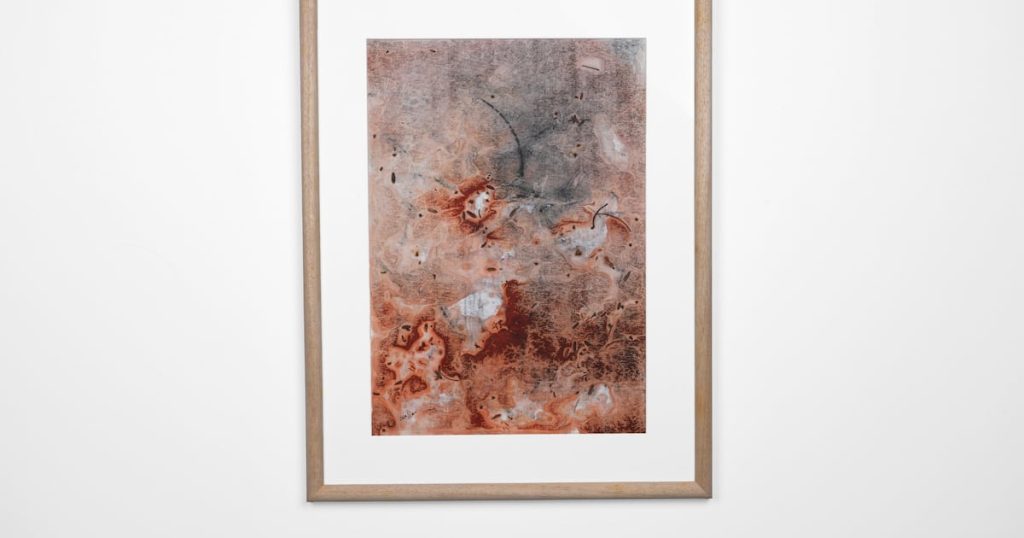
Rather than reconstructing domestic spaces, Unfolding approaches the home through fragments and impressions. Sounds fade in and out, textures recall walls and surfaces, while plaster forms appear warped or incomplete.
Photography acts as a central tool throughout the exhibition, though Al Falasi says she is less interested in documenting spaces than capturing the emotions attached to them.
Among the exhibition’s central works is a two-metre-high 3D-printed sculpture derived from an earlier plaster cast. The original work began as an attempt to preserve the impression of a door motif using clay and plaster, but the piece became unintentionally distorted during the process.
“I was insisting on having it perfect,” Al Falasi says. “I was pressing so hard on the clay and on the mould that the plaster escaped the border I created.”
Rather than discarding the form, she enlarged it through 3D printing. “I wanted to emphasise the changes that happen in our inner landscapes because of grief,” she says.
The sculpture also reflects the circumstances surrounding the exhibition’s creation. After her husband’s death, Al Falasi returned to the programme during its final stages with limited time to produce new work. She revisited and expanded earlier material already developed during the year.
Elsewhere in the exhibition, paintings of women appear alongside olive trees, which become recurring symbols of endurance and continuity.
Al Falasi also uses colour and material in varied ways throughout. While black appears in several pieces, she says grief cannot be reduced to one visual language.
“Sometimes it takes a shape, not only a colour,” she says. “It’s a very personal and individual choice.”
The exhibition extends beyond the gallery through a collaboration with Emirati restaurant Gerbou, located beside the exhibition space. For each Tashkeel exhibition, the restaurant develops a dessert inspired by the artist’s work.
For Unfolding, Al Falasi requested flavours that balanced sweetness with saltiness.
“Sweetness evokes tenderness, intimacy and the comfort of memory, while salt carries the trace of grief, tears and what remains after loss,” she says.
Launched in 2014, Tashkeel’s Critical Practice Programme supports artists as they expand their practices and develop ambitious new work.
“We had weekly meetings and discussions around the progress of the work,” Al Falasi says. “There was a lot of reading around different concepts, and guidance throughout the whole journey.”
Unfolding runs until June 26 at Tashkeel’s Nad Al Sheba 1 Gallery in Dubai