
Japan’s reputation as one of the safest countries in the world isn’t hype. Crime rates are low, lost phones show up at police boxes, and people leave Louis Vuitton bags on cafe chairs while ordering. For solo female travel (or any solo travel), it’s a country where you can generally breathe easy.
But “safe” doesn’t mean “no considerations.” Japan’s version of safety comes with its own quirks, unspoken cultural rules, and gendered spaces. Here’s what that really looks like when you’re out there on your own.
How safe is “safe?” Lower violent crime, check.
Japan is one of the safest countries in the world, and instances of violent crime are especially low. That isn’t just a statistic, but a palpable feeling. Whether walking home alone from a Tokyo bar at midnight or wandering the quiet alleys of Kyoto, the streets feel safe.
This is helped by the presence of kōban (交番), or police boxes, peppered around neighborhoods. Having police within easy reach helps to bolster the sense of security.
When unwanted attention happens
Of course, “safe” doesn’t mean “nothing ever happens.” While violent crime is low, sexual harassment and assault are notoriously underreported in Japan. On trains, Chikan, i.e. groping, often makes headlines – but it’s actually not as much of a concern to solo female travelers as you might think. Because, unfortunately, it tends to target teenage school girls rather than adult women.
If it does happen, the answer is not to sit quietly and take it. Move away, use your voice (“Yamete!” means “Stop it!”), and tell the train staff. Train station employees deal with this more often than you’d think and will take it seriously.
Elsewhere, you might meet “scouts” – men handing out flyers or inviting people into bars or massage parlors. Most are harmless hustlers, but some target foreign women. If someone gets pushy, say no firmly and keep moving.
The golden rule: never follow anyone into an unmarked building or upstairs bar. Even if assault isn’t on their bingo card for the night, a common scam in Japan is luring people into a bar and upcharging outrageous prices for drinks.
The women-only options that make solo female travel safe
One big plus: Japan built systems to combat this and protect women. They do this by creating women-only spaces for situations where women are at highest risk: on crowded trains, in hotel rooms, and in onsen. While attempts to restrict gender or age in restaurants have gotten backlash, most of these women-only spaces are widely accepted and invaluable to any woman traveling alone.
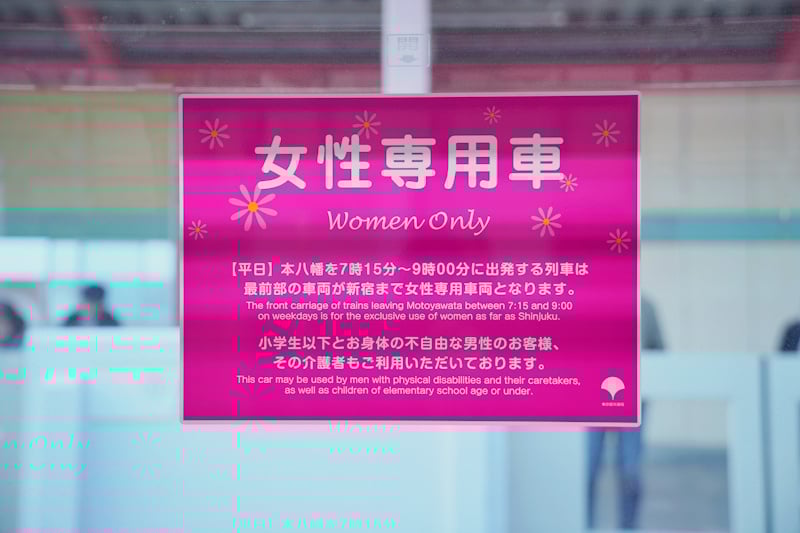
If you’re riding Tokyo or Osaka trains during rush hour, women-only train cars are available. These are marked with red or pink signs in both Japanese and English.
Planning a trip to Japan? Get an authentic, interpreted experience from Unseen Japan Tours and see a side of the country others miss!

Except for a few regional trains, women-only train cars are not an all-day thing, but just for those times when the sardine effect kicks in, and everyone is shoulder-to-shoulder. Some lines are women-only during morning rush hour (from the first train of the day until 9:30 a.m.), while others do it for the evening rush as well.
Picking the right place to stay
The same idea pops up in accommodations. Some hotels, hostels, and guest houses have floors or entire buildings for women only. The women-only floors, for example, might have keycards that restrict access so that only women staying on that floor can go there.
However, there are plenty of safe options even for non-women-only places.
- Capsule hotels: Great for short stays. Some, like Nine Hours and Akihabara Bay Hotel, are entirely women-only, while others, like Resol Pohstel, have a women-only floor. These usually have communal spaces like showers and don’t have a full room, just a pod with a bed.
- Hostels: Similarly, some hostels have women-only restrictions, like bnb plus. These are cheap and come with the bonus of meeting like-minded travelers to talk or hang with. Some hostels even hold events to grease the gears of conversation.
- Private vacation rentals. Many private rentals via AirBnB include renting out entire apartments in quiet neighborhoods.
- Business hotels: Less likely to find women-only options, but these often include solid safety measures like locked elevators and 24-hour desks. Check ahead for security cameras in the halls as a quick metric to see how much a hotel prioritizes safety.
Regardless of where you stay, check for basics: peephole, internal lock, and well-lit access area.
Dining solo is totally normal

Here’s the best part: eating alone in Japan isn’t weird. At all. Locals do it constantly. Counter seating at ramen shops, tempura bars, and casual Japanese-style pubs is made for solo diners. Ichiran Ramen, famous for its solo booths, has practically turned dining alone into a brand.
Of course, not every restaurant is equally welcoming. Many women feel that ramen shops are “male” spaces, and other eateries that are high-end or “couples” spots might discourage solo patrons.
If you sense resistance, skip the awkwardness and head somewhere casual. Bars often attract friendly folks, which is great for meeting someone new; just know that a little skepticism helps—persistent friendliness might not always be innocent. Maid Cafes are another great option, as a few even charge women less than men.
The onsen solo female travel experience
Going to an onsen alone might feel intimidating the first time – yes, you’re fully naked, yes, you’re among strangers – but regulars couldn’t care less.
Some need-to-know etiquette: wash first, tie or clip long hair so it doesn’t touch the water, and leave towels in your personal locker in the changing room. Tattoos tend to be frowned upon, and some onsens ban them outright. Apps like Tattoo Friendly Japan can help you find inclusive spots. Also, some onsen areas such as Beppu hand out guides to local onsen that welcome tattooed guests.
Another option is to seek out hot spring resorts that offer a private rental tub (個室; koshitsu). Time in these tubs can usually be reserved in 45-minute or 60-minute blocks for a nominal fee.
“Noah [at Unseen Japan] put together an itinerary that didn’t lock us in and we could travel at our own pace. In Tokyo, he guided us personally on a walking tour. Overall, he made our Japan trip an experience not to forget.” – Kate and Simon S., Australia

Kon’yoku (混浴) or mixed-gender hot springs are rare nowadays. Most onsen separate bathing areas by gender, and some even host women-only hours. These timeslots add an extra bit of security for any women who might feel vulnerable in the lobby spaces, which are typically co-ed.
Practical checklist
- Apps to download: Google Translate, Japan Travel by NAVITIME, Safety Tips (for emergency alerts), and LINE (messaging app that pretty much everyone uses).
- Emergency numbers: 110 (police), 119 (ambulance/fire).
- Useful phrases: “Eki wa doko desu ka?” (Where’s the station? 駅はどこですか?), “Arigato gozaimasu.” (Thank you. ありがとうございました), “Menyu o kudasai.” (Can I have the menu? メニューをください), “Tasukete kudasai.” (Please help me. 助けてください). To learn more Japanese before your trip, use a service such as Rocket Languages (note: affiliate link – we earn a commission if you make a purchase).
- When packing: If you’re staying in a capsule hotel, pack light! There’s not a lot of luggage space. Keep it to the necessities, and consider bringing earplugs since the walls are thin.
Japan isn’t perfect, but it’s still one of the safest places for solo female travel. With a little bit of preparation, it’s one of the few countries where you can be alone and feel at ease.
Sources
Crime Index by Country 2026 Numbeo
Japan Murder/Homicide Rate Macrotrends