
In Japan, the spring cherry blossom season is a major tourism event, with thousands of visitors carefully tracking forecasts, booking hotel rooms months in advance and ricocheting between Tokyo, Kyoto, Osaka and northern Japan in search of sakura.
It is also, of course, very serious business. The brief flowering period has become one of the country’s most bankable travel moments, drawing visitors in their millions and sending a springtime surge through hotels, restaurants and local economies.
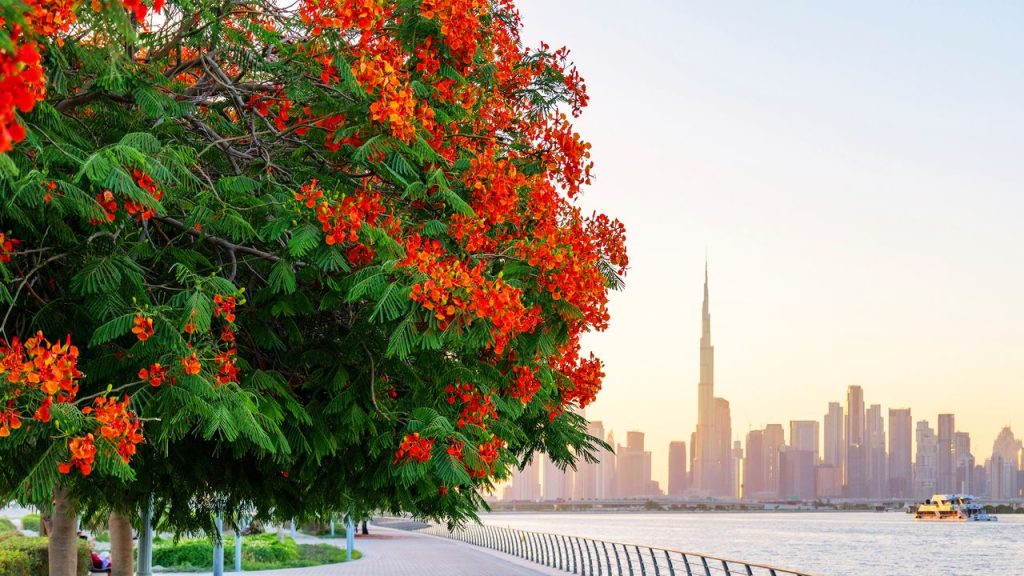
Dubai does not have sakura – but it does have its own flowering season, when thousands of flame trees erupt into bloom, splashing the city with vivid shades of scarlet, orange and vermilion.
From May to July, just as the city begins heating up for summer flame trees ignite across roadsides, parks and residential neighbourhoods, turning pockets of Dubai into some of its most striking scenes.
Known scientifically as Delonix regia – and more romantically as royal poinciana, flamboyant tree or gulmohar – they arrive in a full tropical fanfare and flower precisely when the city is at its hottest.

Getty Images

Getty Images
Now, Sheikh Hamdan bin Mohammed bin Rashid Al Maktoum, the Crown Prince of Dubai, has directed the expansion of flame tree planting across streets, homes, parks and recreational areas, in an initiative that also includes distributing seedlings to residents so more can be planted at homes and farms.
More than 51,000 flame trees already line Dubai’s streets, parks and public spaces, and more are on the way, including over 1,000 along parts of Mirdif and another 1,200 across the city.
Dubai Municipality has also been widening its broader greening drive, with more than 300,000 trees and seedlings planted as part of AED190 million ($52 million) in landscaping projects completed in the first half of 2025.