
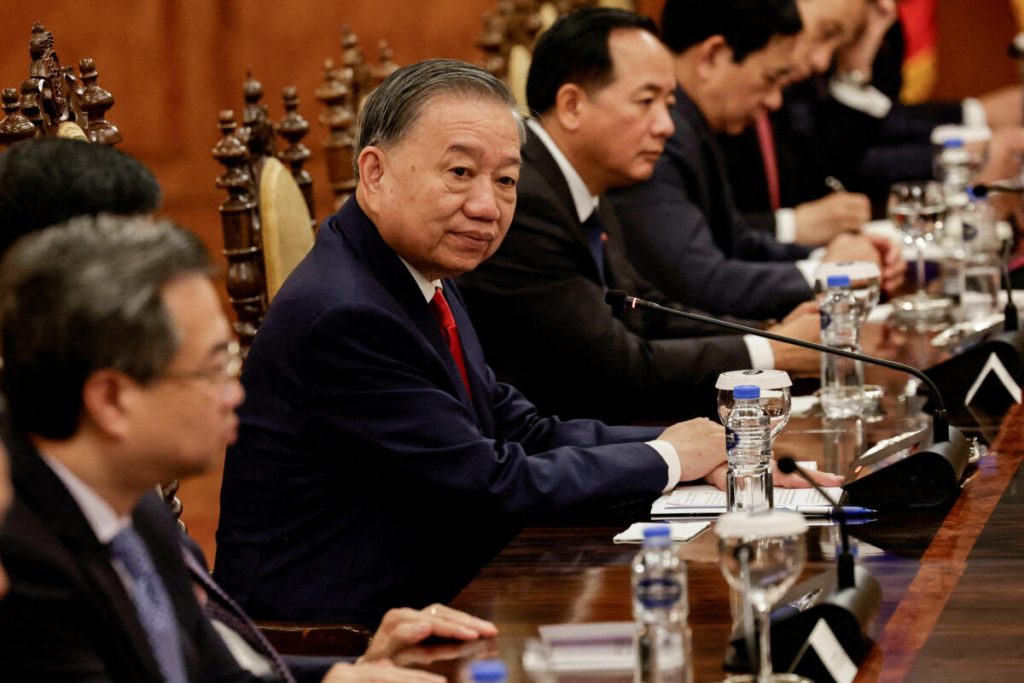
In August 2024, To Lam became General Secretary of the Communist Party of Vietnam to serve out the term of incumbent Nguyen Phu Trong, who passed away. In January 2026, the Central Committee unanimously re-elected Lam as General Secretary for a five-year term. In April, the National Assembly also unanimously selected Lam to serve concurrently as President.
Lam’s political ascendancy has raised concerns that Vietnam’s consensus-based political system is being transformed into strongman rule, along the lines of China under President Xi Jinping. Critics allege that by holding the offices of both party leader and head of state, Lam is undermining the ‘four-pillar’ balance of power, where authority is shared among the General Secretary, President, Prime Minister and Chairman of the National Assembly.
But the comparison of Lam and Xi is both superficial and misplaced. Xi’s entrenchment of power is far deeper than Lam’s and extends beyond what is currently possible within the Communist Party of Vietnam. In 2016, Xi was designated the ‘core leader’ of the Chinese Communist Party and in 2018, the National People’s Congress removed the two-term limit on the presidency. Xi bypasses the Politburo, using its Standing Committee to expedite decision-making. Xi’s policy statements have been enshrined as Xi Jinping Thought, on par with Mao Zedong and Deng Xiaoping.
Xi’s leadership is a decisive shift from China’s post-Mao collective leadership. Xi has a personalistic top-down hierarchy and permission to rule for life. His use of the Politburo Standing Committee has confined decision-making to a small inner circle. Xi Jinping Thought has become orthodox party ideology.
Still, Lam’s concurrent election to both General Secretary and President for a five-year term is unprecedented in Vietnam’s post-war history. Previously, when a leader held both posts, it was only ever in a caretaker capacity after the death of the incumbent and only until the term in office expired.
But unlike Xi, Lam’s dual role as party leader and head of state does not undermine Vietnam’s collective leadership. The ‘four-pillar’ structure, while a long-standing feature of Vietnamese politics, is a heuristic concept that is not grounded in Vietnamese constitutional law or party statutes. Indeed, in 2025, Lam elevated the post of Permanent Member of the Secretariat as the ‘fifth pillar’.
Lam’s authority rests not on the eclipsing of Vietnam’s collective leadership structure, but on his seniority in the Communist Party of Vietnam, his vision for the future and the support of the Central Committee and deputies in the National Assembly.
Vietnam’s Politburo and Central Committee represent a regional balance of power, each composed of provincial factions from the north, centre and south, buttressed by members from interest groups such as the military and the Ministry of Public Security. Of particular note is the rise of the Hung Yen faction — natives of Hung Yen province — led by Lam. Its members occupy key leadership positions across party and state apparatus, which facilitates quick decision-making and efficacious policy implementation.
Lam is sometimes referred to as hat nhan (nucleus) in the Vietnamese media. This is not an official designation and does not carry the same cachet that ‘core leader’ does for Xi. The Communist Party of Vietnam has its own operational code based on a legacy of collective decision-making. While Vietnam’s state constitution gives the president enormous powers, Lam cannot exercise these powers without prior approval from the Politburo and Central Committee. Even then, the National Assembly must agree to approve the president’s recommendations.
Upon assuming the position of General Secretary, Lam proclaimed that Vietnam was entering an ‘era of national rise’. As the caretaker General Secretary during 2024–25, he initiated a far-reaching reform program, streamlining party, state, legislative and provincial institutions and recentralising the authority of party committees embedded in Vietnam’s political apparatus.
The key drivers behind the reforms are economic development and international integration. Lam inherited one of the fastest growing economies in the world. But if Vietnam fails to move up the production chain, it risks falling into the middle-income trap. To avoid this fate, Lam is firmly committed to the goal set by the 14th National Party Congress in January 2026, ‘to become a developing country with modern industry and high middle-income status by 2030’, with ‘science, technology, innovation and digital transformation as the main driving force’.
Lam’s economic strategy is buttressed by three Politburo resolutions — Resolution on the Breakthrough Development of Science, Technology, Innovation, and National Digital Transformation, Resolution on Private Sector Development and Resolution on Ensuring National Energy Security Through 2030, with a Vision Toward 2045.
Lam’s second goal is set out in the 2025 Resolution on International Integration in the New Situation. While the full text of the resolution is unavailable, Lam stated that it positions ‘international integration as a crucial driver propelling the country into a new era’. Lam views strengthening national defence and foreign relations as ‘crucial and constant’ tasks. Under Lam’s leadership, Vietnam has expanded its comprehensive strategic partners from 6 to 15. He visited 24 countries between July 2024 and June 2026 to elicit their support for Vietnam’s rise.
Lam is not an analogue of China’s ‘president for life’. Vietnam’s Politburo and Central Committee are more influential than their Chinese counterparts because of their operational code. In sum, To Lam is primus inter pares in Vietnam’s leadership structure.
Carl Thayer is Emeritus Professor of Politics at the School of Humanities and Social Sciences, UNSW Canberra.