
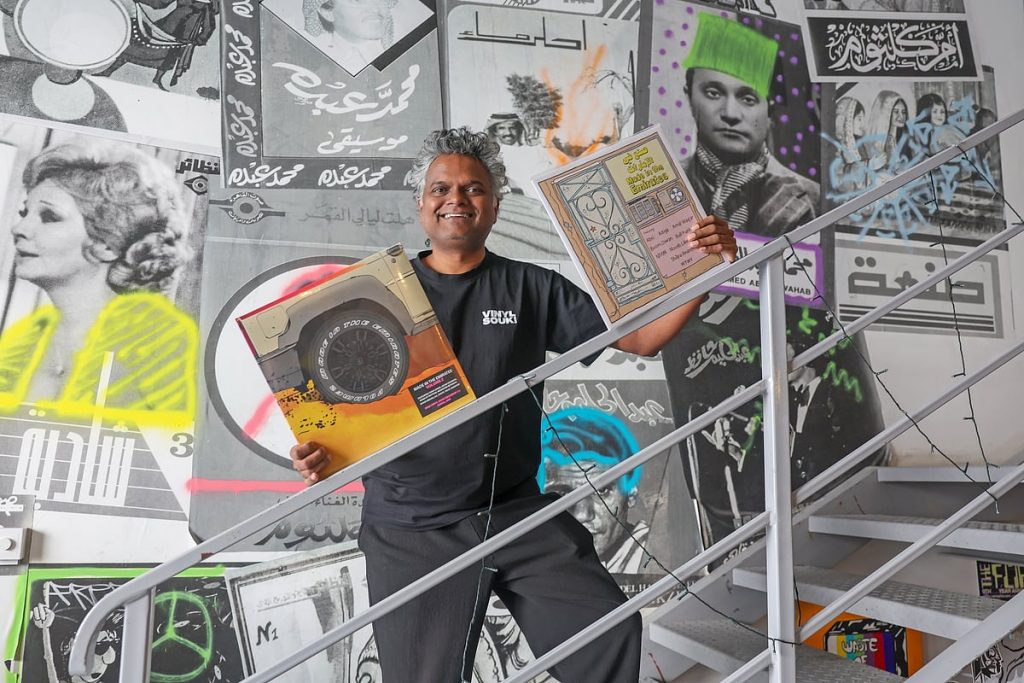
From marketplace to label
Vinyl Souq began as a record fair, bringing together the handful of shops and collectors that existed in the city at the time — The Flip Side, Raw Music Store, and later Metal East Records.
Over three years, it has grown into a platform of more than 50 curated experiences, including a 700-person mini-festival that activated six venues across Dubai simultaneously.
The natural next step was a label.
Vinyl Souq Records, the imprint’s physical-media-first arm, was built to spotlight UAE-based talent through its ongoing compilation series, Made in the Emirates — a nod to the government’s manufacturing initiative of the same name, reframed for culture.
“UAE is known for so many different things,” Veralkar says. “But name a single UAE music artist that someone would know.”
Volume one, released in January 2025, featured nine artists across more than 15 nationalities, spanning jazz, funk and fusion.
All 500 pressed copies sold out within the UAE — and for many of the artists involved, it was the first time they had been paid royalties for their original music rather than for a social media post or a live show. “Seventy years down the line, someone comes across and can track back — this was the scene in the UAE,” Veralkar says.
A scene rebuilding itself
Mostyn Rischmueller, the Australian DJ and producer known as Megadon Betamax, has watched the UAE’s independent scene evolve since arriving in Dubai 18 years ago from Sydney, where he had spent the late 1990s producing hip-hop-influenced music and touring.
He and friends founded the label Voyeurhythm shortly after moving, just before the global financial crisis.
He believes vinyl sales have kept climbing over the years, driven by more people pressing records and manufacturing turntables and equipment — a reaction, in part, to the limits of streaming.
“It doesn’t have the same experience. It’s not a tactile object,” he says. “People don’t own music anymore — owning something real is a good thing.” He also points to a growing wariness of AI-generated tracks circulating on streaming platforms as another reason listeners are turning back to physical formats.
His own label began pressing vinyl 15 to 16 years ago “more as a point of difference than anything,” he says — a way of signalling commitment to a project, even though pressing remains expensive and slow.
As for whether much of a live scene remains, he is candid: DIY parties and clubs that were once common largely stopped before or during the pandemic, has left most working DJs today make their living from restaurant and brunch bookings rather than club nights.
He credits Vinyl Souk, and a handful of other local DJs and promoters, of helping to pull together something of “a DIY renaissance” in recent times.
Rischmueller met Veralkar before Vinyl Souq existed, when Veralkar was still talking through the idea of starting a record market. “I am fully supportive of that,” he says. He believes younger listeners, particularly Gen Z, are drawn to the format too — whether they are DJing with it or simply listening on a good stereo system.
Music, made intentionally
For all three men, the appeal of vinyl goes beyond nostalgia. It is a response to a music industry that increasingly rewards volume over intention — and, they argue, a format built to outlast whatever comes next, including AI-generated tracks now surfacing on streaming platforms.
“As humans, we still feel the need to stay connected with humans,” Veralkar says. “I feel like physical media will keep you a bit more rooted… with more intentionality and mindfulness.”
Megallaa is less certain about what the next five years hold, but is clear on vinyl’s role in it. “I do think we’re moving into a future that feels increasingly disconnected from the physical world,” he says.
“That’s one of the reasons vinyl remains so important to me. It encourages people to slow down, own something tangible, and experience music in a much more intentional way.”

Dhanusha is a Chief Reporter at Gulf News in Dubai, with her finger firmly on the pulse of UAE, regional, and global aviation. She dives deep into how airlines and airports operate, expand, and embrace the latest tech.
Known for her sharp eye for detail, Dhanusha makes complex topics like new aircraft, evolving travel trends, and aviation regulations easy to grasp. Lately, she’s especially fascinated by the world of eVTOLs and flying cars.
With nearly two decades in journalism, Dhanusha’s covered a wide range, from health and education to the pandemic, local transport, and technology. When she’s not tracking what’s happening in the skies, she enjoys exploring social media trends, tech innovations, and anything that sparks reader curiosity. Outside of work, you’ll find her immersed in electronic dance music, pop culture, movies, and video games.