
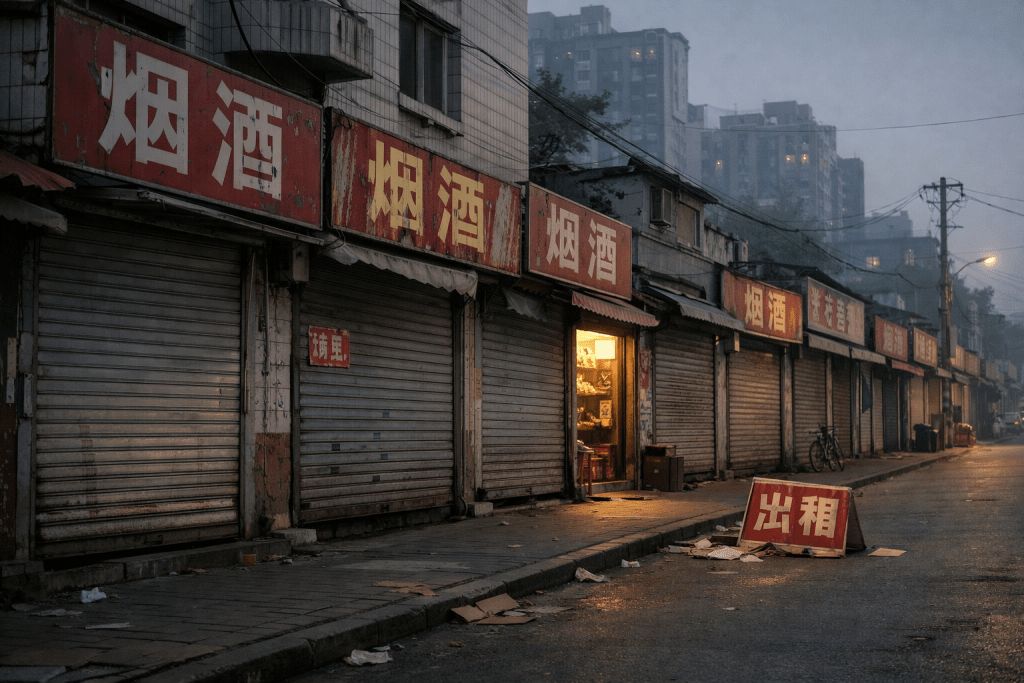
China’s tobacco and alcohol shops once sat at the centre of the country’s wine and spirits distribution network.
For years, these neighbourhood stores served as the primary sales channel for baijiu and wine. Many leveraged strong government and business connections, allowing imported wines to flow into bulk purchasing channels and be rapidly absorbed through corporate banquets, gifting occasions, and holiday consumption. At the same time, their deep roots in local communities gave them a steady retail function.
At their peak, many of China’s leading wine importers including state owned C&D and COFCO’s Wine and Wine built their businesses on this channel.
Today, however, this once-dominant network is shrinking at a visible pace.
Recent data circulating on China’s internet suggests that in 2025 alone, the number of tobacco and alcohol shops nationwide fell by 19%, equivalent to roughly 320,000 stores disappearing in a single year. Over the past five years, more than 1.3 million shops have shut down, averaging around 900 closures or transfers per day.
The decline reflects not only weakening alcohol consumption, but also a broader restructuring of how alcohol is sold in China.
Closures become the norm
“Closures are everywhere now. Even in first-tier cities like Shenzhen, you can see it happening,” said Xie Chuntian, CEO of China Wine Platform.
With offices across the country, China Wine Platfrom, a key importer distributing brands such as Montes and Domaines Barons de Rothschild (Lafite) in China, the company previously ranked among Vino Joy News’ China’s Top 100 Wine Importers, has witnessed the wave of closures firsthand.
A similar trend is unfolding in coastal Fujian, another major wine consumption hub. Wu Yonglei, general manager of Xiamen Fond Wine, also listed among Vino Joy News’ China’s Top 100 Wine Importers, said that while he has not recently seen clients shut down outright, operating pressure has clearly intensified over the years.
Falling demand, shrinking margins
One of the main drivers is the contraction in bulk purchasing demand, the lifeblood of these shops.
“When real-economy businesses are struggling, entertainment budgets are cut, and naturally alcohol demand falls,” Wu said.
Xie of China Wine Platform observed the same trend. Many tobacco and alcohol shops rely heavily on group-buying channels, often built on personal connections within companies or government departments. Such business typically accounts for 60% to 70% of revenue.
But as consumption cools and banquets decline, purchasing volumes have dropped sharply.
“In the past, during economic upcycles, customers rarely negotiated prices. Now it’s completely different – once prices fall, buyers track the market closely,” Xie said.
At the same time, falling alcohol prices have further eroded margins.
“In the past, you could still make some profit on mainstream brands. Now many big labels carry almost no margin. In some cases, inventory bought earlier is being sold below cost,” he added.
Wu noted that price competition has intensified to the point where customers compare prices from one shop to another.
“Products that sell tend to have very thin margins. For products with decent margins, shop owners hesitate to recommend them, fearing higher prices will drive customers away.”
“Sales are down, margins are shrinking, but operating costs, rent and utilities, haven’t fallen. Survival pressure is only increasing,” he said.

Cigarettes no longer a safety net
Compounding the problem, cigarette sales – another pillar of these shops – are also weakening, with some products even experiencing price inversions.
Xie said that in the past, cigarette sales alone could generate monthly profits of RMB 10,000 to 40,000, often enough to cover rent.
But with fewer smokers and tighter economic conditions, many consumers are trading down to cheaper products.
“Like baijiu, the cigarette market is now facing oversupply. Some major brands are also seeing price inversions. Selling cigarettes no longer makes money; it doesn’t even cover rent,” he said.
The squeeze from instant retail
Another major challenge is the rapid rise of instant retail and its impact is greater than many expect.
Wu said instant retail has fundamentally changed how consumers buy alcohol. Where shoppers once stocked up at local stores, they can now simply order via mobile apps, with transparent pricing and fast delivery.
Many assume instant retail primarily serves individual consumers, while tobacco and alcohol shops focus on corporate clients. In reality, the distinction is fading.
“Many office staff today are young and digitally savvy. They’ll suggest to their bosses: there’s no need to stockpile, just buy when needed,” Wu said.
In his view, this reflects a broader shift in business models.
“Shops are declining, but instant retail is expanding rapidly. That tells us demand hasn’t disappeared; the way people consume has changed. People no longer rely on personal connections; they care more about price.”
Adapt — or exit
So, is there still a path forward?
Wu believes adaptation is essential: integrating with instant retail platforms.
“You have to engage with instant retail. There’s no way to resist it,” he said.
But the reality is harsh. Instant retail is itself a highly competitive space, where profitability remains elusive.
Xie noted that even with strong operations, monthly revenue might look good on paper— yet net income may only reach RMB 7,000 to 8,000, barely enough to support one person.
“If you operate well, instant retail might prolong survival — buy time until the market improves,” he said. “If you don’t, you’re simply waiting to die.”
This was echoed by a new report by the country’s official drinks body, the China Alcoholic Drinks Association (CADA), produced in collaboration with delivery giant Meituan and industry media outlet Jiuyejia.
Despite the rapid growth, many traditional retailers remain cautious about fully embracing instant delivery.
Around 38% of respondents say they are still testing the model with a limited number of stores, while nearly a third are holding back due to concerns that online channels could erode their existing customer base.
Diversification as a last resort
Some shops are experimenting with new approaches.
Wu said some retailers are partnering with restaurants, offering services such as reservations and recommendations to strengthen customer relationships.
Xie has also observed shops evolving beyond selling tobacco and alcohol, introducing draft beer, barbecue, and transforming into more integrated consumption spaces.
But he cautioned that food and beverage is a different business altogether.
“Entering catering means stepping into a new industry. You need more staff, sometimes even external expertise. If done poorly, it could accelerate failure,” he said.
Discover more from Vino Joy News
Subscribe to get the latest posts sent to your email.