
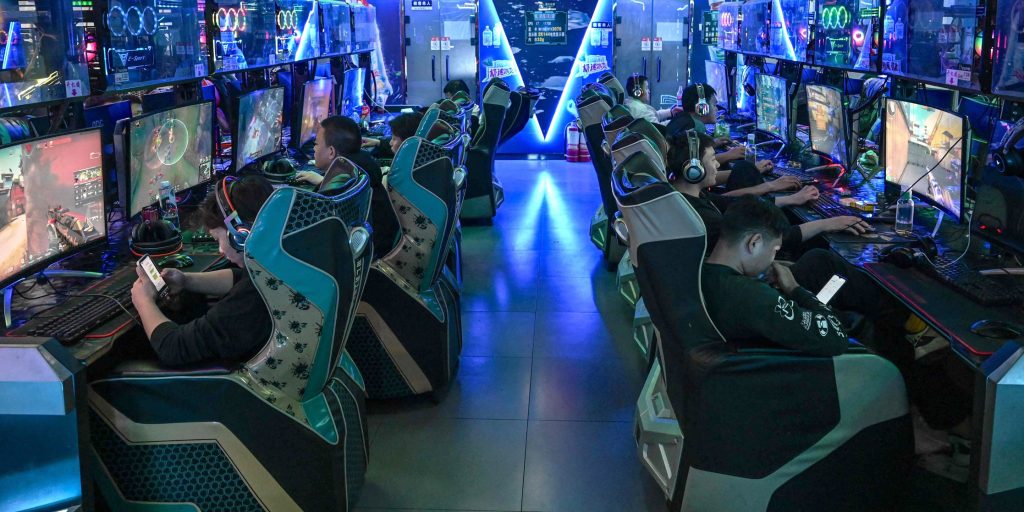
During long holidays, if you ask young and middle-aged men in China how they’ve been occupying themselves, one answer repeatedly comes up: internet cafés.
In an economy where people are increasingly watching their wallets, internet cafés have become popular again in China — offering a chance to catch up with old friends and rekindle the feeling of student days, without the upfront cost of buying their own equipment.
In 2025, the number of internet cafés rose 12.7% year on year, bringing the total to 122,600 nationwide, while industry revenue surpassed 101.7 billion yuan ($14.8 billion), according to the Internet Access Service Association of China (IASAC). Shaking off the slump of the pandemic years, the sector added at least 25,000 new outlets since 2023, while employment grew by over 100,000 in 2025.
And internet cafés today are far more than a room full of computers. Creative entrepreneurs are combining them with lavish buffets, hot springs, and hotels, reflecting an increasingly competitive business landscape.
“Most affordable entertainment”
Internet café owner Bai operates a chain of internet cafés in Changsha, capital of the central Hunan province, and has over a decade of industry experience. His business spans across 13 locations in the city proper and nearby counties.
“In the current economic climate, people are cutting back on high-end consumption, so demand for internet cafés is bound to rise,” he said. “It’s arguably the most affordable form of entertainment — it can ride out economic cycles.”
Regular internet café-goer Xu Ming agrees. “Buying a computer for 8,000 or 9,000 yuan these days is expensive, and the value depreciates fast,” he said. “But at an internet café, you can get the same specs and game to your heart’s content — it’s excellent value for money.”
For those who grow up gaming at internet cafés, the habit tends to stick, Bai said.
“I’ve run these cafés for 10 years, and I’ve grown alongside players in the neighborhood from their 20s to their 30s. The habit of going to internet cafés started with our generation, the post-’80s. Even when we’re older, we’ll still go to game,” he said. “The younger generation will also go when they grow up. So the user base will continue to expand.”
The numbers back this up. Between 2012 and 2025, the share of internet café users aged 30 and above rose from 10.4% to over 22.6%.
“Another change is that people are staying longer. Most of my outlets are neighborhood locations serving local residents,” Bai added. “Many of our customers are middle-aged and not as busy as office workers in big cities, so they can easily spend four or five hours playing at a time.”
The successive popularity of major PC games has also given the industry a much-needed boost. In August 2024, domestic release Black Myth: Wukong went viral, drawing some players back to internet cafés, and many venues still have the game pre-installed on their machines. By 2025, the trend had shifted to role-based first-person shooters like Delta Force and Valorant.
At just a few yuan per hour, customers get access to high-end computers and uninterrupted blocks of time. In the ebb and flow of economic cycles, internet cafés are about more than just hardware; they offer an affordable refuge within easy reach of ordinary people.
Upgrade at all levels
But no matter how long customers spend at an internet café, the number of seats is fixed and the number of hours in a day is capped at 24, meaning usage fees hit a natural ceiling. To boost revenue and keep customers comfortable, most internet cafés now include convenience stores, drink bars, and food services.
At Bai’s outlets, food and beverage revenue accounts for about 40% of takings in urban locations and up to 60% in the counties.
New chain cafés take this model even further. In October 2025, a roughly 3,000-square-meter venue called X-Game Esports in Wuhan, capital of the central Hubei province, went viral for offering gamers a seafood buffet as well as freshly prepared, fixed-menu meals for breakfast, dinner, and late-night hours. Similarly high-end internet cafés are now common in major cities across China.
Hardware is also moving upscale. According to Bai, new internet cafés often feature high-end Zowie gaming monitors priced at 3,000, 5,000, and 8,000 yuan, far exceeding the monitor costs of older venues.
The same trend applies to graphics cards and memory. By 2025, over 59% of internet cafés were equipped with Nvidia GeForce RTX 4060 or higher-tier GPUs, while more than 29% featured Intel Core i7 or higher processors, according to IASAC. With these advanced components, games and videos can be rendered with exceptional clarity and run smoothly, enabling players to enjoy the latest titles at high or even maximum settings without noticeable lag.
Some venues display detailed hardware specs and prices at their entrances — often exceeding 10,000 yuan per setup — to justify the cost of premium private rooms.
The environment and services at most internet cafés have also improved considerably. Features include designated smoking and non-smoking zones, disposable earphone covers, thorough cleaning and disinfection, and even foot massages. Some also allow players to swap in their preferred peripherals upon request.
Beyond enhancing their core gaming services, internet cafés have also sought to increase value by integrating with hotels, hot springs, and other sectors.
Esports hotels, in particular, have seen rapid growth. Offering a play-and-stay experience, they combine comfortable overnight accommodation with professional-grade gaming equipment, including high-performance PCs and ergonomic chairs, in every room. The model caters mainly to groups of friends or gamers who want to play together in a private, social setting without the noise and smoky environment common to traditional internet cafés.
In 2025, China had 29,500 esports hotels, an 8.86% year-on-year increase and nearly double that of 2021.
Taking longer to profit
Despite now spanning neighborhood outlets, high-end venues, and cross-sector hybrids, issues in the pay-to-play gaming industry remain.
“In reality, it’s harder to recoup your investment,” Bai explained. “Before the pandemic, a new outlet would break even in one to two years. Now, even buying a secondhand location at a low cost takes two to two and a half years.”
He attributed this to an influx of competitors. “A lot of people who used to be in construction made good money, but now that business is tough, so they’re investing in pool halls or internet cafés.”
Unlike restaurants, which require higher investment and benefit from economies of scale, running a pool hall or internet café is one of the few businesses where a single outlet can still turn a profit on its own.
Price cuts are a direct effect of this influx. According to Bai, hourly gaming rates rose by about 10% to 20% between 2015 and 2019, and climbed another 30% between 2020 and 2022. Since 2024, however, prices have fallen back to 2015 levels, driven by the number of new outlets and intense competition.
On social media, some venues advertise rates below 5 yuan per hour, with slogans like “No gimmicks, just maximum value for money,” explicitly positioning themselves against the high-end outlets.
“Many new venues blindly follow the high-end path, which makes it harder to recoup their investment,” Bai added. “When a wave of newcomers came in 2024, their opening budgets were 50% to 80% higher, forcing many older venues to either upgrade or shut down.”
But the boom in new internet cafés doesn’t necessarily please everyone.
“New chain cafés lure customers with deposit bonuses, but when you do the math, they’re still more expensive than the old ones. Many of them don’t manage well and fail to retain loyal customers,” said Xu, the gamer. “If an internet café has been around for over a decade, it definitely does something right,” he added, saying he prefers older cafés even if they look more run-down.
To stay afloat
For traditional internet cafés, the highest recurring cost is equipment: PC towers, graphics cards, and monitors all need to be replaced every few years. Now, a new model is emerging to address this burden.
Instead of housing powerful computers in-store, so-called “internet cloud cafés” strip out expensive on-site hardware and keep only the peripherals: keyboard, mouse, speakers, and screen. All the heavy computing and graphics rendering are handled by remote servers owned by telecom companies, which the café pays a rental fee to use — much like streaming a movie rather than buying a DVD player and disc.
The advantage is lower fixed costs, with owners no longer needing to invest large sums in new hardware every two to three years.
Shunwang Technology, a cloud service provider listed on the Shenzhen Stock Exchange, is one of the key players enabling this shift. By the end of 2024, Shunwang was serving over 700,000 terminals, providing cloud services to roughly 10,000 to 20,000 of China’s internet cafés, according to CEO Hua Yong.
An added benefit has emerged this year as storage costs rise industrywide. As cloud cafés don’t own the servers, they are insulated from immediate price hikes. Server cost increases are absorbed first by cloud service providers, then passed along to telecom operators, and finally to the cafés — softening and delaying the financial impact compared to venues that own their own machines.
Beyond cutting costs, some internet café providers are also seeking new revenue streams by leaning into their social and high-value personalized services.
“From what I see, now it’s about half and half between solo customers and those coming in groups,” Bai said. Xu echoes this, saying that when he visits an internet café, it’s mainly to play games with friends.
One way cafés are strengthening their social draw is by organizing tournaments. The well-known chain Jiela E-sport has been hosting annual esports competitions for popular PC games since 2009, offering cash prizes for top performers. Another chain, Wangyu, has held tens of thousands of tournaments through its proprietary “Wangyu Arena” platform.
Smaller brands frequently run internal tournaments to build community and promote their name. Bai, for example, was busy organizing a Valorant tournament.
Some internet cafés also partner with game developers to offer exclusive perks at their venues, such as character skins and in-game items. Tencent’s popular titles League of Legends and Valorant have already rolled out such programs, with over 40,000 internet cafés signing up by 2024.
Ultimately, the internet café is a personal haven. With mobile phones consuming fragmented moments of free time and home broadband meeting everyday entertainment needs, those who still visit are seeking something specific: affordable, immersive experiences free from distraction. They might be office workers gaming with friends after work, introverts wanting an undisturbed corner, or students happy to spend 30 yuan on a night out.
Making them feel their money is well spent is the fundamental logic behind internet cafés’ enduring appeal.
Reported by Zhang Jingwei.
A version of this article originally appeared in Baobian News. It has been translated and edited for brevity and clarity, and is republished here with permission.
Translator: Kiong Xin Xi; editors: Wang Juyi and Elise Mak.
(Header image: People play video games at an internet café in Beijing, 2024. Jade Gao/AFP via VCG)