
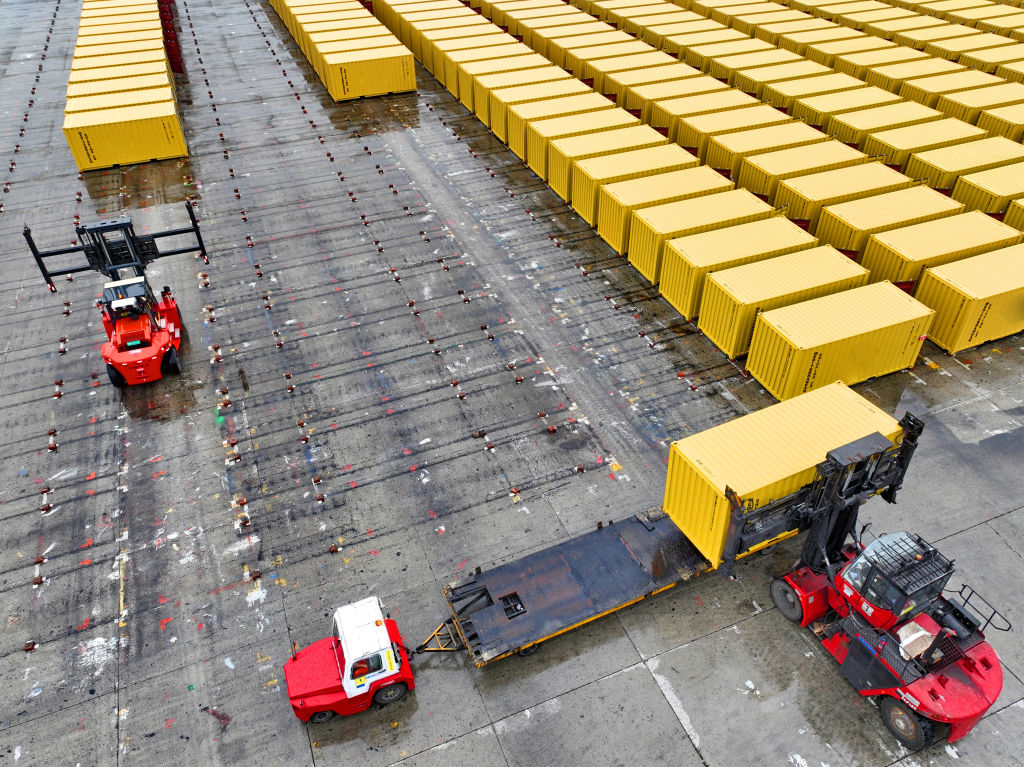
In the 1950s, the United States invented the shipping container, revolutionizing global trade. Today, China makes almost all of them — and just got caught fixing the price.
On May 19, the U.S. Department of Justice (DOJ) indicted four of the world’s largest container manufacturing companies and seven executives — all Chinese — for a “global conspiracy” to fix prices and restrict output of nearly all the world’s standard dry shipping containers. The alleged cartel — which includes one wholly owned subsidiary of China’s state-owned shipping line COSCO — operated during COVID-19, when supply chains were already under severe strain, exploiting that window to double global shipping container prices and increase company profit margins one hundredfold.
The indictment is a critical reminder that China’s dominance in the commercial maritime sector — from shipbuilding to shipping containers — is a strategic vulnerability since it gives Beijing the ability to damage U.S. and allied economies as a means of exerting leverage at the negotiating table or in moments of heightened tension.
China Established Dominance Through Non-Market Practices
China manufactures approximately 95 percent of the world’s dry shipping containers — dominance built not through competitive advantage but through non-market practices.
Chinese state support for the maritime industry totaled $132 billion between 2010 and 2018, subsidizing local firms and thereby enabling them to undercut foreign competitors. The DOJ indictment alleges that from at least 2019 to 2024 the four companies, which together control roughly 87 percent of global shipping container manufacturing, coordinated price cuts to drive outside competitors out of the market, then raising prices once those manufacturers were out of the frame. According to the DOJ indictment, participants themselves expressed concerns that this scheme could be seen as an antitrust violation in internal emails and meeting records.
Chinese firms dominate the critical minerals, steel, and other strategic sectors due in part to state subsidies and market manipulation. In the maritime sector, China controls 62 to 69 percent of new shipbuilding orders globally, operates or holds stakes in 129 ports across six continents, supplies roughly 80 percent of the world’s ship-to-shore cranes, and operates LOGINK — a state-owned logistics platform deployed across more than 20 ports worldwide that collects trade, cargo, and passenger data, giving Beijing visibility to critical intelligence data.
China’s Strength Corresponds to American Vulnerability
This monopoly represents a major strategic challenge for the United States and its allies. The COVID-19 pandemic illustrated the downstream consequences of shipping container scarcity, increased port congestion, and maritime transit slowdowns, giving rise to manufacturing input shortages, factory slowdowns, and reduced work hours.
While the COVID-19 disruption seems to have unintentionally intensified the impact of this scheme, such a pronounced supply chain vulnerability could be deliberately weaponized by China at times of geopolitical stress. China repeatedly used critical mineral export controls as leverage in last year’s trade negotiations. In future conflicts, including a potential invasion of Taiwan, Beijing could restrict container output and strand cargo to threaten U.S. manufacturing and increase the cost of any U.S. foreign policy response.
China has already used maritime coercion in retaliation to further its geopolitical agenda, detaining at least 136 Panama-flagged ships in Chinese ports after the Panamanian Supreme Court canceled Chinese port operator C.K. Hutchison’s Panama Canal port concessions.
America and Its Allies Must Reinvigorate Their Maritime Industries
Prosecuting China’s price fixing is an important first step, especially when it involves subsidiaries of state-owned entities like COSCO, but one enforcement measure does not rebuild supply chain resilience.
Washington and its allies must invest in developing maritime manufacturing capacity outside of Chinese control. Indeed, other countries have already recognized the risk: India is investing $1 billion in domestic container manufacturing capacity.
However, building out China-free shipping container manufacturing capacity will not address China’s chokehold on the broader maritime sector. Barriers to attracting and developing skilled labor for America’s domestic maritime industry must also be addressed — including updating outdated restrictions on skilled labor mobility, funding the Merchant Marine Academy, and building recruitment pipelines to draw more workers to the field.
Susan Soh is a research associate for the Center on Economic and Financial Power at the Foundation for the Defense of Democracies (FDD). For more analysis from Susan and FDD, please subscribe HERE. Follow FDD on X @FDD. Follow Susan on X @SusanSoh827. FDD is a Washington, DC-based, nonpartisan research institute focusing on national security and foreign policy.