
This is the concluding installment of a four-part series on “The First Airtight Empire.” Part I documented the two slogan substitutions through which Beijing rewrote its history and prewrote its future. Part II described the three lockdowns that conditioned the population to accept the airtight seal that followed. Part III mapped the four mechanical seals, the asymmetric one-way valve, and the 2,200-year social foundation through which the latest closure has been engineered. This installment places the configuration in its long historical frame, examines the three American policy assumptions the configuration invalidates, and offers the strategic recalibration that the closure now requires.
Chinese statecraft has been organized, since 221 BCE, around a structural attractor that pulls every regime toward closure. The unitary-power state founded by Qin Shi Huang and matured under Han Wudi was designed to suppress competing centers of authority and refuse the legitimacy of any institutional check on the throne. As Part III argued, power politics even became embedded in China’s social architecture. The Qin reform established a unitary social structure – the registered-household system, in which every individual was directly enrolled by the central state with no chartered intermediate institution between sovereign and subject. Chinese statecraft has been pulling toward the ideal of unity power over an isolated, granulated population for two millennia.
But for most of those two millennia, the pull toward closure was defeated by the technical limits of premodern statecraft. The Tang dynasty assimilated Buddhism, Persian music, and Indian mathematics. The Song produced its commercial revolution and movable-type printing. The Yuan integrated China into the Eurasian trade system. The early Ming sent Zheng He to East Africa. Each opening demonstrates the same point: the unitary-power structure leaked, because premodern technology could not actually achieve closure. Edicts could be issued, but local officials could be paid to look the other way. Coastal trade could be prohibited, but the prohibition could not survey the coastline.
The golden era of the Qing dynasty (1661 through 1796) was another period of attempted closure. It proved fatal to the dynasty because it coincided with the 18th-century industrial transition – China sealed itself precisely as the world transformed. Britain sent the Macartney Mission to China in 1793; it went home empty-handed. Less than 50 years later, Britain was able to open China by force, via the Opium Wars. But even during the Qing’s era of closure, the system was not perfect. Macartney’s mission carried back accurate intelligence; the Jesuits maintained the imperial astronomical bureau; coastal smuggling continued through the Canton System. The walls were thick, but the world was already global, and pre-industrial walls had natural permeability.
The closure being constructed in 2026 has no historical equivalent. The walls are no longer made of distance, customs houses, and edicts that local officials can ignore for a price. This closure is built on fiber-optic cable inspection at the international gateway, biometric identification linked to every transaction, state-controlled platforms mediating every digital interaction, and an exit-ban infrastructure capable of identifying any individual at any border in real time. The leakage paths that broke every previous closure are being closed at the technical level, not merely the legal level. The Chinese rulers’ 2,200-year quest for closure and control has finally been achieved.
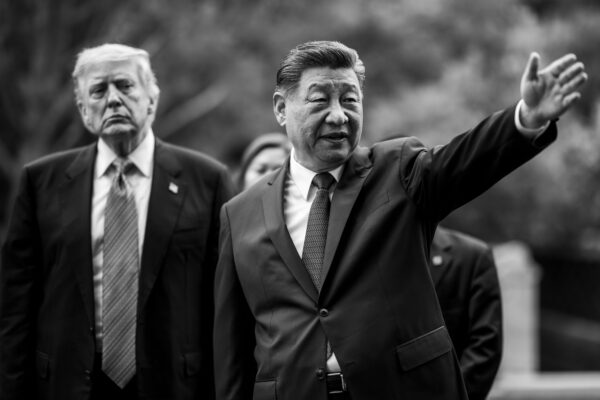
Yet U.S. leaders don’t seem aware of the change. As U.S. President Donald Trump was flying to Beijing, he posted on Truth Social that his “very first request” to Xi Jinping would be for the Chinese leader “to ‘open up’ China so that these brilliant people” – referring to the American CEOs who accompanied Trump – “can work their magic.” Trump apparently didn’t realize how pointless it is, in 2026, to ask China to “open up.”
U.S. Policy Assumptions No Longer Hold
The conventional American long game on China rests on three assumptions. China’s new airtight closure invalidates all three.
First is the assumption that economic pressure produces political opening. For 30 years, U.S. China policy has counted on the proposition that as the Chinese economy slows, the regime will face pressure to liberalize – first economically, then politically. The proposition has historical support: the Deng Xiaoping-led reforms of 1978, Soviet glasnost of 1985, Vietnamese Doi Moi of 1986. But with the benefit of hindsight, we can see that each opening actually served to ultimately strengthen the authoritarian regimes. The Communist Parties of China and Vietnam used economic reform to tighten political control, not weaken it. And while the Soviet Union fell, Russia today is far from democratic.
In each case, economic opening came from the regime’s recognition that closure was producing economic failure that endangered the regime itself. An airtight regime can suppress that recognition. If the population cannot access alternative information about its own economic condition, if officials cannot privately compare notes with foreign counterparts, if the leadership receives only the reports its loyalty system filters upward – economic decline becomes a problem the regime can deny indefinitely. American assumptions that economic pressure produces political pressure depend on a feedback mechanism the airtight closure is specifically designed to disable.
A second U.S. assumption holds that the rising generation of Chinese leaders, having come of age during the era of reform and opening, will gradually steer the regime back toward engagement. The airtight closure breaks this directly. A child raised in China in 2026 has less access to unfiltered foreign information than her counterpart in 2010, dramatically less than her counterpart in 2000, and arguably less than her counterpart in 1985, when foreign films, students, and journalists were beginning to penetrate the late-Mao closure. The next generation of Chinese leaders will not be more cosmopolitan than the current one. They will be less so.
A third American assumption holds that the regime will revert to engagement when convenient. In this view, the closure is essentially a defensive posture the regime will relax when external pressure eases. The airtight closure inverts this causality. A regime that has invested the technical and political capital required to construct an airtight closure does not unbuild it when external pressure eases. The closure is now an asset, not a cost. It eliminates the vectors by which external influence has historically destabilized Chinese regimes; it forecloses the succession competition that has historically produced regime turnover; it secures the leadership against the kind of internal challenge that took down Khrushchev, Brezhnev, and Hua Guofeng. The Chinese Communist Party will not voluntarily reopen what has cost so much to close.
Reform-Foreclosed, Collapse-Prone
The framework offered in this series implies a specific prediction about the trajectory of the closed Chinese regime. An airtight regime cannot reopen, but it also cannot permanently sustain the contradictions that have always destroyed late-dynastic Chinese regimes – the divergence between civilizational self-presentation and operational machinery, the structural inability to correct its own mistakes. What the airtight configuration forecloses is gradual reopening. It does not foreclose collapse. The historical pattern of late-dynastic Chinese regimes is that they do not reform; they break.
This is not a prediction that the Chinese regime is about to collapse. The literature of “China collapse” predictions has a long and embarrassing history, and this analysis does not join it. The prediction concerns the form of the eventual transition, not its timing. A regime that has structurally disabled every internal mechanism of self-correction is precisely the regime that combines maximum surface stability with maximum underlying fragility. It cannot bend; therefore, when it eventually fails to absorb a sufficient shock, it will break.
American policy should be prepared for a Chinese trajectory in which the next decade looks like increasing rigidity rather than incremental softening, followed by some form of systemic crisis whose specific mechanism cannot be predicted but whose general shape – succession failure, economic seizure, factional rupture, or some combination – is consistent with how every previous airtight regime has eventually ended. The form is forecastable. The timing is not; it may take decades or more.
What the United States Must Now Do
There are three specific policy domains that require recalibration in light of China’s new reality.
On Taiwan deterrence: the framework predicts that the risk of forced unification rises, not falls, as the airtight closure deepens. A regime that cannot reopen, cannot deliver the prosperity its propaganda has promised, and cannot deflate its civilizational pretensions to match its economic reality will reach for external adventure as the only available legitimacy strategy. U.S. deterrence calibrated to Chinese capabilities is looking at the wrong variable. The relevant variable is the gap between what the regime’s propaganda has promised and what its sealed economy can deliver. That gap is widening, and the closure makes it impossible to acknowledge or address.
On engagement strategy: the marginal returns to U.S. engagement initiatives – academic exchange, business diplomacy, people-to-people programs – have collapsed in a way the policy community has not yet absorbed. The exchange programs of the 1990s and 2000s worked because they exploited the leakage mechanisms of an imperfect closure. The exchange programs of 2026 do not have those leakage mechanisms to exploit. The slow diffusion of foreign perspective through returning Chinese intellectuals – the mechanism that made engagement productive – has been engineered out of the system.
On information policy: the classical playbook of beaming information into a closed society depends on the closed society’s technical inability to fully block the signal. The 2026 Chinese system can fully block the signal – and, more decisively, has produced the social condition in which information that does cross the wall no longer aggregates into political consequence. The primary audience that U.S. China-information policy must now serve is Americans. The U.S. policy community, electorate, and business community will need to understand a closed China for the foreseeable future, and the analytical infrastructure for that understanding must be built deliberately.
Every previous Chinese closure U.S. policy has studied – the late Qing, the Mao period, the early reform era retrenchments – eventually broke through internal contradictions and external pressure that the regime could not narratively manage. This time is different. American policy must begin from the recognition that we are observing the first airtight empire – and that what comes next will not look like what came before. Previous closures always eventually leaked, and this one will not.
The most important policy conclusion of this series is also the most uncomfortable. U.S. strategy toward China for the next decade should be calibrated not to the China engagement-era policymakers expected, and not to the China conventional rising-power frameworks describe, but to the China the airtight closure is producing: a great power authoritarian state that has, for the first time in human history, escaped the structural mechanisms that have historically forced closed regimes back open. This China will be more rigid, more brittle, more dangerous, and more sealed than U.S. policy assumptions permit.
This configuration cannot be talked back open through diplomacy, cannot be pried open through economic pressure, and cannot be waited open through generational change. What it can be is contained, monitored, and outlasted. The U.S. policy disposition this analysis points toward is neither engagement nor confrontation: long time horizons, hardened deterrence at the points of likely external adventure, sustained investment in the analytical capacity to understand a China that remains closed-off for decades, and preparedness for a Chinese systemic crisis whose timing cannot be forecast but whose eventual occurrence the structure makes nearly inevitable.