
- For foreign trade companies like us, things are difficult. We just hope the war will end as soon as possible
GUANGZHOU: Shao Haixia’s plastics factory in China has seen raw material costs jump 20 percent since the war in Iran began and has been unable to fully pass those extra costs on to its foreign customers. Xiatao Plastic Industry mainly sources from local refiners and makes components for electrical appliances, which it sells exclusively abroad. Like many others attending this year’s Canton Fair, China’s largest trade exhibition, Shao is worried about rising input costs and the impact a prolonged conflict could have on global demand.
“We’ve had to re-quote prices and clients are still considering it,” said Shao, the general manager of the 27-year-old factory.
“For foreign trade companies like us, things are difficult. We just hope the war will end as soon as possible,” she added, saying her margins had halved to 5 percent since the war started.
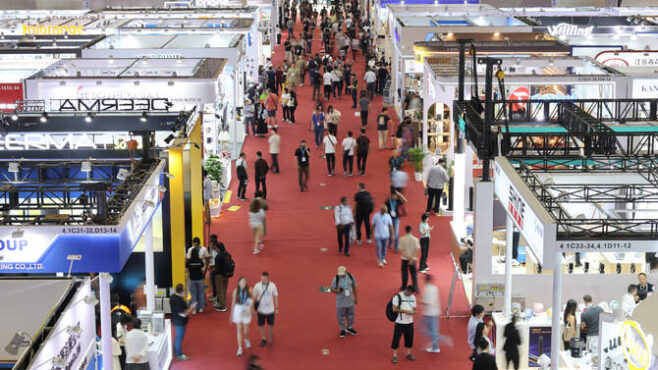
Xiatao is among 32,000 companies exhibiting at the Canton Fair, showcasing products to foreign buyers across an area larger than 200 football fields.
Before the war, China’s export sector was feeling triumphant, having weathered US tariff hikes by conquering new markets and achieving a record trade surplus — the size of the Dutch GDP — last year.
But the energy shock and higher commodity prices are raising production costs in the world’s biggest manufacturing power, threatening already-thin margins at factories that collectively employ hundreds of millions of people.
At the same time, global demand is taking a hit — as trade data from Beijing showed this week — exposing China’s overreliance on exports for economic growth.
Liang Su, general manager at rice cookers and kettle maker Weking, was among the most pessimistic exhibitors, having seen his output halved due to slower orders and surging costs of plastic, copper, and aluminum.
Liang is selling at a loss even after raising prices by 15 percent.
“If the fighting keeps going, it’s not just us — Europe’s economy is in bad shape. Southeast Asia’s economy was already weak to begin with. Now the US dollar has fallen as well,” Liang said.
Unless the war ends soon, his next move is to “cut everything that can be cut,” including jobs, he said.
Steven Shen, who manages a firm producing industrial blowers, vacuums, and hair dryers, is less downbeat because he’s been able to fully pass on the higher costs of fibers, metals, and plastics to consumers.
Had he not done that, the firm’s entire margin would have been wiped out by raw material costs and the stronger yuan, he said.
“It’s not just us, our competitors are also raising prices — so I think it’s okay,” Shen said.
Taimu Electrical, which makes low-voltage circuit breakers and other products, is taking an even more direct hit because it had been banking on first-half sales to the Middle East of up to 30 million yuan ($4.4 million), sales director Wang Yuqing said.
“Since the war, our sales in the Middle East have basically been on hold,” Wang said.
Jojo Lei, the home appliances unit manager of Golden Field Industrial, which makes ovens and computer accessories, said overall input costs increased around 8 percent, but the firm plans to fully absorb the hit for at least six months to preserve orders and customer relationships.
He does not expect global demand to collapse. If it does, Lei’s Plan B is to accelerate a shift in production to Southeast Asia, where US tariffs are lower, and labor is cheaper than in China. Golden Field currently faces levies of just under 40 percent on its US sales, after a turbulent 2025 in which Trump raised tariffs to more than 100 percent before Beijing retaliated and he partly reversed them. Lei is hopeful that Trump’s plans to visit China next month herald “somewhat lower” tariffs, though he is wary that “the US side is full of uncertainty.”
Shao, the plastics factory manager, thinks a Trump visit, should it happen, would signal that relations between Washington and Beijing are finally stabilizing.
“If he really comes to China, for foreign trade companies like ours, it would be a welcome sign, almost like the arrival of spring,” Shao said.
Reuters